

Archives
(PRELIMS Focus)
Category: International Organisations
Context:
- EAM S Jaishankar recently participated in India’s first-ever engagement in the Weimar Triangle, with French and Polish counterparts along with German representatives.
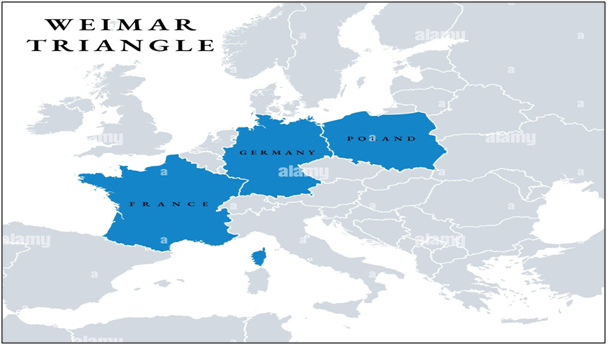
About Weimar Triangle:
-
- Countries involved: It is a regional political grouping of France, Germany, and Poland.
- Formation: It was formed on 29 August 1991 by a joint declaration issued in Weimar, Germany, by the Foreign Ministers of the three countries.
- Nomenclature: The group takes its name from the city of Weimar, Germany, where the initial meeting took place. The Triangle was initially the key forum for supporting German-Polish reconciliation after World War II.
-
- Structure: It has no formal institutional headquarters or permanent secretariat; it operates through regular summit meetings of heads of state and foreign ministers.
- Utility: Although the Weimar Triangle still has no institutional structure, it remains a framework of reference at the political level.
- Objectives: It had three objectives:
-
-
- To involve France in German-Polish reconciliation by building on the Franco-German experience;
- To strengthen dialogue and political cooperation between the three countries,
- To support Poland in its process of integration into NATO and the European Union (EU).
-
- Significance: Regular meetings at levels including heads of government, foreign ministers, and European affairs ministers have enabled coordination on EU policies, with notable outcomes including Poland’s accession to NATO in 1999 and the European Union in 2004.
- Role beyond diplomacy: Beyond diplomacy, it encompasses civil society efforts like youth exchanges, academic collaborations, and business networks to promote intercultural dialogue and mobility.
Source:
Category: Polity and Governance
Context:
- The Directorate General of Mines Safety (DGMS), celebrated its 125th Foundation Day today at its Headquarters in Dhanbad, Jharkhand.
About Directorate General of Mines Safety (DGMS):
-
- Nodal ministry: It is the regulatory agency under the Ministry of Labour & Employment, Government of India.
- Objective: It dealt with matters pertaining to occupational safety, health, and welfare of persons employed in mines.
-
- Regulation: The objective is regulated by the Mines Act, 1952, and the Rules and Regulations framed thereunder.
- Headquarters: It has its headquarters at Dhanbad (Jharkhand) and is headed by the Director-General of Mines Safety.
- Constitutional provision: Under the Constitution of India, the safety, welfare, and health of workers employed in mines are the concern of the Central Government (Entry 55-Union List-Article 246).
- History: For administering the provisions of the Indian Mines Act, 1901, the Government of India set up a “Bureau of Mines Inspection” on the 7th January 1902 with headquarters at Calcutta.
- Change in name: The name of the organization was changed to the Department of Mines in 1904, and its headquarters shifted to Dhanbad in 1908. On 01.01.1960, the organization was renamed as “Office of the Chief Inspector of Mines”. Since 01.05.1967, the office has been redesignated as the DGMS.
- Focus areas: The mission of the DGMS is to continually improve safety and health standards, practices, and performance in the mining industry and upstream petroleum industry by implementing:
- proactive safety and health strategies;
- continuous improvement of processes;
- effective use of resources;
- commitment and professional behaviour in its personnel.
Source:
Category: Science and Technology
Context:
- Scientists analyzing the first images from the Vera C. Rubin Observatory have discovered the fastest-spinning asteroid in its size class yet.
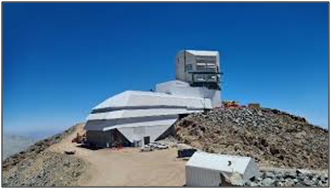
About Vera C. Rubin Observatory:
-
- Location: It is located 8,684 feet above sea level atop the Cerro Pachón mountain in the Chilean Andes, where dry air and dark skies provide one of the world’s best observing locations.
- Nomenclature: It is named after American astronomer Vera C. Rubin, who provided evidence about dark matter for the first time in the 1970s.
- Funding: It is jointly funded by the U.S. National Science Foundation and the U.S. Department of Energy’s Office of Science.
- Goals: The observatory has four main scientific goals:
-
-
- Understand the nature of dark matter and dark energy.
- Create an inventory of the asteroids, comets, and other objects in the solar system.
- Map the Milky Way and help reconstruct its history.
- Explore objects — like exploding stars and black holes — that change position or brightness over time.
-
- Centrepiece: The centrepiece of the observatory is the Simonyi Survey Telescope.
-
- Uniqueness: The 8.4-meter telescope has the world’s largest digital camera, which is the size of a small car, weighs 2,800 kg, and boasts a staggering resolution of 3,200 megapixels. It can capture about 45 times the area of the full moon in the sky with each exposure.
- Fastest-slewing telescope: It is the fastest-slewing telescope in the world and takes just five seconds to move and settle from one target to another. This speed is due to the telescope’s compact structure (owing to the three-mirror design) and its mount, which floats on a film of oil.
- Significance: This observatory will provide comprehensive images of the night sky unlike anything astronomers have seen before. It will constantly scan the sky of the southern hemisphere for 10 years, creating an ultra-wide, ultra-high-definition time-lapse record of the universe.
- Huge data: It will produce approximately 20 terabytes of data every night. The amount of data gathered by Rubin Observatory in its first year alone will be greater than that collected by all other optical observatories combined.
Source:
Category: Environment and Ecology
Context:
- Forest staff who are to be involved in census of tigers and other wild animals will be using the advanced M-Stripes app at Anamalai Tiger Reserve.

About M-STrIPES:
- Full Form: MSTrIPES stands for Monitoring System for Tigers: Intensive Protection and Ecological Status.
-
- Nature: It is a software-based monitoring system created to assist patrol and protect tiger habitats.
- Launch: It was launched by the National Tiger Conservation Authority (NTCA) along with the Wildlife Institute of India in 2010.
- Objective: It is designed to assist wildlife protection, monitoring, and management of Protected Areas.
-
- Technologies used: It uses Global Positioning System (GPS), General Packet Radio Services (GPRS), and remote sensing.
- Role of forest guards: Under MSTrIPES protocols, forest guards are expected to patrol their beats and record their tracks using a GPS, in addition to recording observations in site-specific data sheets.
- Composition: The programme consists of two parts:
-
-
- an analytical engine with a central desktop software and
- an online analysis tool, and an Android-based mobile application that records field observations and tracks using real-time GPS.
- Focus areas: It aims to
- collect information from the field
- create a database using modern Information Technology (IT)-based tools
-
- analyze the information using GIS and statistical tools
-
- provide inferences that allow tiger reserve managers to better manage their wildlife resources.
Source:
Category: Geography
Context:
- The Public Investment Board (PIB) recently gave approval for the Rs 26,070-crore, 1,720 MW Kamala hydroelectric project in Arunachal Pradesh.

About Kamala Hydroelectric Project:
-
- Location: It is located in Arunachal Pradesh‘s Kamle district.
- Associated river: It is a 1,720 MW hydroelectric project, proposed on the Kamala River (a major tributary of the Subansiri River).
- Nature: The project involves construction of a 216-metre-high concrete gravity dam and an underground powerhouse.
- Capacity: The project will generate 6,869.92 MU of green energy annually on completion.
- Significance: In addition to power generation, the project also envisaged to provide flood relief in the Brahmaputra valley.
-
- Implementation: The project will be implemented on a Build-Own-Operate-Transfer (BOOT) basis through a joint venture company with 74% equity by NHPC and 26% by the Govt of Arunachal Pradesh (GoAP).
- Cost: The completion cost of the project is estimated at Rs 26,069.50 crore.
- Financing structure: The project’s financing structure reflects strong institutional backing, with a 70:30 debt-equity ratio, substantial Central grants—Rs 1,340 crore for enabling infrastructure and Rs 4,743.98 crore for flood moderation—and 100 percent SGST reimbursement by the Arunachal Pradesh Government.
Source:
(MAINS Focus)
GS-II: Effect of policies and politics of developed and developing countries on India’s interests, Indian diaspora; important international institutions, agencies and fora — their structure, mandate
Context (Introduction)
The post-Second World War global order was largely shaped and led by the United States through institutions such as the United Nations and the Bretton Woods system. However, recent U.S. policy choices—especially under the Trump administration signal a growing disengagement from the very multilateral architecture it helped create, raising concerns about the future of global governance.
Core Idea
The U.S. is progressively walking away from rules-based multilateralism in favour of unilateral, transactional, and short-term national interest calculations. This shift threatens the stability, legitimacy, and effectiveness of international institutions that have underpinned global cooperation and relative order for decades.
Nature of the U.S. Retreat
- Erosion of Multilateral Commitment: Withdrawal from or undermining of global organisations dealing with trade, climate change, migration, and human rights weakens institutional credibility.
- Unilateralism and Executive Action: Increased reliance on executive orders and tariffs bypasses negotiated norms and dispute-resolution mechanisms.
- Normative Inconsistency: Actions such as violating sovereignty norms while claiming to uphold international law dilute moral authority.
- Trade System Disruption: Protectionist tariffs and coercive bargaining undermine the predictability of the global trading system.
- Leadership Vacuum: Reduced U.S. engagement leaves institutions under-resourced and directionless.
Why It Matters
- Fragility of Global Institutions: Institutions like the UN and WTO depend on leadership by major powers for enforcement and legitimacy.
- No Ready Substitute: While China may expand its influence, it lacks both normative acceptance and institutional depth to fully replace U.S. leadership.
- Impact on Global South: Multilateral weakening disproportionately affects developing countries that rely on rules-based systems for voice and protection.
- Rule-based Order at Risk: Retreat from norms risks a return to power-centric, interest-driven global politics.
Implications for India
- Strategic Autonomy Challenge: A weakening multilateral order complicates India’s reliance on international law and institutions.
- Opportunity for Middle-Power Diplomacy: India can play a stabilising role by supporting institutional reform and coalition-based multilateralism.
- Need for Issue-based Engagement: Climate action, trade reform, and development finance require India to engage beyond great-power binaries.
Way Forward
- Strengthen and reform multilateral institutions rather than abandon them
- Encourage shared leadership and burden-sharing among major powers
- Enable greater representation of the Global South in global governance
- Promote adherence to international law and negotiated norms
Conclusion
America’s disengagement from the international system it built risks accelerating institutional decay and global disorder. In the absence of a credible alternative leader, the erosion of multilateralism could result in a harsher, more unequal world. Preserving a rules-based order now depends on collective responsibility, adaptive reform, and renewed commitment by both established and emerging powers.
Mains Question
- The weakening of the liberal international order today stems less from external challengers than from the retreat of its principal architect. Critically analyse the implications of the United States’ disengagement from multilateral institutions for global governance, and discuss the strategic choices this creates for emerging powers like India. (250 words, 15 marks)
GS-II: Issues relating to development and management of Social Sector/Services relating to Education.
Context (Introduction)
India’s higher education system is undergoing a significant transition under the National Education Policy (NEP) 2020, marked by curriculum flexibility, interdisciplinary learning, and regulatory reform. This transformation has gained momentum, but its sustainability hinges critically on building trust between the State and higher education institutions (HEIs).
Core Idea
High-quality education cannot be delivered through regulation alone; it requires institutional autonomy anchored in accountability. Trust between the State and institutions enables innovation in teaching, research, and governance, while excessive control risks stifling academic creativity and global competitiveness.
Trust Deficit and Structural Constraints
- Over-regulation legacy: Historically fragmented and compliance-heavy regulation has limited institutional autonomy and experimentation.
- Uneven regulatory capacity: Multiple regulators and ad hoc oversight have created uncertainty and inhibited long-term planning.
- Research ecosystem gaps: While ANRF and RDI schemes strengthen research funding, collaboration and institutional confidence remain uneven.
- Science education limitations: Despite progress, hands-on, experiential science education remains inadequate across institutions.
- Global mobility pressures: Tighter visa regimes and geopolitics require strong domestic institutions to retain talent.
Why Trust Matters
- Institutional autonomy: Trusted institutions can innovate curricula, pedagogy, and assessment aligned with global standards.
- Quality assurance: Unified accreditation and transparent disclosure signal quality to students and parents without micromanagement.
- Research competitiveness: Stable state support enables long-term investments in interdisciplinary and frontier research.
- Human capital outcomes: Education systems grounded in trust produce adaptable graduates suited for leadership, innovation, and economic growth.
- International credibility: Predictable governance enhances India’s attractiveness as a global education hub.
Way Forward
- Implement the Bharat Shiksha Adhishthan Bill, 2025 to create a single, credible regulatory architecture
- Shift the State’s role from controller to enabler and standard-setter
- Strengthen accreditation, benchmarking, and public disclosure instead of prescriptive controls
- Deepen industry academia collaboration and experiential science education
- Institutionalise formal trust-based compacts between the State and HEIs
Conclusion
India’s higher education reform stands at a decisive moment. Regulatory consolidation and policy clarity have created momentum, but excellence will depend on mutual trust between the State and institutions. A governance model that empowers institutions while ensuring accountability is essential if India is to build a globally competitive, innovation-driven higher education system.
Mains Question
- Reforms in higher education increasingly emphasise autonomy, interdisciplinarity, and regulatory consolidation. Critically examine why trust between the State and higher education institutions is essential for achieving quality, innovation, and global competitiveness in India’s higher education system. (250 words, 15 marks)