

Archives
(PRELIMS Focus)
Category: Polity and Governance
Context:
- Recently, government doctors in Haryana extended their strike indefinitely despite the state invoking ESMA to ban such protests for six months.
About Essential Services Maintenance Act (ESMA):
-
- Enactment: It is an act of the Indian Parliament enacted in 1968 to assure the supply of certain services that, if impeded, would harm people’s daily lives.
- Objective: It is enforced to prohibit striking employees from refusing to work in certain essential services. Employees cannot cite bandhs or a curfew as an excuse not to report to work.
- Constitutional Basis: ESMA is a law made by the Parliament under List No. 33 of the Concurrent List in the Seventh Schedule of the Constitution. This allows both the central government and state governments to enact their own versions of the Act.
- Implementation: The Act’s execution largely depends on the discretion of the government (central or state). Before enforcing ESMA, the government must alert the employees through media or newspaper notifications.
- Duration: An order under ESMA is typically in force for six months, but the government can extend it, if necessary, in the public interest.
- Customised ESMA of each state: Each state has its own ESMA, with provisions that differ slightly from the federal statute. As a result, if the nature of the strike disturbs only one or more states, the states can initiate it. The Act also allows states to choose the essential services on which to enforce ESMA.
- Central government imposing ESMA: In a nationwide interruption, particularly involving railways, the central government may activate the ESMA.
- Applicability: The government can declare a range of services as “essential” such as:
- Transportation (railways, airways, public road transport)
- Public health (hospitals, sanitation, water supply)
- Energy (electricity generation and distribution, petroleum, coal)
- Communication (postal, telegraph, telephone services)
- Defence-related establishments and production
- Banking services
- Penal actions that can be taken to impose it:
-
- Persons who commence the strike as well as those who instigate it are liable to disciplinary action, which may include dismissal.
- As the strike becomes illegal after ESMA is invoked, legal action can also be taken against these employees.
- Any police officer is empowered to arrest the striking person without a warrant.
- Persons participating in or instigating the strike are punishable with imprisonment, which may extend to one year, or with fine, or with both.
Source:
Category: Environment and Ecology
Context:
- Sultanpur National Park is once again echoing with the sounds of migratory birds, with their numbers rising significantly as temperatures drop.
About Sultanpur National Park:
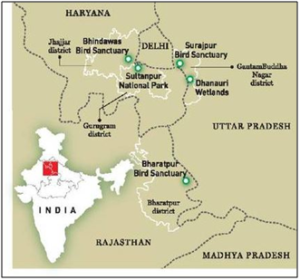
- Location: Sultanpur National Park, formerly known as Sultanpur Bird Sanctuary, is located in the Gurgaon district in Haryana, 46 km from Delhi.
- Area: Spanning 1.42 sq.km., it consists primarily of marshy lakes and floodplains. It includes a core area of 1.21 sq. km containing the main Sultanpur Lake/Jheel.
- Establishment: It was declared a Bird Sanctuary in 1972. And, it was upgraded to a National Park in 1991.
- Lake inside the National Park: The Sultanpur Jheel is a seasonal freshwater wetland with fluctuating water levels throughout the year. This shallow lake is mostly fed by waters from River Yamuna’s Gurgaon canal and the overflowing waters of the neighbouring agricultural lands.
- National attention: It gained national attention in the late 1960s due to the conservation efforts of ornithologists Peter Michel Jackson and Dr. Salim Ali, who frequently visited the site for birding.
- Significance: It was recognised as a Ramsar site in 2021. It has also been identified as an Important Bird Area by BirdLife International.
- Flora: The vegetation of this park is tropical and dry deciduous, and the flora includes grasses, dhok, khair, tendu, ber, jamun, banyan tree, neem, berberis, Acacia nilotica, and Acacia tortilis.
- Fauna: Over 320 bird species have been recorded at Sultanpur, making it a vital wintering ground. Other faunal species, such as Nilgai, Sambar, Golden jackals, wild dog, striped hyenas, Indian porcupine, mongoose, etc., are also found here.
- Part of Central Asian Migratory Flyway: It forms a part of the ‘Central Asian Migratory Flyway’ and thousands of migratory birds from the countries of Russia, Turkey, Afghanistan, and Europe visit the park during the winter months.
- Important species: Winter migrants include Greater Flamingos, Northern Pintails, Eurasian Wigeons, Common Teals, and Bar-headed Geese. Resident Birds include Indian Peafowl, Red-wattled Lapwings, Cattle Egrets, and White-throated Kingfishers. And, threatened species include Sarus Crane, Black-necked Stork, and Indian Courser.
Source:
Category: International Organisations
Context:
- Recently, the Union Minister for Ports inaugurated the 3rd Session of the Council of the International Organization for Marine Aids to Navigation (IALA) held in Mumbai.

About International Organization for Marine Aids to Navigation (IALA):
- Establishment: It was established in 1957 as a Non-Governmental Organisation (NGO).
- Nature: It officially changed its status from a Non-governmental Organization (NGO) to an Intergovernmental Organization (IGO) based on a Convention ratified by 34 States in 2024.
- Objective: Its mandate is to harmonise global maritime navigation systems, promote maritime safety initiatives, and collaborate with member states, international organizations, and industry stakeholders to address emerging challenges in maritime safety and environmental protection.
- Motto: Its motto is ‘Successful Voyages, Sustainable Planet.’
- Headquarters: Its headquarters is located in Saint-Germain-en-Laye, France.
- Governance: The IALA Council is the key decision-making body of the intergovernmental organization responsible for marine aids to navigation.
- Members: It comprises 200 members, 80 of which are national authorities and 60 are commercial firms. (India has been a member of this organization since 1957).
- Focus areas: It aims to
- Foster safe, economic and efficient movement of vessels by improving and harmonizing aids to navigation worldwide and by other appropriate means.
- Encourage, support and communicate recent developments; develop international cooperation by promoting close working relationships and assistance among members;
- Enhance mutual exchange of information with organizations representing users of aids to navigation.
Source:
Category: Science and Technology
Context:
- A government working paper released recently suggested that AI large language models like ChatGPT should, by default, have access to content freely available online.

About Large Language Models (LLMs):
-
- Definition: An LLM is a type of artificial intelligence (AI) program that can recognize and generate text, among other tasks. In simpler terms, an LLM is a computer program that has been fed enough examples to be able to recognize and interpret human language or other types of complex data.
- Nomenclature: LLMs are trained on huge sets of data, hence the name “large.” Since LLMs are now becoming multimodal (working with media types beyond text), they are now also called “foundation models.”
- Based on machine learning: LLMs are based on Machine Learning (ML) specifically, a type of neural network called a transformer model, which excels at handling sequences of words and capturing patterns in text.
- Training via tuning: LLMs use a type of machine learning called deep learning in order to understand how characters, words, and sentences function together. They are fine-tuned or prompt-tuned to the particular task that the programmer wants them to do.
- Curated data set: Many LLMs are trained on data that has been gathered from the Internet—thousands or millions of gigabytes’ worth of text. But the quality of the samples impacts how well LLMs will learn natural language, so LLM’s programmers may use a more curated data set.
- Applications:
-
- LLMs can perform various language tasks, such as answering questions, summarizing text, translating between languages, and writing content.
- Businesses use LLM-based applications to help improve employee productivity and efficiency, provide personalized recommendations to customers, and accelerate ideation, innovation, and product development.
- LLMs serve as the foundational powerhouses behind some of today’s most used text-focused generative AI (GenAI) tools, such as ChatGPT, Claude, Microsoft Copilot, Gemini, and Meta AI.
- Challenges faced: Though they are groundbreaking, LLMs face challenges that may include computational requirements, ethical concerns, and limitations in understanding context.
Source:
Category: Science and Technology
Context:
- Aditya-L1 played a key role in helping scientists decode why the strongest solar storm that struck Earth in May 2024 behaved so unusually, ISRO said recently.
About Aditya-L1:
-
- Development: It was developed and launched by the Indian Space Research Organisation (ISRO) in September 2023.
- Launch vehicle: It was launched using PSLV-C57 rocket.
- Nature: It is ISRO’s second astronomy observatory-class mission after AstroSat (2015).
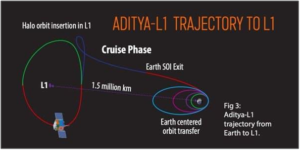
- Uniqueness: Aditya-L1 is the first space based observatory class Indian solar mission to study the Sun from a substantial distance of 1.5 million kilometers.
- Objective: The mission aims to provide valuable insights into the solar corona, photosphere, chromosphere, and solar wind.
- Location in space: The spacecraft is placed in a halo orbit around the Lagrangian point 1 (L1) of the Sun-Earth system, which has the major advantage of continuously viewing the Sun without any occultation.
- Payloads: The spacecraft carries seven scientific payloads for observations:
- Visible Emission Line Coronagraph (VELC)
- Solar Ultraviolet Imaging Telescope (SUIT)
- Solar Low Energy X-ray Spectrometer (SoLEXS)
- High Energy L1 Orbiting X-ray Spectrometer (HEL1OS)
- Aditya Solar wind Particle Experiment (ASPEX)
- Plasma Analyser Package For Aditya (PAPA)
- Advanced Tri-axial High Resolution Digital Magnetometers
- Major focus areas:
-
- Understanding Coronal Heating and Solar Wind Acceleration.
- Understanding initiation of Coronal Mass Ejection (CME), solar flares and near-earth space weather.
- Understanding coupling and dynamics of the solar atmosphere.
- Understanding solar wind distribution and temperature anisotropy.
Source:
(MAINS Focus)
(UPSC GS Paper III – Indian Economy: Growth, Development, Mobilisation of Resources, Inclusive Growth)
Context (Introduction)
India’s Q2 GDP growth of 8.2% signals strong economic momentum, driven by manufacturing, services, and consumption revival. Yet the IMF’s Grade C rating for India’s national accounts raises questions over data credibility, structural weaknesses, and sustainability of long-term growth.
Main Arguments: What Drives the 8.2% Growth Momentum ?
- Manufacturing Revival : Manufacturing grew 9.1%, reflecting stronger industrial demand, better capacity utilisation, and healthy credit growth across sectors.
- Services-Led Expansion : The services sector now forms 60% of GDP, growing at 9.2%, with financial services at 10.2%—indicating high transaction volumes and strong urban consumption.
- Real GVA Strength : GVA rose from ₹82.88 lakh crore to ₹89.41 lakh crore, showing genuine value addition across agriculture, industry and services rather than inflation-led growth.
- Consumption Recovery : Private Final Consumption Expenditure (PFCE) grew 7.9%, signalling household optimism; agriculture growth at 3.5% reflects improved reservoir status and horticulture output.
- Macro Stability : Low inflation, strong GST and direct tax collections, and stable foreign exchange reserves provided a supportive macroeconomic base for high GDP growth.
Challenges / Criticisms
- IMF Grade C on Data Quality : Outdated 2011–12 base year, reliance on WPI as deflator, absence of producer price indices, large GDP estimation discrepancies, and lack of seasonally adjusted data weaken statistical credibility.
- Sectoral Unevenness : Mining grew only 0.04% and utilities 4.4%, revealing stress in foundational sectors that employ millions and support industrial supply chains.
- Employment Structure Mismatch : Agriculture employs ~45% of workforce but generates only 14% of GVA; services contribute 60% of GDP but not equivalent job creation—raising concerns on inclusive growth.
- External Sector Pressures : RBI notes rising global protectionism, tariff uncertainties, and geopolitical risks affecting India’s goods exports—limiting long-term growth drivers.
- Financial Market Fragility : A weakening rupee near 90 per USD, fluctuating FPI flows, and one of the world’s highest real interest rates (3.5%+) may suppress investment and growth momentum.
Way Forward: Ensuring Sustainable Long-Term Growth
- Modernise National Accounts : Update GDP base year to 2017–18 or 2020–21, introduce producer price indices, adopt OECD-style seasonally adjusted quarterly GDP, and improve estimation of the informal sector.
- Strengthen State-Level Capacity : Build better fiscal databases and statistical systems at the State level—similar to Brazil’s IBGE or Mexico’s INEGI—to improve accuracy and transparency.
- Export Competitiveness Strategy : Shift from tariff protection to Vietnam-like export-led manufacturing, integrate into global value chains, and scale electronics, renewables, pharmaceuticals, and textiles.
- Labour Productivity Reforms : Enhance skilling, MSME upgrading, and formalisation incentives—learning from South Korea’s SME modernisation and China’s productivity-driven employment strategy.
- Investment-Friendly Financial Conditions : Lower real interest rates to ~1%, stabilise the rupee through diversified reserves, and deepen corporate bond markets to support long-term capital formation.
- Climate-Resilient Core Sectors : Infrastructure, mining, and utilities need climate-proof planning (Japan model), given their vulnerability to monsoon variability and extreme weather.
Conclusion
India’s 8.2% growth reflects genuine momentum, yet its sustainability hinges on addressing structural deficits in data integrity, productivity, export capacity, and institutional depth. Growth is strong today, but long-term resilience demands statistical reform, economic diversification, and stronger State-level capacity.
Mains Question
- “India’s strong GDP performance masks deeper structural vulnerabilities. Discuss and suggest reforms for a sustainable growth with inclusivity. (250 words, 15 marks )
Source: The Hindu
(UPSC GS Paper II – International Relations, India–USA Relations, Global Security Architecture)
Context (Introduction)
The 2025 U.S. National Security Strategy under President Donald Trump marks a sharp shift from post-1945 internationalism to selective engagement, regional focus, and burden-sharing. For India, this strategic recalibration opens both opportunities and challenges in navigating evolving U.S. foreign policy.
Key Shifts in Trump’s National Security Strategy
- Western Hemisphere Priority : The strategy elevates Latin America and the Caribbean as the core theatre of U.S. security, reshaping Washington’s global hierarchy of interests.
- End of Global Hegemony : It abandons the idea that the U.S. must act everywhere, moving toward selective interventions tied strictly to vital American interests.
- Burden-Sharing Expectation : U.S. allies are expected to assume greater security responsibility, reducing reliance on American military support.
- Cultural–Political Pluralism : The strategy rejects liberal universalism and endorses the right of states to choose their own political and institutional models, marking a significant ideological shift.
- Economic Nationalism : National security is fused with reindustrialisation, secure supply chains, and “fair trade”, signalling inward economic orientation.
Why These Shifts Create Opportunities for India
- Strategic Autonomy Advantage : An America that recognises limits to its power and avoids intrusive interventions aligns better with India’s long-held concerns about unequal alliances.
- Reduced U.S. Interference : Less appetite for nation-building abroad lowers the risk of American involvement in India’s domestic or regional affairs.
- Scope for Regional Leadership : The U.S. insistence on burden-sharing supports India’s ambition to lead in the Indo-Pacific, Indian Ocean Region, and South Asia.
- Convergence on Multipolarity : Washington’s acceptance of diverse political models indirectly validates India’s advocacy for a multipolar, pluralistic world order.
Challenges Highlighted for India
- Persistent Trade Disputes : Tariffs, market access issues, and protectionist tendencies under Trump continue to complicate India–U.S. economic engagement.
- Softening U.S. Tone on China : Trump’s openness to a new accommodation with Beijing could dilute U.S. pressure on China’s assertiveness—affecting India’s strategic leverage.
- Renewed Engagement with Pakistan : Washington’s outreach to Pakistan risks reviving geopolitical linkages that traditionally constrained India’s regional space.
India’s Strategic Response: What the Article Suggests
- Accelerate Economic Growth : Narrow India’s power gap with China and consolidate strategic superiority over Pakistan through high, sustained growth.
- Reform Defence and Security Institutions : Modernise procurement, jointness, and indigenous capability to deter Chinese military power—aligning with the U.S. burden-sharing model.
- Stabilise Relations with Pakistan : Reducing bilateral tensions limits opportunities for external powers, including the U.S., to intervene in South Asia.
- Engage Multiple Partners : Balance Trump’s America by deepening ties with Europe, Russia, Japan, and ASEAN, reinforcing India’s multi-alignment approach.
Conclusion
Trump’s National Security Strategy, despite turbulence in India–U.S. ties, offers Delhi a structural opening: an America less interventionist, more inward-looking, and more willing to share security responsibilities. For India, this environment favours strategic autonomy, regional leadership, and pragmatic multi-alignment—provided economic and defence reforms keep pace.
UPSC Mains Question
- “The 2025 U.S. National Security Strategy marks a decisive shift from global interventionism to selective engagement. Analyse how this restructuring of American foreign policy creates both opportunities and challenges for India’s strategic interests.” (250 words, 15 marks)
Source: Indian Express