

Archives
(PRELIMS Focus)
Category: Geography
Context:
- The Andhra Pradesh chief minister recently objected to Karnataka’s move to increase the height of the Almatti Dam on the Upper Krishna.
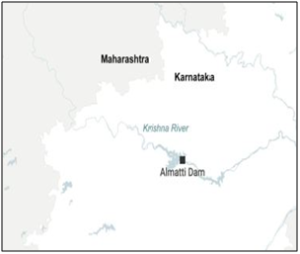
About Almatti Dam:
-
- Nature: Almatti Dam is a multipurpose dam primarily used for irrigation, hydroelectric power generation, and flood control.
- Location: It is situated in the Nidgundi area of Vijayapura (Bijapur) district, North Karnataka, on the border with Bagalkote district.
- River: It is built across the Krishna River, the second-largest east-flowing peninsular river.
- Other names: It is also known as the Lal Bahadur Shastri Dam.
- Structure: It stands at a height of 52.5 meters and extends 3.5 kilometers in length.
- Completion: The dam was completed in July 2005.
- Output: The annual electric output of the dam is 713,000,000 kilowatts (KW).
- Water capacity: The dam holds a gross water storage capacity of 123.08 TMC at 519 meters MSL.
- Project: It is the primary reservoir for the Upper Krishna Irrigation Project, designed to provide irrigation and drinking water to drought-prone districts like Kalaburagi, Yadgir, Raichur, and Bagalkot.
- Power generation: It features a 290 MW hydroelectric station using vertical Kaplan turbines.
- Release of water: After generating power, water is released into the Narayanpur reservoir to meet the irrigation requirements downstream.
- Picnic spot: Seven terrace gardens have been developed as a picnic spot in the dam area. On one side of the dam, a garden named “Rock Hill” has an artificial forest with ceramic wild animals and birds and many idols representing village life in India.
Source:
Category: Miscellaneous
Context:
- India has improved its position by four slots and is now placed at 45th rank as per the Network Readiness Index 2025 (NRI 2025) report.

About Network Readiness Index 2025:
- Nature: It maps how economies leverage information and communication technologies to support growth, innovation and social development.
- Methodology used: It assesses the network-based readiness landscape of 127 economies based on their performance in four pillars: Technology, People, Governance and Impact, covering a total of 53 indicators.
- Publishing agency: The report has been prepared by the Portulans Institute, an independent, non-profit research and educational institute based in Washington DC.
- Theme: The theme of the report was “AI Governance in a Global Context: Policy and Regulatory Approaches.”
-
- Top position: The United States retained the top position for the fourth consecutive year, leading globally in terms of access to and use of digital technologies. Finland has now taken second place, surpassing Singapore, which has fallen to third place this year.
- India’s score: India improved its score from 53.63 out of 100 in 2024 to 54.43 out of 100 in 2025.
- Global leadership: India secured 1st rank in “Annual investment in telecommunication services”, “AI scientific publications”, “ICT services exports” and “E-commerce legislation”.
- Income Group Performance: India is ranked 2nd among lower-middle-income countries, after Vietnam, performing better than expected in network readiness relative to its income level.
- Dropped countries: 6 economies—the Bolivarian Republic of Venezuela, the Democratic Republic of the Congo, Chad, the Seychelles, Sierra Leone, and Yemen—were dropped out this year due to limitations in data coverage.
Source:
Category: Science and Technology
Context:
- Recently, NASA found a hydrogen leak during a wet dress rehearsal of its Artemis II mission.

About Wet Dress Rehearsal:
- Definition: It is the final practice run for a high-stakes rocket launch.
-
- Nomenclature: The “wet” in the name refers to the loading of cryogenic fuel (typically liquid oxygen and liquid hydrogen for large rockets) into the rocket’s massive tanks.
- Objective: It aims to identify potential issues that only occur under extreme cryogenic conditions, such as seal leaks, material stress, or fuel line issues.
- Procedure: It is a rigorous demonstration of ground team preparedness. The team will cool the fuel feed lines, load the tanks, pressurise them, monitor leak detectors, and execute the countdown into its final stages.
-
- Role of rehearsals: These rehearsals keep the tanks full as the propellant warms and boils off, then executes a stop just before ignition, followed by draining and returning the vehicle to a stable configuration.
- Simulation: This puts the entire craft through each step of a simulated launch, exposing it to the super-chilled fuels to ensure that everything will function properly on launch day.
- Significance: Wet rehearsals are important because only they can reveal events that happen in cryogenic conditions, e.g., leaks in seals or in the connections between the rocket and ground equipment.
About Dry Dress Rehearsal:
- Nature: It practices the countdown and important operations without loading cryogenic propellants into the rocket.
- Procedure: The team will power up vehicle and ground systems, verify its communications equipment, simulate critical events, and validate decision-making and handoffs between launch control, engineering, range safety, and, if applicable, crew operations.
- Significance: Many of the testing steps use simulated sensor inputs. These rehearsals are useful to reveal logical problems in the flow of events without risking fuel leaks.
Source:
Category: Economy
Context:
- Recently, the Minister of State for finance informed the Rajya Sabha about the Public Financial Management System (PFMS).
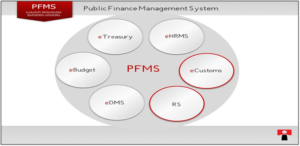
About Public Financial Management System (PFMS):
-
- Nature: It is a Centralized Transaction System & Platform, providing end to end financial management services to all stakeholders. It is a web-based online transaction system for fund management and e-payment to implementing agencies and other beneficiaries.
- Origin: It was launched in 2009 as a Central Sector Scheme of the Planning Commission (initially called the Central Plan Schemes Monitoring System or CPSMS).
- Objective: It aims to facilitate a sound Public Financial Management System for Government of India by establishing an efficient fund flow system as well as a payment cum accounting network.
- Implementation: It is developed and implemented by the Controller General of Accounts (CGA), Department of Expenditure, Ministry of Finance, Government of India.
- Coverage: It includes all Central Sector and Centrally Sponsored Schemes (CSS), as well as other expenditures like Finance Commission Grants.
- Integration: It is linked with the Core Banking System (CBS) of over 300 banks (public, private, RRBs, and cooperative) and the National Payments Corporation of India (NPCI) for Aadhaar-linked payments.
- Tracking of funds: It tracks funds released under all Plan schemes of Government of India, and real time reporting of expenditure at all levels of Programme implementation. The government has mandated PFMS as a single platform for payment, accounting & reconciliation of government transactions and DBT.
- Cash management modules: It has been introduced on PFMS for better fund management like Single Nodal Agency (SNA), Treasury Single Account (TSA), Central Nodal Agency (CNA) and Single Nodal Agency Samyochit Pranali Ekikrit Shighra Hastantaran (SNA SPARSH).
- Grievance Redressal System: PFMS has introduced the Customer Relationship Management (CRM) system, to strengthen the grievance redressal mechanism for PFMS users/ beneficiaries.
- Transparency & Accountability: It has reduced manual intervention and has provided a clear audit trail of every rupee spent.
- Decision Support System (DSS): It has provided reliable data to ministries for better budget planning and evidence-based policy analysis.
Source:
Category: Environment and Ecology
Context:
- Recently, a male gibbon was found electrocuted to death at Hollongapar Gibbon Wildlife Sanctuary (HGWS) in Jorhat.

About Hollongapar Gibbon Wildlife Sanctuary:
-
- Location: It is located in the Jorhat district of Assam, India.
- Establishment: The Assam Government upgraded the area’s status from the Hoollongapar Reserve Forest to a wildlife sanctuary on July 30, 1997.
- Area: It covers approximately 20.98 sq km.
- Uniqueness: It is the only sanctuary in India named after a gibbon due to its distinction for containing the densest gibbon populations in Assam.
- Terrain: It is situated at an altitude between 100 and 120 m (330 and 390 ft), the topography gently slopes downward from southeast to northwest.
- River: The Bhogdoi River creates a waterlogged region dominated by semi-hydrophytic plants along the border of the sanctuary.
- Isolation: It is a “forest island” completely surrounded by tea gardens.
- Flora: The upper canopy of the forest is dominated by the Hollong tree, while the Nahar dominates the middle canopy. The lower canopy consists of evergreen shrubs and herbs.
- Fauna: It contains India’s only gibbons–the hoolock gibbons, and Northeastern India’s only nocturnal primate–the Bengal slow loris, Indian elephants, tigers, leopards, jungle cats, wild boar, three types of civet, four types of squirrels, stump-tailed macaque, northern pig-tailed macaque, etc.
Source:
(MAINS Focus)
(GS Paper II – Indian Constitution—features, amendments, significant provisions; Separation of powers; Role of Judiciary in constitutional governance)
Context (Introduction)
Recent judgments of the Madras High Court concerning the Thiruparankundram Deepathoon and the Thenkalai sect’s recitation rights reflect the continuing constitutional engagement of courts with religious disputes. These cases reaffirm that temples are not insulated private spaces but public institutions subject to constitutional discipline. The increasing litigation marks a deeper contest between denominational autonomy and constitutional morality.
Pre-Constitution to Constitutional Shift
- Civil Rights Character: In Sankaralinga Nadan vs Raja Rajeswara Dorai (1908), temple entry disputes were treated as civil rights issues rather than constitutional questions.
- Legislative Supervision: The Madras Hindu Religious Endowments Act, 1927 institutionalised state supervision over temple administration and finances.
- Constitutional Transformation: After 1950, Articles 25 and 26 converted temple disputes into fundamental rights adjudication.
- Public Order Limitation: Religious freedom was expressly made subject to public order, morality and health.
- Judicial Centrality: Constitutional courts became arbiters in balancing equality with religious autonomy.
Development of the Essential Religious Practices Doctrine
- Judicial Innovation: The Supreme Court evolved the Essential Religious Practices (ERP) test to determine core religious protections.
- Secular-Religious Distinction: Practices not deemed essential were classified as secular and open to state regulation.
- Equality Emphasis: Courts used ERP to strike down exclusionary customs inconsistent with Articles 14 and 21.
- Sabarimala Consolidation: In Indian Young Lawyers Association (2018), the Court held that even essential practices are subject to constitutional morality.
- Doctrinal Inconsistency: Subsequent judgments revealed inconsistency in applying ERP, raising concerns of judicial subjectivity.
Contemporary Constitutional Tensions
- Denominational Autonomy vs Equality: Article 26 rights frequently collide with individual equality guarantees.
- Judicial Theologising: Courts often enter theological terrain, risking overreach beyond institutional competence.
- Expanding Litigation: Rising religious disputes reflect ideological polarisation and rights consciousness.
- Constitutional Morality Debate: The content of constitutional morality remains interpretatively fluid.
- Separation of Powers Concern: Frequent judicial involvement may blur boundaries between judiciary and religious administration.
Way Forward
- Shift to Proportionality: Courts may adopt a proportionality framework instead of theological scrutiny.
- Legislative Clarity: Clearer statutory frameworks under HR&CE laws can reduce litigation.
- Institutional Mechanisms: Internal grievance redressal within temples can prevent constitutional escalation.
- Judicial Restraint: Courts must combine constitutional vigilance with doctrinal consistency.
- Faith-Constitution Harmony: Religious freedom must operate within the constitutional framework of justice, liberty, equality and fraternity.
Conclusion
Judicial review of religious practices is a constitutional necessity rather than an intrusion. The challenge lies not in withdrawing courts from religious disputes but in refining doctrinal tools to harmonise faith with constitutional supremacy.
Mains Question
- Examine the evolution of judicial intervention in religious disputes in India. Discuss whether the Essential Religious Practices doctrine requires reconsideration in light of constitutional morality (250 words)
Source: The Hindu
(GS Paper II – Issues and challenges pertaining to the federal structure; Reorganisation of States; Parliament and State Legislatures—structure, functioning and conduct of business)
Context (Introduction)
India’s state reorganisation has historically been episodic and politically driven rather than institutionalised. From linguistic consolidation in the 1950s to developmental bifurcations in the 2000s, the rationale has evolved. The proposal for a permanent framework seeks to move from reactive fragmentation to structured federal redesign.
Historical Evolution of State Reorganisation
- Linguistic Foundation (1953–56): The States Reorganisation Commission (SRC), constituted in 1953 under Jawaharlal Nehru, recommended linguistic states to reduce regional tensions and ensure administrative accessibility in the mother tongue.
- Cultural Stabilisation Objective: Linguistic reorganisation translated diverse identities into politically manageable units, strengthening early national integration.
- Shift in Rationale (2000 onwards): The creation of Uttarakhand, Chhattisgarh and Jharkhand was driven by developmental imbalances rather than linguistic identity.
- Socio-Political Imperatives: The bifurcation of Andhra Pradesh in 2014 reflected regional grievances rooted in perceptions of neglect and unequal development.
- From Identity to Governance: Contemporary demands increasingly arise from governance deficits rather than cultural differences.
Governance Challenges of Mega-States
- Population Scale: Uttar Pradesh (240+ million), Maharashtra and Bihar (130+ million each) exceed the population of most European sovereign nations.
- Administrative Distance: Large territorial and bureaucratic distances weaken responsiveness between citizens and the state apparatus.
- Implementation Deficit: Policies designed at state capitals often fail to reach remote regions effectively.
- Service Delivery Gaps: Health, education and law enforcement face structural strain in oversized administrative units.
- Demand for Proximity: Calls for smaller states often reflect a desire for governance closer to citizens rather than identity politics.
Limitations of the Current Approach
- Ad Hoc Mechanism: Article 3 empowers Parliament to reorganise states, but decisions have largely been politically negotiated rather than institutionally evaluated.
- Absence of Objective Criteria: There is no permanent body to assess economic viability, administrative efficiency or fiscal sustainability.
- Fiscal Risks: New states without viable revenue bases risk long-term dependence on central transfers.
- Federal Strain: Sudden reorganisations can disrupt inter-state resource sharing and administrative continuity.
- Political Expediency: Statehood demands are often addressed in moments of crisis rather than through a stable evaluative framework.
Rationale for a Permanent Reorganisation Framework
- Holistic Criteria: Reorganisation should consider economic viability, administrative manageability and social cohesion.
- Evidence-Based Evaluation: A permanent mechanism can ensure objective and data-driven assessment of statehood demands.
- Fiscal Sustainability: New states must demonstrate credible pathways to financial self-sufficiency.
- Administrative Efficiency: The purpose of division should be improved governance and service delivery.
- National Unity Safeguard: Reorganisation must strengthen federalism rather than encourage centrifugal fragmentation.
Way Forward
- Institutionalisation: Establishing a permanent commission or constitutional mechanism under Article 3 can depoliticise the process.
- Multi-Factor Test: Criteria may include population size, regional imbalance, fiscal health, geographic contiguity and governance outcomes.
- Consultative Federalism: States, civil society and expert bodies must be formally consulted before any reorganisation.
- Transition Framework: Clear provisions for asset division, debt sharing and institutional continuity should accompany any bifurcation.
- Periodic Review: Federal structure must be adaptable to demographic and economic shifts over time.
Conclusion
State reorganisation in India has evolved from linguistic integration to developmental rationalisation. A permanent, structured framework would shift the process from political reaction to institutional foresight, aligning federal restructuring with democratic responsiveness and national cohesion.
Mains Question
- “The smaller the states the better the administration”. In this light critically examine the need for a permanent institutional framework for state reorganisation in India. (250 words)
Source: Indian Express