

Archives
(PRELIMS Focus)
Category: Polity and Governance
Context:
- The Central Ground Water Board (CGWB) has stated that Andhra Pradesh is one of the States facing widespread contamination of groundwater as per the BIS standards.
About Central Ground Water Board:
-
- Nature: It is the National Apex Agency entrusted with the responsibilities of providing scientific inputs for management, exploration, monitoring, assessment, augmentation, and regulation of groundwater resources of the country.
- Establishment: It was established in 1970 by renaming the Exploratory Tube wells Organization under the Ministry of Agriculture, Government of India. It was merged with the Ground Water Wing of the Geological Survey of India during 1972.
- Nodal ministry: It is a multidisciplinary scientific organization of the Department of Water Resources, River Development and Ganga Rejuvenation, Ministry of Jal Shakti, Government of India.
- Mandate: It aims to develop and disseminate technologies and monitor and implement national policies for the scientific and sustainable development and management of India’s groundwater resources.
- Organization Setup: It is headed by the Chairman and has five members. It operates via 18 regional offices and 17 divisional offices across India.
- Composition: It is a multidisciplinary scientific organization consisting of Hydrogeologists, Geophysicists, Chemists, Hydrologists, Hydrometeorologists, and Engineers.
- Wings: It has four main wings, namely
- Sustainable Management & Liaison (SML)
- Survey, Assessment & Monitoring (SAM)
- Exploratory Drilling & Materials Management (ED&MM)
- Water Quality & Training and Technology Transfer (WQ&TT).
- Headquarters: Its headquarters is located in Bhujal Bhawan, Faridabad, Haryana.
- Regulation: The regulation and control of groundwater development is managed by Central Ground Water Authority (CGWA) in coordination with State Government Organizations.
- Focus areas:
-
- Groundwater explorations to delineate groundwater-worthy areas and potential aquifers.
- Geophysical surveys to delineate groundwater bearing zones, etc.
- Periodic assessment of the country’s groundwater resources.
- Monitoring of groundwater levels and quality through groundwater observation wells.
- Dissemination of Ground Water Data and knowledge.
Source:
Category: Society
Context:
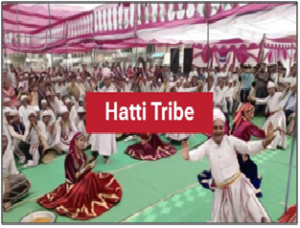
- “Boda Tyohar”, the biggest annual festival of the Hati tribe in Himachal Pradesh’s Sirmour commenced recently with traditional fervour.
About Hatti Tribe:
-
- Nomenclature: The Hattis are a close-knit community who take their name from their age-old professional practice of selling their homegrown crops at small markets called ‘Haat’ in nearby cities.
- Location: These tribal people reside in the Himachal-Uttarakhand border in the basin of the Giri and Tons rivers, both tributaries of the Yamuna.
- Social Structure: The community maintains a rigid caste system, primarily divided into upper castes (Bhat and Khash) and lower castes (Badhois).
-
- Clans: There are two main Hatti clans: one in the Trans-Giri area of the Sirmaur district in Himachal Pradesh and the other in Jaunsar Bawar of Uttarakhand. The two Hatti clans have similar traditions, and intermarriages are common.
- Marriage: Jodidara is a traditional form of polyandrous marriage practised among the Hatti tribe in Himachal Pradesh, where a woman marries two or more brothers. Polyandry is legally recognised in Himachal Pradesh under revenue laws.
- Attire: Hatti men traditionally don distinctive white headgear on ceremonial occasions.
- Governance: Harris is governed by a traditional council called ‘khumbli’ which decides community matters.
- Economy: The Hatti population relies on agriculture for livelihood and bare subsistence since their climate is ideal for growing “Cash Crops.”
-
- Festival: Boda Tyohar, also called Magho ko Tyohar, is the biggest annual festival of the Hatti tribe.
- Population: According to the 2011 census, members of the community numbered around 2.5 lakh, but at present the population of the Hattis is estimated at around 3 lakhs.
- ST Status: In 2023, the Indian government granted Scheduled Tribe (ST) status to the Hatti community in Himachal Pradesh.
Source:
Category: International Organisations
Context:
- Union Minister for New and Renewable Energy recently delivered India’s national statement at the 16th Assembly of the IRENA in Abu Dhabi, United Arab Emirates.
About International Renewable Energy Agency (IRENA):
-
- Establishment: It is an intergovernmental organisation that was founded in 2009 to support countries in their transition to a sustainable energy future.
- Objective: It serves as the principal platform for international cooperation, a centre of excellence, and a repository of policy, technology, resource and financial knowledge on renewable energy.
- Member countries: It has 170 Members and the European Union. India is also one of the founder members of IRENA.
- Association with UN: It is an official United Nations observer.
- Secretariat: It comprises the Director-General and his staff, provides administrative and technical support to the Assembly, the Council and their subsidiary bodies.
- Headquarters: Its headquarters is in Abu Dhabi, United Arab Emirates.
- Governance: Assembly is IRENA’s ultimate decision-making authority, made up of one representative from each Member.
- Council: It is composed of 21 Member States elected for a two-year term and is accountable to the Assembly. Council members serve on a rotating basis to ensure the effective participation of both developing and developed countries and a fair and equitable geographical distribution.
Source:
Category: Science and Technology
Context:
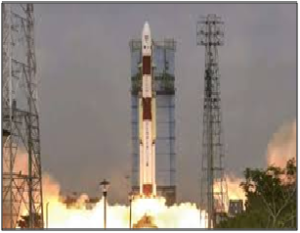
- ISRO recently said that the PSLV-C62 mission encountered an anomaly during end of the PS3 stage and a detailed analysis has been initiated.
About PSLV-C62 Mission:
- Nature: It was the first space mission of 2026 for the Indian Space Research Organisation (ISRO).
-
- Launch Vehicle: It was launched using PSLV-DL variant (Dual Launch), which utilizes two solid strap-on motors (PSOM-XL) to augment thrust.
- Payloads: It carried one primary satellite and 18 secondary payloads into space. The primary payload was the earth observation satellite EOS-N1 (codenamed ‘Anvesha’), an hyperspectral imaging satellite developed primarily for the Defence Research and Development Organisation (DRDO) for strategic purposes.
- Significance of EOS-N1: Unlike conventional imaging satellites, hyperspectral satellites could “see” the Earth in hundreds of wavelengths, allowing them to identify materials and objects with far greater precision. This capability made EOS-N1 a high-value asset for national security, border surveillance and strategic monitoring.
- Other Important Payloads:
-
- AayulSAT (India): Developed by OrbitAID Aerospace, this was India’s first on-orbit satellite refuelling demonstrator, aimed at extending satellite life.
- KID (Spain): The Kestrel Initial Technology Demonstrator, a small-scale prototype for a re-entry vehicle designed to splash down in the South Pacific Ocean.
- Theos-2A (Thailand): An Earth observation satellite developed in collaboration with international partners.
- Anomaly: The mission encountered a third-stage malfunction (anomaly) after an initially successful lift-off. This was the second consecutive failure involving the PSLV’s third stage, following the PSLV-C61 mission setback in May 2025.
Source:
Category: Environment and Ecology
Context:
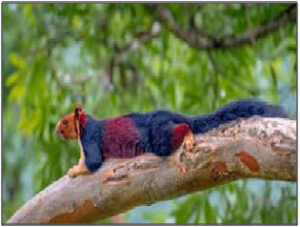
- During the ongoing All India Tiger Estimation 2026 survey, the Indian giant squirrel, was sighted in the Atwan region of the Pune forest division.
About Indian Giant Squirrel:
-
- Scientific Name: The scientific name of Indian Giant Squirrel is Ratufa indica.
- Nature: The Indian Giant Squirrel is a large rodent species native to India. More specifically, it is a type of tree squirrel. It is one of the largest squirrels in the world.
- Other names: It is also known as the Malabar Giant Squirrel.
-
- Distribution: It is found primarily in the Western Ghats, Eastern Ghats, and Satpura Range. Their ranges include many states, including Karnataka, Andhra Pradesh, Madhya Pradesh, Gujarat, Chhattisgarh, Jharkhand, Maharashtra, Kerala, and Tamil Nadu.
- Significance: It is Maharashtra’s state animal and locally known as Shekru.
- Habitat: It is arboreal, spending most of its time in trees. It makes its shelter within holes in trees. They can propel impressive distances of 20 feet.
- Structure: Its total body length varies from 254 to 457 mm. The tail is typically longer than the length of its body. These squirrels weigh approximately 1.5 to 2 kg. They have short, round ears, a broadened hand with an expanded inner paw for gripping, and large, powerful claws used for gripping tree bark and branches.
- Difference between males and females: Females are usually larger in size than their male counterparts by about three centimeters and have mammae for nursing their young.
- Mating pattern: They are typically solitary animals, being seen only rarely in pairs during the breeding season.
- Distinguishing features: They are distinguishable by their striking, multi-colored hues.
- Colour patterns: The colours vary between individual squirrels. There is a common pattern of two to three shades, including white or cream, brown, black, red, maroon, and sometimes dark Fuschia. The deep shades are primarily seen along the body, while the lighter colors occur on the underside and the long, bushy tail.
- Conservation Status: It is classified as Least Concern under the IUCN Red List.
Source:
(MAINS Focus)
GS-II: Indian Constitution—features, significant provisions and basic structure; Fundamental Rights; Directive Principles of State Policy.
Context (Introduction)
Public debates in India often frame equality as hostile to growth and entrepreneurship, portraying it as a call for state overreach or “levelling down”. However, high inequality, not equality, poses deeper risks to growth, governance, and democratic trust.
Core Idea
Equality is not an obstacle to economic growth; rather, excessive inequality undermines social trust, institutional integrity, and democratic legitimacy. In modern, human-capital-intensive economies, broad-based opportunity and social mobility are prerequisites for sustainable growth.
How High Inequality Distorts Polity and Governance
- Erosion of social trust: High income and wealth concentration weakens faith in democratic institutions and the fairness of outcomes, encouraging political alienation.
- Capture of the State: Inequality often translates into disproportionate political influence of elites, leading to regulatory capture, selective tax enforcement, and ad-hoc bailouts rather than rule-based governance.
- Entrepreneurship distortion: Inequality restricts entrepreneurship by limiting access to credit, education, networks, and legal protection, confining risk-taking to inherited elites instead of broad talent pools.
- Misallocation of resources: Capital and talent are drawn into rent-seeking sectors (finance, lobbying, regulatory arbitrage) rather than productive innovation.
- Weak public goods provision: Unequal societies systematically underinvest in health, education, sanitation, and social protection, undermining long-term productivity.
Why Equality Matters for Democratic Polity
- Substantive equality (Article 14) is not about uniform outcomes, but about preventing structural exclusion.
- Equality of opportunity lowers entry barriers, expanding the base of citizens capable of meaningful economic and political participation.
- Universal public services reduce bureaucratic discretion, corruption, and political patronage.
- Social trust—a key democratic asset—is stronger in societies where inequality is moderate and mobility is credible.
Way Forward
- Strengthen universal access to health, education, and nutrition
- Reduce policy discretion through rule-based regulation and taxation
- Expand equality of opportunity, not outcome micromanagement
- Curb elite capture through transparency, competition policy, and electoral integrity
- Reframe public discourse away from “growth vs equality” binaries
Conclusion
Equality is not an ideological luxury but a constitutional and governance necessity. Far from constraining growth, moderate inequality sustains entrepreneurship, social trust, and democratic legitimacy. In India’s context, restoring equality to its rightful place in public discourse is essential—not to weaken markets, but to preserve democracy itself.
Mains Question
- In contemporary policy discourse, equality is often portrayed as being in tension with economic growth and entrepreneurship. Critically examine this claim in the light of constitutional guarantees of equality and India’s commitment to a welfare state. How does excessive inequality affect democratic governance and institutional trust? (250 words, 15 marks)
GS-II: Issues relating to development and management of Social Sector/Services relating to Education.
Context (Introduction)
India’s aspiration to become a Viksit Bharat and a $30-trillion economy by 2047 cannot be realised through infrastructure and macroeconomic reforms alone. As highlighted in the article, early childhood care and development (ECCD)—especially during the first 3,000 days of life—remains a critical yet underinvested pillar of India’s development strategy.
Core Idea
Early investment in children is not a welfare expenditure but a high-return strategic investment in human capital. Scientific evidence shows that nutrition, health, stimulation, and caregiving from conception to early childhood shape lifelong cognitive ability, emotional regulation, productivity, and social mobility.
Why Early Childhood Matters
- First 1,000 days (conception to age 2):
- 80–85% of brain development occurs
- Most neural connections are formed
- Damage due to malnutrition or stress is often irreversible
- First 3,000 days (up to ~8 years):
- Shape brain architecture, learning capacity, emotional health, and social skills
- Determine adult productivity, health outcomes, and earnings
- WHO & UNICEF recognise this phase as a “critical window of opportunity”
Gaps in India’s ECCD Approach
- Survival-centric focus: Policies prioritise keeping children alive, not enabling full developmental potential.
- Fragmentation of services: Nutrition, health, education, and caregiving operate in separate silos.
- Targeted rather than universal approach: ECCD largely restricted to poorer households, ignoring middle-income developmental risks.
- Delayed interventions: Formal developmental inputs begin around 30–36 months, missing the most critical period.
- Limited parental support: Parents lack structured guidance on early stimulation, responsive caregiving, and milestone monitoring.
Why It Matters for Governance and Education
- Human capital formation: ECCD reduces future expenditure on remedial education, healthcare, and social protection.
- Equity and social mobility:Early investment breaks intergenerational transmission of poverty and inequality.
- Economic productivity: Well-nourished and cognitively stimulated children become a healthier, skilled workforce.
- Institutional efficiency: Universal systems reduce discretion, leakage, and exclusion compared to targeted schemes.
Way Forward
- Shift from fragmented schemes to an integrated national ECCD mission
- Make pre-conception care and parental counselling central to public health
- Universalise early childhood interventions beyond safety-net beneficiaries
- Integrate schools, anganwadis, health centres into child development hubs
- Train teachers, health workers, and caregivers in child development science
- Promote a citizen-led movement for early learning and caregiving
Conclusion
India’s future will be shaped not by what it promises its children, but by what it invests in them during their earliest years. Early childhood care and development is the invisible infrastructure of a developed nation. Ignoring it risks fragile growth; prioritising it lays the foundation for inclusive, durable, and competitive development.
Mains Question
- Early childhood care and development (ECCD) is increasingly recognised as a decisive factor in long-term human capital formation. Critically examine why India’s development strategy must prioritise universal, integrated early childhood interventions over fragmented and survival-centric approaches. (250 words, 15 marks)
