

Archives
(PRELIMS Focus)
Category: Environment and Ecology
Context:
- Urban hard surfaces worsen heat, flooding, and drought conditions, and this has recently prompted interest in the Miyawaki method as a corrective planning response.
About Miyawaki Method:
-
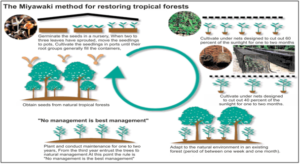
- Development: This method of afforestation was developed by renowned Japanese botanist Akira Miyawaki in the 1970s.
- Nature: It is a revolutionary method for creating dense forests in limited spaces.
- Other names: It is also referred to as the ‘pot plantation method’, it involves planting trees and shrubs close to one another to accelerate their growth.
- Growth trajectory: The competition for sunlight encourages trees to grow more vertically and less laterally.
-
- Significance: It emphasizes planting only plant species native to the local area. This fosters a more resilient and naturally balanced ecosystem. Plants grow 10 times faster with this technique, making it a practical solution for urban areas.
- Similar to primordial forests: They are much denser and house much more biodiversity, just like ancient, primordial forests.
- Self-sustaining: For the first two to three years, the forest requires regular watering, weeding, and monitoring. After this period, the forest becomes self-sustaining and requires minimal intervention.
- Advantages:
-
-
- It improves soil quality, enhances biodiversity, and accelerates forest development.
- Trees planted using the Miyawaki technique absorb more carbon, grow faster, and support richer biodiversity compared to traditional forests.
-
- In urban settings, this technique has transformed polluted, barren lands into green ecosystems.
-
-
- It has successfully managed industrial waste, reduced dust and foul odours, and curbed air and water pollution.
-
- Additionally, it prevents soil erosion and promotes ecological balance, making it an effective tool for environmental restoration.
Sources:
Category: Miscellaneous
Context:
- NITI Aayog recently released the Export Preparedness Index 2024, a comprehensive assessment of export readiness across India’s States and Union Territories (UTs).
About Export Preparedness Index (EPI):
- Nature: It is a comprehensive assessment of export readiness across India’s States and Union Territories (UTs).
- Significance: It recognises the diversity of subnational economic structures and their critical role in advancing India’s global trade ambitions.
- First edition: The first edition of the EPI was published in August 2020 and this is the 4th edition.
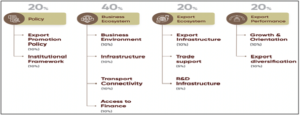
- Framework: It is structured around four pillars, further disaggregated into 13 sub-pillars and 70 indicators. Four Pillars are:
- Export Infrastructure (20% Weightage)
- Business Ecosystem (40% Weightage)
- Policy and Governance (20% Weightage)
- Export Performance (20% Weightage)
- Classification of States and Union Territories: States and UTs have been categorised into Large States & Small States, North East States and Union Territories. Within each category, they are further classified as
- Leaders: States/UTs demonstrating relatively high export preparedness
- Challengers: States/UTs with moderate preparedness and scope for improvement
- Aspirers: States/UTs at early stages of export ecosystem development
- Key highlights of EPI 2024: Under EPI 2024, the following States and UTs have emerged as leading performers in their respective categories:
- Leading Performers (Large States): Maharashtra, Tamil Nadu, Gujarat, Uttar Pradesh, Andhra Pradesh
- Leading Performers (Small States, North Eastern States & Union Territories): Uttarakhand, Jammu and Kashmir, Nagaland, Dadra and Nagar Haveli & Daman and Diu, Goa.
Source:
Category: Government Schemes
Context:
- Recently, the Pension Fund Regulatory and Development Authority (PFRDA) has issued the NPS Vatsalya Scheme Guidelines 2025.

About NPS Vatsalya Scheme:
- Nature: It is a contributory savings and long-term financial security scheme designed exclusively for minors.
- Regulatory Body: It is regulated and administered by the Pension Fund Regulatory and Development Authority (PFRDA).
- Eligibility: It is open to all Indian citizens, including NRI/OCI, below 18 years of age.
- Account Operation: Account is opened in the name of the minor and is operated by the guardian.
-
- Contribution: Minimum initial and annual contribution is ₹250 and there is no maximum limit on contribution. The contribution can also be gifted by relatives and friends.
- Pension Fund Selection: Guardian can choose any one Pension Fund registered with PFRDA for this purpose.
- Withdrawal Provisions:
-
-
- Partial Withdrawal: It is allowed after 3 years for specific purposes like education, medical treatment, or disability (up to 25% of own contributions).
- Exit at 18: If the subscriber exits at 18, at least 80% of the corpus must be used to purchase an annuity, while 20% can be a lump sum (if the total corpus is ≤ ₹2.5 lakh, a full lump sum is allowed).
-
- Significance:
-
- Financial Inclusion: Expands the pension net to the younger population, ensuring “Viksit Bharat@2047” goals of a pensioned society.
- Intergenerational Equity: Promotes wealth accumulation through the power of compounding over decades.
- Social Security: Addresses long-term financial risks for minors, providing a cushion for retirement long before they enter the workforce.
Source:
Category: Science and Technology
Context:
- Recently, astronomers studied the L328 molecular cloud, located around 700 light years away, to map the magnetic fields at multiple scales.

About Molecular Cloud:
- Nature: It is an interstellar cloud of gas and dust in which molecules can form, the most common of which is hydrogen (H2).
- Characterization: These are characterized by their low temperatures (below 40 K, colder than liquid nitrogen) and relatively high densities (103–104 particles per cubic cm).
- Size: The size of these clouds can be from a few light years up to 600 light years. Their total mass can reach several million solar masses. Molecular clouds with dimensions of more than about 15 light years are also called giant molecular clouds.
- Observation: Because dust blocks visible light, they appear as dark patches (Dark Nebulae). Astronomers use radio and infrared telescopes to peer through the dust.
- Mechanism: The complex interplay between three key forces, namely gravity, magnetic fields, and turbulence, determines how these clouds collapse to form stars. The central regions of these clouds are completely hidden from view by dust.
- Longevity: These clouds do not last for a very long time. After the new stars are born, their solar winds blow away the remaining gas and dust.
- Significance: Molecular clouds are so important because they are the raw material of stars and planets. It is thought to be the birthplace of stars and planetary systems through processes of contraction, condensation, and accretion.
Source:
Category: Geography
Context:
- The awaited Chadar trek on the frozen Zanskar river in Ladakh has been deferred due to inadequate ice formation, disappointing trekkers and adventure sports enthusiasts.
About Zanskar River:
-
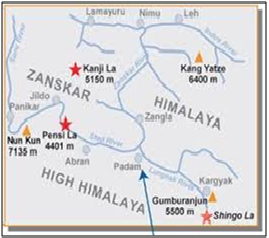
- Location: It is a major left-bank tributary of the Indus River, flowing entirely within the union territory of Ladakh in northern India. It drains the remote Zanskar Valley in the northwestern Himalayas.
- Course: The Zanskar River starts high in the Himalayas. It has two main branches; one is Doda, with main source near Pansi-La Pass, and the other branch is formed by the Kargyag River (source near Shingo La) and the Tsarap River (source near Baralacha La).
- Gorge: The river meanders northwestwards and finally meets the Indus River near Nimmu of the Ladakh region at an elevation of about 3,100 meters. It is famous for its incredible Zanskar Gorge, which is a super deep canyon it has carved over many years.
- Structure of valley: The entire catchment area of the Zanskar River has been formed by the action of glaciers. Its valley is U-shaped, and a number of hanging valleys open into it.
- Significance: In the summer season, tourists can embark on river rafting trips, especially in the stretches between Chilling and Nimmu. Winter brings a unique and thrilling experience of walking along the frozen river of Zanskar, which is often called ‘Chadar Trek’.
Source:
(MAINS Focus)
GS-III: Infrastructure: Energy; Conservation; Environmental pollution and degradation; Science and Technology—developments and their applications in energy and resource utilisation.
Context (Introduction)
India’s clean energy transition—covering renewables, electric mobility, battery storage, and green hydrogen—is critically dependent on imported critical minerals and rare earths. With China tightening export controls and global supply chains becoming geopolitically fragile, minerals diplomacy has emerged as a strategic economic and energy-security priority for India.
Core Idea / Definition
Minerals diplomacy refers to the use of foreign partnerships, investments, and standards-based cooperation to secure reliable access to critical minerals (lithium, cobalt, nickel, rare earths) essential for the energy transition, while simultaneously building domestic processing and value-chain resilience.
India’s current approach reflects a two-pronged strategy:
- External diversification of supply sources
- Internal capacity building across mining, refining, recycling and manufacturing
Key Challenges
- Overdependence on China: China dominates rare-earth processing and refining, creating strategic vulnerabilities for India’s clean-energy ambitions.
- Extraction without value addition risk: Many partnerships remain resource-access focused, lacking commitments on processing, refining and technology transfer.
- Fragmented institutional depth: While India has signed multiple bilateral and multilateral agreements, long-term implementation frameworks and financing mechanisms remain weak.
- Geopolitical volatility of partners:
- U.S. trade unpredictability (tariffs, IRA-linked incentives) complicates cooperation
- Russia faces sanctions and logistics constraints useful as a hedge, not a foundation
- Weak domestic midstream capability: Absence of large-scale refining, recycling and battery-grade processing exposes India to choke points even after securing raw materials.
Why It Matters
- Energy security: Critical minerals are as strategic today as oil was in the 20th century
- Industrial competitiveness: EVs, batteries, semiconductors and renewables depend on mineral supply chains
- Strategic autonomy: Supply resilience reduces coercive leverage by dominant producers
- Clean transition credibility: Without minerals, net-zero targets remain aspirational
India’s Emerging Partnership Landscape
- Australia: Stable partner; India–Australia Critical Minerals Investment Partnership (lithium, cobalt)
- Africa: Namibia (lithium, rare earths, uranium), Zambia (copper, cobalt) rising focus on local value creation
- Latin America: Argentina (₹200 crore KABIL exploration deal), Chile, Peru, Brazil — new frontiers
- Canada: Nickel, cobalt, copper, rare earths; trilateral agreements with India & Australia
- EU: Critical Raw Materials Act, European Battery Alliance—emphasis on transparency, lifecycle standards, ESG
- Japan: Model of stockpiling, recycling and long-term R&D–led resilience
Way Forward
- Move from access to integration: Shift focus from mining contracts to value-chain partnerships covering refining, recycling and battery materials.
- Build domestic midstream capacity: Prioritise refining, separation technologies and battery recycling to reduce processing dependence.
- Country-by-country strategy
- Africa, Australia, Latin America: upstream extraction
- West Asia & Japan: midstream processing
- EU & U.S.: downstream technology, batteries, recycling
- Institutionalise minerals diplomacy: Leverage initiatives like KABIL, TRUST Initiative, Strategic Minerals Recovery Initiative with long-term financing and execution capacity.
- Strengthen ESG and transparency: Align domestic mining with environmental, social and governance (ESG) norms to enhance credibility in global partnerships.
Conclusion
India has built an impressive web of critical mineral partnerships, but securing ores alone is insufficient. The real strategic test lies in processing, technology, and long-term certainty. A value-chain–oriented minerals diplomacy, aligned with domestic industrial capacity and global sustainability norms, is indispensable for India’s energy security, clean transition and strategic autonomy in an era of resource geopolitics.
Mains Question
- In the context of India’s clean-energy transition, access to critical minerals has emerged as a strategic constraint rather than a mere resource challenge. Critically examine India’s minerals diplomacy in securing energy security and industrial competitiveness. Why is a shift from extraction-centric agreements to integrated value-chain partnerships essential for reducing strategic vulnerabilities? (250 words, 15 marks)

GS-II: India and its relations with other countries; bilateral, regional and global groupings and agreements involving India and/or affecting India’s interests
Context (Introduction)
The global trade and geopolitical environment have entered a phase of heightened unpredictability, marked by renewed U.S.–China trade tensions, tariff shocks, supply-chain reorientation and slowing global growth. In this context, the stalled India–European Union Free Trade Agreement (EU FTA) has regained strategic urgency, especially as Europe seeks diversified partners and India aims to insulate itself from external volatility.
Core Idea
The EU FTA is no longer merely a trade agreement; it is a strategic economic stabiliser for India. With the U.S. economy showing structural imbalances, tariff-driven inflation risks, and China’s long-term growth decelerating, India must pivot towards rules-based, high-value trade partnerships that offer technology, investment, and services access—areas where the EU is uniquely positioned.
Key Challenges
- Trade uncertainty due to Trump-era tariff politics and reciprocal tariff risks
- Over-dependence on U.S. demand, especially in services
- China’s export diversion, distorting global trade flows
- Long-standing EU concerns on labour and environmental standards delaying FTA conclusion
- Under-utilisation of services trade and investment chapters in India’s FTAs
Why the EU FTA Matters for India
- The EU is India’s 4th largest trading partner and a major FDI source
- Cumulative EU FDI ≈ $120 billion by 2024, concentrated in electronics, infrastructure, manufacturing
- Germany’s leadership in the EU aligns with India’s priorities in advanced manufacturing, green tech, Industry 4.0
- Potential to deepen Mode 4 (skilled mobility) commitments, especially through Germany’s Skilled Immigration Act
- Shifts focus from tariff reduction to services trade, technology transfer and investment facilitation
Way Forward
- Fast-track India–EU FTA with flexible solutions on sustainability clauses
- Prioritise services, digital trade, investment protection and skilled mobility
- Leverage Germany as the technology and manufacturing anchor within the EU
- Align FTA outcomes with Make in India, PLI and supply-chain resilience goals
- Use the FTA to hedge against U.S. protectionism and China-centric trade risks
Conclusion
In an era of fragmented globalisation, accelerating the India–EU FTA offers India a path toward trade diversification, investment stability and strategic autonomy. Moving decisively now can transform the agreement from a delayed negotiation into a cornerstone of India’s long-term economic diplomacy.
Mains Question
- The shifting contours of global trade—marked by protectionism, trade diversion and geopolitical uncertainty have altered the strategic value of free trade agreements. In this context, critically examine why accelerating the India–European Union Free Trade Agreement (EU FTA) has become imperative for India’s economic diplomacy? (250 words, 15 marks)