

Archives
(PRELIMS Focus)
Category: International Organisations
Context:
- Recently, India reaffirmed its commitment to the ideals of Vasudhaiva Kutumbakam at the 11th United Nations Alliance of Civilizations, UNAOC, forum in Riyadh.
About United Nations Alliance of Civilizations (UNAOC):
- Establishment: It was established in 2005, as the political initiative of Mr. Kofi Annan, former UN Secretary-General. It was co-sponsored by the Governments of Spain and Türkiye.
- Objective: It was created to serve as a soft-power political tool of the United Nations Secretary-General for conflict prevention and conflict resolution.
- Headquarters: Its headquarters is located in New York, USA.
- Functions: It maintains a global network of partners including states, international and regional organizations, civil society groups, foundations, and the private sector to improve cross-cultural relations between diverse nations and communities.
- Governance: The Global Forum is the highest-profile event of the UNAOC which brings together prominent personalities, current and potential partners, and others from different sectors.
- Funding: The Secretary-General has established a voluntary Trust Fund for UNAOC. This fund supports the UNAOC projects, activities and outreach, undertaken by the High Representative for the United Nations Alliance of Civilizations in his official capacity, and core operational and human resources needs.
- Administration: The Trust Fund for UNAOC is administered by the United Nations Secretariat in accordance with the United Nations Financial Regulations and Rules. UNAOC also receives voluntary contributions from member states, international organizations, private sector and foundations.
About UNAOC 2025 (11th Edition):
-
- Host: It was hosted by Saudi Arabia, Riyadh.
- Theme: Its theme was “UNAOC: Two Decades of Dialogue for Humanity—Advancing a New Era of Mutual Respect and Understanding in a Multipolar World.”
- Key highlights of the 11th edition:
-
- It renewed global commitment to dialogue, mutual respect, and religious harmony amid conflicts and trust deficits in multilateralism.
- It marked 20 years of UNAOC, setting the course for its third decade.
- It witnessed broad participation of political leaders, international organizations, religious and faith actors, youth, civil society, media, arts and sports to advance peacebuilding through dialogue.
Source:
Category: Environment and Ecology
Context:
- Community-led conservation efforts at the Chakrashila Wildlife Sanctuary have successfully restored wild honey bee colonies and revitalized associated wildlife.
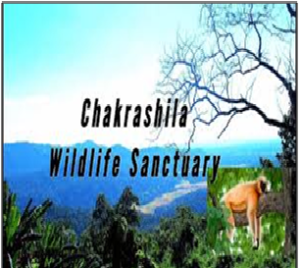
About Chakrashila Wildlife Sanctuary:
- Location: It is locatеd in thе Kokrajhar and Dhubri districts of Assam.
- Area: It spans over 45.5 sq.km. of hilly tеrrain and dеnsе forеsts.
- Establishment: It was first declared a reserve forest in 1966 and upgraded to a wildlife sanctuary in 1994.
- Lakes: There are two lakes (Dheer Beel and Diplai Beel) on either side, which are integral to the ecosystem of the sanctuary.
- Flora: The vegetation of the sanctuary is predominantly tropical moist deciduous forests, mixed deciduous forests, and semi-evergreen forests. Sal tree is a dominant tree in this forest.
- Fauna: It is home to various species, including elephants, tigers, leopards, clouded leopards, sambar deer, barking deer, and gaur. The sanctuary is also home to several species of birds, including the endangered Bengal Florican, Great Hornbill, and White-winged Wood Duck.
- Significance: The sanctuary is the second protected habitat for the endangered golden langur (Trachypithecus geei), a rare primate species endemic to the Indo-Bhutan border region.
Source:
Category: Defence and Security
Context:
- Indian Army is undertaking a strategic shift in its air defence operations, repurposing its MANPADS to specifically counter the rising threat of sub-sonic cruise missiles.
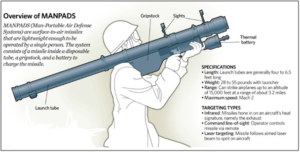
About MANPADS:
- Full form: MANPADS stands for Man-Portable Air Defence Systems.
- Nature: MANPADS are surface-to-air missiles that can be fired by an individual or a small team of people against aircraft. These weapon systems often are described as shoulder-fired anti-aircraft missiles.
- Structure: MANPADS are generally less than 2 metres in length and weigh approximately 10–20 kg,
- Range: MANPADS are most effective against low-flying aircraft (helicopters, UAVs, and cruise missiles) within a range of 8 km and an altitude of up to 4.5 km.
- First deployment: The United States and the Soviet Union first deployed MANPADS—the Redeye and Strela systems, respectively—in the 1960s to provide their infantries with portable anti-aircraft weapons.
- Global operation: The militaries of about 105 countries across the world operate MANPADS, although only 12 countries, including India, produce them.
- Famous varieties: The most famous MANPADS are the US-made ‘Stinger’ and the Soviet 9K32 Strela-2, or simply ‘SA-7′ with the China-made ‘FN-16’ being the latest entrant.
- Types: Three general types of MANPADS exist: command line of sight, laser guided, and infrared seekers.
- Command line-of-sight MANPADS are guided to their targets through the use of a remote control.
- Laser-guided or laser beam rider MANPADS follow a laser projected onto the target.
- The most common MANPADS, frequently called heat seeking missiles, however, are infrared seekers that acquire their target by detecting the heat of an aircraft’s engine.
- India’s MANPADS arsenal: India is one of the 12 countries that produce these systems.
- Igla-S: A Russian-origin system recently inducted to replace the aging Igla-M. It has a range of up to 6 km.
- VSHORADS: An indigenously developed system by DRDO (Research Centre Imarat). As of now, it has undergone successful flight trials to neutralize drones and low-altitude threats.
Source:
Category: Science and Technology
Context:
- ISRO is scheduled to launch the US-based commercial BlueBird-6 satellite developed by US-based AST Spacemobile in December 2025 using ISRO’s LVM-3 rocket.
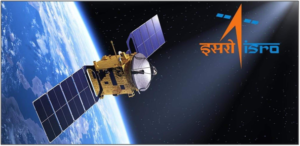
About Bluebird 6 Satellite:
- Nature: It is a heavy-lift commercial communication satellite designed to provide direct-to-mobile broadband connectivity.
- Origin: It is developed by the US-based commercial company AST SpaceMobile for global mobile coverage.
- Objective: It is designed to provide direct-to-device internet connectivity, enabling mobile phones to access broadband without relying on traditional cell towers.
- Mission Agency: It will be launched by ISRO via its commercial arm, NewSpace India Limited (NSIL).
- Launch Vehicle: It will be launched using LVM3 (formerly GSLV Mk-III), also known as “Bahubali”.
- Structure: It weighs around 6.5 tonnes, making it one of the heaviest satellites launched by ISRO.
- Orbit: It will operate in low-Earth orbit (LEO) to cover large regions of the Earth efficiently.
- Technology: It features one of the largest phased array antennas ever flown, which covers nearly 2,400 square feet, allowing it to communicate directly with standard mobile phones.
- Capacity: It is part of the “Block-2” series, offering up to 10,000 MHz of bandwidth and 10x higher data capacity than previous generations.
- Collaboration: It represents a significant step in Indo-US space cooperation and commercial space ventures.
- Significance: It enhances global mobile broadband connectivity, especially in remote and rural areas. Further, It is expected to help bridge the digital divide, providing internet access to regions without cellular infrastructure.
Source:
Category: Society
Context:
- Recently, members of Dandami Madia tribe performed the traditional Bison Horn Maria dance at village festivals in Jagdalpur, Chhattisgarh.
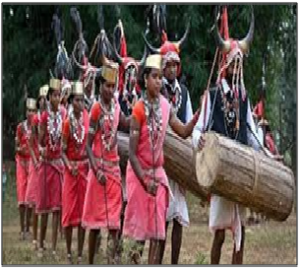
About Dandami Madia Tribe:
- Location: It is a tribal community which lives in Chhattisgarh.
- Nomenclature: They have derived their name from their unique custom of wearing a distinctive head-gear, which resembles the horns of a wild bison. They generally wear that head-gear during ceremonies.
- Other names: It is also known by other names like Bison Horn Maria and Khalpati Maria.
- Tradition: They identify themselves as part of the larger Gond tradition.
- Dance: They perform the traditional Bison Horn Maria dance during a village festival. It is performed by both men and women.
- Economy: They live by agriculture, supplemented by hunting and fishing.
- Belief: Their belief is a combination of Hinduism with Animistic beliefs.
- Marital norms: They permit divorce and widow remarriage.
- Uniqueness: Their ghotul (youth dormitory for unmarried boys and girls) is an important social institution.
- Language: The main distinct language spoken by this tribe is Dandami Maria. Some of them speak Gondi dialects, which is an oral language of Dravidian origins.
Source:
(MAINS Focus)
(UPSC GS Paper III – Infrastructure: Energy; Investment Models; Science and Technology; Regulatory Frameworks)
Context (Introduction)
Nuclear power contributes only about 3% of India’s electricity generation, yet the government has set an ambitious target of installing 100 GW of nuclear capacity by 2047. The proposed SHANTI Bill seeks to enable private participation in civil nuclear energy to mobilise capital, reduce project risks, and accelerate capacity expansion, including through indigenous small modular reactors.
Rationale Behind the SHANTI Bill
- Need for Capital Mobilisation: Achieving the 100 GW target requires large-scale capital investment, which cannot be met by public resources alone.
- Expansion of Eligible Operators: Allowing licensed government entities, joint ventures, and private companies broadens the pool of project developers and distributes construction risk.
- Controlled Private Participation: Sensitive nuclear fuel cycle activities remain under state control, while private participation is limited to plant construction, operation, and parts of the supply chain relevant to power generation.
- Legal Clarity for Investors: Consolidating safety, enforcement, dispute resolution, and participation terms within a single statute reduces regulatory ambiguity for new entrants.
- Reduced Project Delays: Streamlined approvals and clearer liability structures can lower transaction costs and shorten commissioning timelines.
Key Challenges and Concerns
- Inadequate Liability Cap: The operator liability ceiling of ₹3,000 crore raises concerns about sufficiency for victim compensation and environmental remediation in the event of a major nuclear accident.
- Asymmetric Public Accountability: Exemption of central government nuclear installations from mandatory insurance or financial security necessitates stronger public accounting and transparency.
- Weak Supplier Accountability: Operator recourse against suppliers depends largely on contractual terms, leading to uneven accountability across projects.
- Regulatory Independence Deficit: Significant executive influence over appointments to the nuclear regulator and the Atomic Energy Commission undermines institutional autonomy.
- Public Trust and Investor Confidence: Limited regulatory independence risks eroding public confidence in nuclear safety and may deter long-term private investment.
Way Forward
- Strengthen Regulatory Autonomy: Ensure functional and appointment-level independence of the nuclear regulator from executive control.
- Revisit Liability Framework: Align liability limits with international best practices to balance investor certainty with adequate victim compensation.
- Standardise Supplier Liability: Establish minimum statutory supplier accountability norms beyond contractual arrangements.
- Enhance Transparency: Mandate uniform financial disclosure and risk coverage for both public and private nuclear installations.
- Build Public Confidence: Embed safety oversight, accountability, and grievance redress mechanisms to sustain social acceptance of nuclear expansion.
Mains Question
- “Private participation is critical for scaling nuclear power in India, but regulatory independence remains a prerequisite for safety and public trust.” Examine the implications of the SHANTI Bill in this context. (250 words, 15 marks)
(UPSC GS Paper II – International Relations: India–USA Relations; Global Strategic Architecture)
Context (Introduction)
In 2005, India–U.S. relations entered a transformative phase with Washington explicitly supporting India’s rise as a major global power. The 2025 U.S. National Security Strategy (NSS), however, signals a retreat from this internationalist vision, redefining partnerships through the lens of burden-sharing, strategic selectivity, and inward-looking realism.
2005 Moment: Strategic Optimism and Partnership
- Shared Confidence: The U.S. belief that strengthening rising powers would reinforce global stability underpinned the civil nuclear agreement and strategic partnership.
- India as an End in Itself: India’s rise was viewed as intrinsically valuable, not merely instrumental to counterbalancing another power.
- Internationalist Outlook: Washington embraced global leadership and institutional engagement as assets rather than liabilities.
- Strategic Autonomy Respected: India’s insistence on autonomy was accommodated within a framework of expanding cooperation.
- Civil Nuclear Breakthrough: Symbolised trust, long-term commitment, and widening strategic horizons on both sides.
2025 Shift: Retrenchment and Instrumentalism
- Burden Minimisation: The NSS explicitly rejects the role of the U.S. as the primary guarantor of global order, emphasising cost reduction.
- India as a Strategic Function: Cooperation with India is framed mainly in terms of its utility within the Indo-Pacific and China strategy.
- Conditional Partnership: Support is linked to India assuming greater regional responsibility, signalling reduced U.S. strategic investment.
- Hemispheric Inward Turn: Emphasis on enforcing exclusivity in the Western Hemisphere reflects a narrower geopolitical focus.
- Performative Strategy: The NSS prioritises domestic reassurance and political signalling over deep engagement with global complexities.
Implications for India
- End of Assumptive Support: India can no longer presume that the U.S. will actively enable its rise as a strategic objective.
- Selective Convergence: Cooperation will persist where interests align but will be transactional and issue-specific.
- Greater Strategic Responsibility: India must increasingly manage its regional security and geopolitical environment independently.
- Autonomy Revalidated: The U.S. embrace of unilateral realism ironically legitimises India’s long-standing emphasis on strategic autonomy.
- Expanded Strategic Space: Reduced American commitments create room for India to shape outcomes aligned with its own priorities.
Way Forward for India
- Build Internal Capacity:India’s rise must rest on economic strength, technological capability, and military preparedness.
• Calibrated Partnership: Engage the U.S. pragmatically without anchoring India’s strategic future to American preferences.
• Multi-Alignment: Deepen ties with Europe, Russia, Japan, ASEAN, and the Global South to hedge against strategic uncertainty.
• Regional Leadership: Assume responsibility in the Indo-Pacific and South Asia on India’s own terms.
• Civilisational Confidence: Craft a global role consistent with India’s scale, interests, and historical worldview.
Conclusion
The contrast between 2005 and 2025 marks a shift from shared optimism to asymmetric expectations. While India–U.S. cooperation remains important, the foundation has changed. India’s emergence as a major power will now depend less on external endorsement and more on its own strategic confidence and material capability.
Mains Question
- “The evolution of India–U.S. relations from 2005 to 2025 reflects a shift from strategic optimism to selective partnership.” Analyse the implications of this shift for India’s foreign policy choices. (250 words, 15 marks