

Archives
(PRELIMS Focus)
Category: History and Culture
Context:
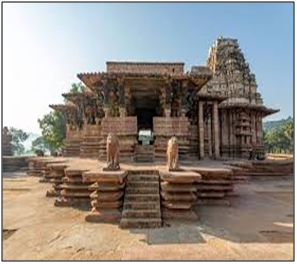
- Recently, Ambassador and Permanent Representative of India to UNESCO-Paris visited the Rudreswara (Ramappa) Temple, in Palampet village of Mulugu district.
About Ramappa Temple:
- Location: It is located in the state of Telangana.
- Construction: It was constructed in 1213 AD during the reign of the Kakatiya Empire by RecharlaRudra, a general of Kakatiya king Ganapati Deva.
- Presiding deity: The presiding deity here is Ramalingeswara Swamy.
- Other names: It is also known as the Rudreswara Temple.
- Uniqueness: It is probably the only temple in India that is named after the architect. The temple got its name Ramappa because of its chief sculptor Ramappa.
- Structure: The temple stands on a 6 feet high star-shaped platform (Upapitha) with walls, pillars and ceilings adorned with intricate carvings.
- Use of sandbox technique: The temple construction was done using the sandbox technique. This is a technique where the foundation pit is filled with a mixture of sand-lime, jaggery and black myrobalan fruit.
- Earthquake-proof: It is made out of clay mixed with acacia wood, chaff and myrobalan fruit (a family of amla), and the bricks used in building the gopuram of the temple are light enough to float on water. Using this technique has made the temple light, meaning, in case of a natural event like an earthquake, the probability of it collapsing would be very low.
- Historical Recognition: The traveller Marco Polo reportedly described it as the “brightest star in the galaxy of temples”.
- Significance: In 2021, the temple was inscribed as a UNESCO World Heritage Site as “Kakatiya Rudreshwara (Ramappa) Temple, Telangana”.
Source:
Category: Science and Technology
Context:
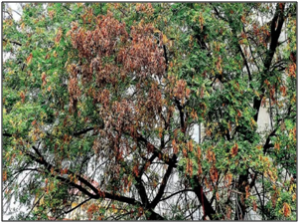
- The withering of thousands of neem trees prompted the Mulugu-based FCRI to launch a comprehensive scientific probe into the devastating “dieback disease.”
About Dieback Disease:
- Genus: The dieback fungus belongs to the genus Phytophthora.
- First case: It was first reported in the country during the 1990s near Dehradun in Uttarakhand.
- Causing agent: It is a fungal disease which kills a wide variety of plants.
- Transmission: The fungus is spread through the movement of soil and mud, especially by vehicles and footwear. It also moves in free water and via root-to root contact between plants.
- Infected parts: The fungus lives in susceptible plant tissue and soil, and migrates and reproduces in warm, moist conditions. Infected roots cannot provide the water and nutrients needed to maintain life, and the plants die from dehydration.
- Symptoms: It is responsible for causing wilting and browning of leaves from the tip of the branch, stem canker, and fruit rot. It causes almost 100% loss of fruit production in severely infected trees.
- Impact on native vegetation: Where the disease occurs, the native vegetation can become devastated, and the delicate fabric of ecosystems seriously impaired; certain species can disappear from the area.
- Timeline: The symptoms usually appear with the monsoon (warm and humid conditions) and worsen through late rainy season into early winter.
- Detection: Dieback is not easy to detect, as infected plants often appear to be dying from drought.
- Treatment: Currently, there is no known cure for the disease.
- Prevention: The strategies for prevention include:
- Pruning: Cutting and destroying infected twigs to stop the spread.
- Chemical Treatment: Spraying a blend of fungicide and insecticide after pruning or applying it to the soil around the base of small plants.
- Biological Control: Treating seeds with bio-agents like Trichoderma.
- Cluster Approach: Since the fungus can be airborne or spread by insects, community-level efforts in specific localities are more effective than treating isolated trees.
Source:
Category: Environment and Ecology
Context:
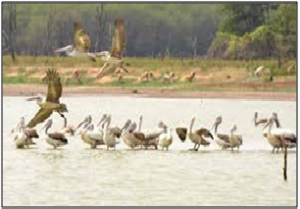
- Migratory birds have begun arriving at the Vellode Bird Sanctuary at Vadamugam Vellode, as it serves as a breeding ground for both resident and migratory birds.
About Vellode Bird Sanctuary:
- Location: It is located in the Erode district of Tamil Nadu.
- Area: It was established in 1966 and it covers an area of around 0.77 sq km.
- Designation: It is built around the Periyakulam lake and has been designated a protected Ramsar site since 2022.
- Significance: It is part of an important migratory bird flyway (central Asian flyway). It also serves as a breeding ground for both resident and migratory birds.
- Source of water: The sanctuary receives rainfall from the Northeast monsoon between September and December. Seepage from the Lower Bhavani Project (LBP) canal and rainwater are the main sources of water during the migration period.
- Fauna: Migratory birds like Northern pintail, Northern Shoveler, Garganey, Blue tailed bee-eater, Wood Sandpiper, Common Sandpiper, Green Sandpiper, Chestnut tailed starling, Blyth’s warbler, Skyes warbler are seen here.
- Flora: The Site is also an ideal habitat for notable plant species including Cayratia pedata, Tephrosia purpurea and Commelina tricolor.
Source:
Category: Government Schemes
Context:
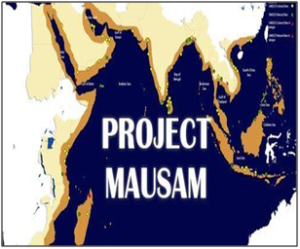
- Archaeological Survey of India organised a National Workshop on the Project Mausam titled as “Islands at the Crossroads of Maritime Networks within Indian Ocean Region.”
About Project Mausam:
-
- Nature: It is an Indian government-led cultural-diplomacy and maritime heritage initiative.
- Nodal ministry: It was launched in 2014 by the Ministry of Culture.
- Objective: It aims to explore the multi-faceted Indian Ocean ‘world‘ – collating archaeological and historical research in order to document the diversity of cultural, commercial, and religious interactions in the Indian Ocean.
- Countries involved: A total of 39 Indian Ocean littoral countries have been identified under Project Mausam.
- Significance: It serves as a tool for soft power diplomacy and counters historical narratives by focusing on shared Afro-Asian heritage.
- Implementation: The project is implemented by the Archaeological Survey of India (ASI) as the nodal agency with research support of the Indira Gandhi National Centre for the Arts (IGNCA) and National Museum as associate bodies.
- Working mechanism: The project will have two major units, viz. Project Research Unit and World Heritage Nomination Unit.
- Focus areas:
-
- To study and document the Indian Ocean “world” shaped by monsoon winds (Mausam).
- To prepare transnational nominations for the UNESCO World Heritage List, such as the “Routes followed by the Cholas” and the “Spread of Buddhism”.
- To promote research on themes related to the study of maritime routes through international scientific seminars and meetings and by adopting a multidisciplinary approach.
- To encourage the production of specialized works, as well as publications for the general public, with an attempt at promoting a broader understanding of the concept of a common heritage and multiple identities.
Source:
Category: Defence and Security
Context:
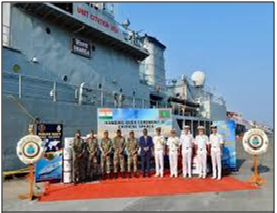
- Deputy Chief of the Naval Staff (DCNS), Indian Navy, is on an official visit to Maldives to attend the closing ceremony of Exercise Ekatha 2025.
About Exercise Ekatha:
-
- Countries involved: Exercise Ekatha is an annual bilateral maritime exercise between the Indian Navy and the Maldives National Defence Force (MNDF).
- Establishment: The exercise was first instituted in 2017 with the objective of strengthening maritime cooperation between India and Maldives.
- Objective: It aims to improve operational synergy in maritime and littoral environments by addressing shared regional maritime security challenges.
- Significance: It aligns with India’s vision of Mutual and Holistic Advancement for Security and Growth for All in the Region (MAHASAGAR) and the Neighbourhood First Policy.
- Focus Areas: It primarily focuses on enhancing interoperability in:
- Combat and technical diving operations.
- Special forces tactics and asymmetric warfare.
- Boarding operations and explosive handling.
- About Exercise Ekatha 2025:
-
- It was the eighth edition of the Exercise.
- The exercise witnessed extensive professional interactions aimed at enhancing interoperability and operational synergy.
- The activities included technical and combat diving, boarding operations, firing drills, demolition and explosive handling, asymmetric warfare tactics, and special heli-borne operation drills.
Source:
(MAINS Focus)
(UPSC GS Paper I – Society: Migration; GS Paper II – Polity: Elections, Representation, Federalism)
Context (Introduction)
India is witnessing unprecedented population mobility due to urbanisation, labour markets, education and marriage. With over one-third of Indians classified as migrants, migration is no longer marginal but a structural force reshaping democracy, representation, and governance.
Scale and Nature of Migration in India
- Magnitude: Census 2011 recorded 45.3 crore migrants, constituting 37.7% of India’s population, up from 31% in 2001.
- Internal Dominance: Over 99% of Indian migrants are internal migrants, making migration primarily a domestic governance challenge.
- Gender Composition: Around 68–70% of migrants are women, largely due to marriage, while male migration is predominantly economic.
- Economic Drivers: NSS and Periodic Labour Force Survey (PLFS) show employment and livelihood as the leading reasons for long-distance male migration.
Migration and Urbanisation Linkages
- Urban Pull: Economic Survey highlights that urban areas generate over 60% of GDP, accelerating rural-to-urban migration.
- City Transformation: Cities like Delhi, Mumbai, Bengaluru and Hyderabad have migrant populations exceeding 35–45%.
- Labour Dependence: Construction, manufacturing, logistics, domestic work and services are heavily migrant-dependent.
- Invisible Citizenship: Despite economic centrality, migrants remain politically under-represented in destination cities.
Citizenship–Territory Mismatch
- Territorial Assumption: Democratic rights presume stable residence within a fixed constituency.
- Mobility Reality: Migrants live, work and pay taxes in destination regions but vote (if at all) in source regions.
- Political Dislocation: This weakens accountability of urban local bodies and distorts representative democracy.
- Global Parallel: Similar challenges are visible in the U.S., EU, Gulf states and Southeast Asia, where mobility outpaces political inclusion.
Migration and Electoral Governance
- Electoral Roll Stress: Election Commission cites migration as a key cause of duplicate and outdated voter entries.
- Special Intensive Revision (SIR): Triggered by rapid mobility, urbanisation and multiple registrations across constituencies.
- Voting Exclusion: Migrant workers often fail to vote due to distance, documentation gaps and work constraints.
- Policy Gap: Unlike postal ballots for service voters, no nationwide migrant voting mechanism exists for internal migrants.
Migration and Federal Representation
- Uneven Flows: Bihar, Uttar Pradesh, Rajasthan and Odisha are net migrant-sending States, while Maharashtra, Delhi, Gujarat, Tamil Nadu and Kerala are net receivers.
- Political Consequence: Voting location determines political weight; migrants voting in source States dilute representation in destination States.
- Delimitation Impact: Post–Census 2027 delimitation will redistribute Lok Sabha seats, reflecting migration-driven population shifts.
- Silent Federal Shift: Migration is altering Centre–State political balance without explicit constitutional amendment.
Social and Political Dimensions
- Identity Politics: Migration reshapes language, culture and electoral strategies, reducing viability of rigid nativism over time.
- Urban Politics: Parties increasingly field migrant-origin candidates, reflecting demographic realities.
- Inequality Risk: Migrants often lack access to housing, healthcare, education and political voice despite economic contribution.
- Demographic Dividend: Migrant youth sustain ageing urban economies, making inclusion economically rational.
Key Challenges
- Political Exclusion: Large migrant populations remain weakly represented in local governance.
- Administrative Capacity: Tracking mobile populations strains electoral and welfare databases.
- Policy Fragmentation: Migration is addressed sectorally (labour, elections, housing) rather than holistically.
- Public Anxiety: Migration becomes politicised through fears of demographic change and “outsider” narratives.
Way Forward
- Recognise Migration as Structural: Treat mobility as a permanent feature of development, not an anomaly.
- Migrant Voting Reform: Explore secure absentee, remote or portable voting models for internal migrants.
- Data Integration: Use Census, Aadhaar-linked residence data (with safeguards) to update rolls without exclusion.
- Urban Political Inclusion: Strengthen local governance and service-based representation in migrant-heavy cities.
- National Migration Framework: Integrate labour, housing, welfare and political rights into a unified migration policy.
Conclusion
Migration is not merely a social phenomenon but a democratic force reshaping representation, federal balance and citizenship itself. India’s challenge is to adapt its political institutions to a mobile population without compromising inclusion, equity or democratic legitimacy.
Mains Question
“Internal migration has emerged as a structural force reshaping Indian democracy.” Analyse its implications for electoral governance, federal representation and political inclusion. (250 words, 15 marks)
Source: The Hindu
(UPSC GS Paper III – Environment, Conservation, Land Degradation, Climate Change)
Context (Introduction)
Judicial Intervention: In November 2025, the Supreme Court of India settled a long-standing ambiguity by adopting a uniform definition of the Aravalli hills and paused fresh mining leases across Delhi, Haryana, Rajasthan and Gujarat, responding to decades of ecological degradation and regulatory evasion.
Ecological Significance of the Aravalli Range
- Ancient Mountain System: One of the world’s oldest fold mountain ranges, nearly 2 billion years old, stretching ~650 km from Delhi to Gujarat.
- Desertification Barrier: Acts as a climatic shield, preventing the eastward expansion of the Thar Desert into Haryana, western Uttar Pradesh and the Indo-Gangetic plains.
- Groundwater Recharge: Supports aquifer systems and regulates hydrology in semi-arid regions with low rainfall.
- River Origins: Source region for rivers such as Chambal, Sabarmati and Luni, crucial for regional water security.
- Biodiversity Corridor: Hosts forest patches, wildlife corridors and tiger movement routes connecting Rajasthan and Madhya Pradesh ecosystems.
- International Commitments: India is obligated under the UN Convention to Combat Desertification (UNCCD) to protect ecologically fragile landscapes like the Aravallis.
Mining-Induced Degradation: The Core Challenge
- Excessive Quarrying: Four decades of legal and illegal mining for stone, sand and minerals caused habitat fragmentation and dust pollution.
- Air Quality Impact: Mining and stone-crushing worsened particulate pollution in NCR and adjoining regions.
- Water Table Decline: Removal of hill structures disrupted natural recharge, accelerating groundwater depletion.
- Regulatory Failure: Environmental restrictions imposed since the early 1990s were routinely violated at the State level.
Judicial and Institutional Responses
- 2009 Supreme Court Ban: Blanket prohibition on mining in Faridabad, Gurugram and Mewat (Haryana)due to rampant violations.
- 2024–25 Judicial Review: Supreme Court directed the Central Empowered Committee (CEC) to examine mining impacts across the entire Aravalli system.
- CEC Recommendations (2024):
- Scientific Mapping of the Aravalli range across States.
- Macro-Level Environmental Impact Assessment (cumulative, not project-wise).
- Absolute Mining Prohibition in ecologically sensitive zones — wildlife habitats, aquifer recharge areas, NCR region, water bodies.
- Strict Regulation of Stone-Crushing Units.
- Moratorium on New Mining Leases until mapping and assessments are completed.
- Judicial Acceptance: Supreme Court incorporated these recommendations in its November 2025 order.
Uniform Definition of the Aravalli Hills: Why It Matters
- Earlier Inconsistencies: States and agencies used divergent criteria, enabling regulatory arbitrage and illegal mining.
- Forest Survey of India (2010): Proposed slope-based and buffer-based definitions (slope >3°, foothill buffer 100 m, valley width 500 m).
- Expert Committee (2025): Included MoEFCC, FSI, Geological Survey of India, State Forest Departments and CEC.
- Final Judicial Definition: Hills above 100 metres elevation classified as Aravalli hills.
- Rationale: Court held this definition to be more inclusive, preventing exclusion of large hill systems while enabling enforceability.
- Criticism Addressed: Concerns about hills below 100 m being opened to mining were countered by broader ecological zoning and management planning.
Why the Supreme Court Did Not Impose a Total Mining Ban?
- Past Experience: Absolute bans historically fuelled illegal mining syndicates and sand mafias.
- Governance Reality: Enforcement gaps led to violence, corruption and ecological damage outside legal frameworks.
- Calibrated Approach:
- Existing legal mining continues under strict scrutiny.
- Fresh leases paused until scientific planning is completed.
- Permanent no-go zones demarcated for ecologically critical areas.
Management Plan for Sustainable Mining (MPSM): Court Directions
- Landscape-Level Planning: Entire Aravalli system to be treated as a single ecological unit.
- Zoning Framework:
- Absolute prohibition zones
- Highly regulated limited mining zones
- Ecological Carrying Capacity: Assessment before any activity approval.
- Wildlife and Habitat Mapping: Identification of corridors and breeding zones.
- Restoration Obligations: Mandatory mine reclamation and ecological rehabilitation.
- Enforcement Mechanisms: Monitoring, compliance audits and penalties.
Complementary Executive Initiative
- Aravalli Green Wall Project (2025):
- Expansion of green cover in a 5-km buffer zone across 29 districts of Delhi, Haryana, Rajasthan and Gujarat.
- Contribution to restoring 26 million hectares of degraded land by 2030, aligned with national land degradation neutrality goals.
Conclusion
The Supreme Court’s intervention marks a shift from fragmented regulation to science-based landscape governance. By rejecting both unregulated exploitation and blanket bans, the Court has prioritised ecological integrity, enforceability and livelihood concerns. Protecting the Aravallis is central to climate resilience, groundwater security and desertification control in northern and western India.
Mains Question
- “The Aravalli range plays a critical role in preventing desertification and maintaining ecological balance in northern India.” Examine the threats faced by the range and evaluate the recent judicial and policy measures taken for its protection. (250 words, 15 marks)
(UPSC GS Paper II – Indian Constitution, Fundamental Rights, Women and Vulnerable Sections)
Context (Introduction)
- Constitutional Framework: Articles 14, 15 and 21 of the Constitution guarantee equality, non-discrimination, dignity, privacy and bodily autonomy to all individuals, irrespective of marital status.
- Existing Legal Position: Section 63 of the Bharatiya Nyaya Sanhita (BNS), 2023 retains the marital rape exception, exempting husbands from prosecution for non-consensual sexual intercourse with adult wives.
- Contemporary Concern: The exception reflects colonial-era patriarchal assumptions and stands increasingly at odds with constitutional jurisprudence and social realities.
Main Arguments (Removing the Marital Rape Exception)
- Equality Before Law: The marital rape exception creates an unreasonable classification between married and unmarried women, violating Article 14, as recognised in multiple Supreme Court rulings emphasising substantive equality.
- Right to Life and Dignity: Article 21 jurisprudence after Puttaswamy (2017) and Joseph Shine (2018) affirms bodily autonomy and decisional privacy, which the exception negates by presuming perpetual consent within marriage.
- Empirical Evidence of Harm: NFHS-5 data shows that 83% of women aged 18–49 who experienced sexual violence reported their current husband as the perpetrator, establishing marital spaces as the primary site of sexual violence.
- Legal Inconsistency: While forced sexual intercourse by a husband is recognised as abuse under the Protection of Women from Domestic Violence Act, 2005, it is excluded from criminal accountability under rape law.
- Committee Recommendations: The Justice Verma Committee (2013) categorically recommended removal of the marital rape exception, stating that marriage cannot be a defence to sexual violence.
- International Commitments: India’s obligations under CEDAW require elimination of discrimination in marriage and family relations, and the continued exception places India in violation of these commitments.
- Changing Judicial Standards: The Supreme Court has repeatedly rejected notions of conjugal ownership over women’s bodies, notably in Independent Thought (2017) which read down marital immunity for minors.
Concerns and Counter-Arguments Raised
- Sanctity of Marriage Argument: Opponents argue that criminalisation may destabilise marital institutions, despite evidence that domestic violence laws have not led to societal breakdown.
- Misuse Concerns: Claims of false cases mirror earlier objections to dowry and domestic violence laws, though NCRB data consistently shows underreporting of sexual offences rather than overuse.
- Evidentiary Challenges: Difficulty of proof is cited, even though criminal law routinely adjudicates offences occurring in private spaces based on testimony and circumstantial evidence.
- Fear of Over-Criminalisation: Concerns persist that criminal law may be excessive, despite sexual violence already being recognised as a serious offence outside marriage.
Way Forward
- Legislative Amendment: Parliament must delete the marital rape exception from the Bharatiya Nyaya Sanhita to align criminal law with constitutional guarantees.
- Procedural Safeguards: Standard safeguards such as preliminary inquiry, medical evidence, and judicial scrutiny can address misuse concerns without denying justice.
- Institutional Sensitisation: Police, prosecutors and judges require training on consent-based adjudication and trauma-informed investigation.
- Holistic Support Systems: Legal reform must be accompanied by strengthened counselling, shelter, and victim compensation mechanisms.
- Normative Shift: Marriage must be legally and socially recognised as a partnership of equals, not a licence for sexual entitlement.
Conclusion
- Constitutional Morality Over Social Morality: No personal relationship can override fundamental rights guaranteed by the Constitution.
- Gender Justice Imperative: Retaining marital rape immunity perpetuates systemic violence against women and undermines the rule of law.
- Democratic Maturity: Criminalising marital rape is essential for India to uphold dignity, autonomy and equality in both law and practice.
Mains Question
- “The marital rape exception represents a conflict between constitutional morality and social conservatism.”
Examine the constitutional, legal and ethical arguments for its removal in India. (250 words, 15 marks)
Source: Indian Express