

Archives
(PRELIMS Focus)
Category: Environment and Ecology
Context:
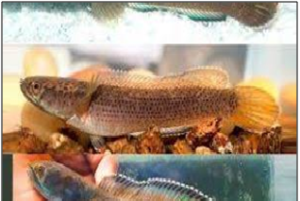
- Recently, scientists identified a new species of snakehead fish, Channa bhoi, in Meghalaya highlighting the state’s importance as a hub of freshwater biodiversity.
About Channa Bhoi:
- Nature: It is a new species of snakehead fish.
- Taxonomy: It belongs to the Channidae family and the Gachua group. Phylogenetic analysis identified it as a sister species to Channa bipuli, another snakehead found in Northeast India.
- Discovery: It was discovered from a small mountain stream near Iewmawlong village in the Ri-Bhoi district of Meghalaya.
- Nomenclature: It has been named Channa bhoi, after the indigenous Bhoi people of the Khasi tribe who inhabit the Ri-Bhoi region.
- Significance: The discovery brings the total number of Channa species recorded from India to 26.
- Uniqueness: It is characterised by a bluish-grey body marked with minute black spots on each scale, forming eight to nine horizontal rows of broken lines along the sides. It can be distinguished from its close relatives by a unique colour pattern.
- Physical Characteristics: It has a bluish-grey body with black spots forming broken lines and distinctive banding on its pectoral fins.
- Biodiversity Indicator: Their presence suggests healthy stream ecosystems.
- Concern: It faces threats from rat-hole coal mining runoff and the illegal international aquarium trade.
Source:
Category: Science and Technology
Context:
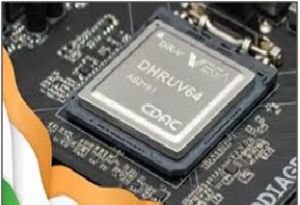
- India has achieved a significant milestone in its semiconductor journey with the launch of DHRUV64, which is a fully indigenous microprocessor developed by C-DAC.
About DHRUV64:
-
- Nature: DHRUV64 is a fully indigenously developed microprocessor of India.
- Development: It is developed by the Centre for Development of Advanced Computing (C-DAC) under the Microprocessor Development Programme (MDP).
- Uniqueness: It is India’s first homegrown 1.0 GHz, 64-bit dual-core microprocessor.
- Speed: It is a 64-bit dual-core processor running at 1.0 GHz, giving it the ability to handle multiple tasks smoothly.
- Execution technique: It uses superscalar execution, which allows the processor to start more than one instruction in the same moment for better speed.
- Packaging: It includes built-in communication and control functions inside an advanced FCBGA package, making the chip compact and ready for use in many systems.
- Indigenisation: It provides homegrown microprocessor technology designed for startups, academia, and industry to build, test, and scale indigenous computing products without relying on foreign processors.
- Improved efficiency: It supports out-of-order processing, meaning it can complete instructions that are ready first, improving overall efficiency.
- Significance: Following earlier processors like SHAKTI (IIT Madras) and AJIT (IIT Bombay), it paves the way for the upcoming Dhanush and Dhanush+ processors.
- Applications:
-
- It is capable of supporting strategic and commercial applications.
- It is suitable for sectors such as 5G infrastructure, automotive systems, consumer electronics, industrial automation and the Internet of Things (IoT).
- It supports prototype development for new system architectures at lower cost.
Source:
Category: Defence and Security
Context:
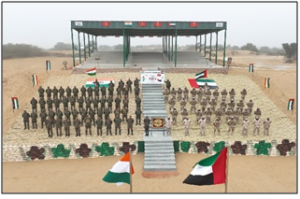
- Recently, an Indian Army contingent departed for the United Arab Emirates to participate in the second edition of the Joint Military Exercise Desert Cyclone II.
About Exercise Desert Cyclone II:
-
- Countries involved: Desert Cyclone II is the second edition of the India–U.A.E. Joint Military Exercise.
- Origin: The Exercise was first held in 2024 between the Indian Army and the U.A.E. Land Forces.
- Objective: The core objective of the exercise is to enhance interoperability and strengthen defence cooperation between the Indian Army and the U.A.E. Land Forces.
- Indian representation: The Indian contingent comprises 45 personnel, primarily drawn from a Mechanised Infantry Regiment battalion of the Indian Army.
- Follows UN mandate: The exercise focuses on sub-conventional operations in urban environments under a United Nations mandate, preparing forces for peacekeeping, counter-terrorism, and stability operations.
- Focus areas:
-
- Joint training includes fighting in built-up areas, heliborne operations, and detailed joint mission planning.
- A key feature is the integration of Unmanned Aerial Systems (UAS) and counter-UAS techniques for conducting urban military operations.
- It reflects deepening military diplomacy, shared strategic interests, and growing operational synergy between India and the U.A.E.
Source:
Category: Miscellaneous
Context:
- Portraits of all 21 Param Vir Chakra awardees are now on display at Rashtrapati Bhavan, replacing the previously displayed portraits of 96 British Aide-de-Camps.
About Param Vir Chakra (PVC):
- Establishment: It was introduced on January 26, 1950, on the first Republic Day with retrospective effect from 15 August 1947.
- Nomenclature: Literally, Param Vir Chakra means ‘Wheel (or Cross) of the Ultimate Brave’.
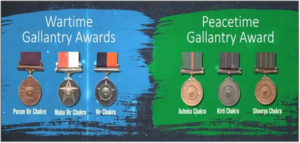
- Uniqueness: It is India’s highest military decoration, awarded for displaying the most exceptional acts of valour, courage, and self-sacrifice during war.
- Order of Precedence: It is followed by the Ashoka Chakra (peacetime), Maha Vir Chakra, Kirti Chakra, Vir Chakra, and Shaurya Chakra.
- Eligibility: It can be awarded to officers, men, and women of all ranks of the Army, the Navy, and the Air Force; of any of the Reserve Forces, of the Territorial Army Militia; and of any other lawfully constituted Armed Forces. It can be, and often has been, awarded posthumously.
- Similarity: It is similar to the British Victoria Cross, the US Medal of Honor, the French Legion of Honor, or the Russian Cross of St. George.
- Design: The medal was designed by Mrs. Savitri Khanolkar.
- Structure: The medal is cast in bronze and circular in shape. In the centre, on a raised circle, is the state emblem, surrounded by four replicas of Indra’s Vajra, flanked by the sword of Shivaji.
- First winner: Major Somnath Sharma, from the Kumaon regiment was the first recipient of the award for his actions in the 1947 Indo-Pak War.
- Recipients: Till now, only 21 people had been given the Param Vir Chakra award, of which 14 are posthumous.
Source:
Category: History and Culture
Context:
- Recently, Vice President of India released a commemorative postal stamp in honour of Emperor Perumbidugu Mutharaiyar II.
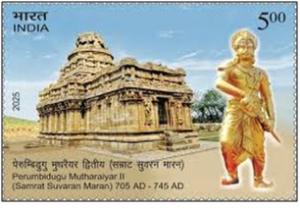
About Emperor Perumbidugu Mutharaiyar II:
- Dynasty: Perumbidugu Mutharaiyar belonged to the Mutharaiyar dynasty, which ruled central Tamil Nadu from 705 AD-745 AD.
- Other names: He was also known as ‘Suvaran Maran’ and ‘Shatrubhayankar.’
- Capital: He ruled primarily from Tiruchirappalli.
- Great administrator: He is believed to have fought bravely in several battles alongside the Pallava king Nandivarman, and is remembered as a great administrator.
- Patronage: He seems to have patronised Shaivya and other scholars, as a Jain monk Vimalachandra is mentioned as visiting his court to debate them.
- Political Status: Initially, the Mutharaiyars were powerful feudatories of the Pallavas. As Pallava central authority weakened, Perumbidugu II emerged as an influential regional power.
- Territorial extent: The Mutharaiyars held sway over areas including Thanjavur, Pudukkottai, Perambalur, Tiruchirappalli, and others near the Cauvery river.
- Cultural significance: As the feudatories of the Pallavas, the Mutharaiyars were great temple builders. Muttarayars were also engaged in cave temple enterprises up to the opening decades of the ninth century.
- Legacy: They acted as a bridge between Pallava and Chola traditions, especially in temple architecture and governance.
- Decline: The Mutharaiyar rule declined in the mid-9th century after Vijayalaya Chola captured Thanjavur, marking the rise of the Imperial Cholas.
Source:
(MAINS Focus)
(UPSC GS Paper III – Science & Technology: Indigenisation of Technology; Electronics and IT)
Context (Introduction) India’s launch of the DHRUV64 microprocessor marks a significant step in reducing dependence on imported semiconductor designs, strengthening strategic autonomy, supply-chain resilience, and long-term technological self-reliance in the electronics and industrial automation sectors.
Progress and Rationale Behind DHRUV64
- Indigenous Development Milestone: DHRUV64 is a fully indigenous 64-bit, dual-core microprocessor developed by C-DAC under MeitY’s Microprocessor Development Programme, reflecting sustained public investment in core computing technologies.
- Strategic Imperative: India is a major global consumer of chips but lacks control over processor IP, toolchains, and update pathways. Indigenous processors enhance security against export controls and geopolitical supply shocks.
- Targeted Use-Cases: With a 1 GHz clock speed, DHRUV64 is designed for telecom base stations, industrial controllers, routers, and automotive modules, where reliability and integration matter more than peak consumer performance.
- Ecosystem-Oriented Approach: MeitY positions DHRUV64 as a platform for startups, academia, and industry to prototype systems without reliance on foreign processors, recognising that processors succeed only with strong software–hardware ecosystems.
- Alignment with Open Standards: The chip is tied to the Digital India RISC-V (DIR-V) programme, leveraging open instruction sets to avoid licence dependencies and encourage modular, customisable designs.
India’s Broader Processor Ecosystem
- SHAKTI (IIT Madras): RISC-V–based processors focused on academic research, secure computing, and commercial deployment; supported under the National Mission on Interdisciplinary Cyber-Physical Systems.
- AJIT (IIT Bombay): Designed primarily for strategic and defence applications, emphasising reliability and deterministic performance.
- VIKRAM (ISRO–SCL): Radiation-hardened processors for spaceflight systems, underscoring India’s niche strengths in mission-critical electronics.
- THEJAS32/64 (C-DAC): Earlier DIR-V chips, with THEJAS64 fabricated at SCL Mohali, demonstrating incremental progress in domestic fabrication capabilities.
- Ecosystem Logic: Together, these processors cater to diverse needs—space, defence, industrial control, and embedded systems—indicating a portfolio-based strategy rather than a single “flagship” chip.
Key Information Gaps and Criticisms
- Lack of Performance Transparency: MeitY has not released benchmarks, cache architecture, memory controller details, I/O capabilities, or performance-per-watt metrics—critical for industrial and OEM adoption.
- Unclear Fabrication Details: The foundry, process node, yields, packaging, and reliability standards have not been disclosed, raising questions for telecom and automotive lifecycle requirements.
- Ambiguity of ‘Fully Indigenous’: It is unclear whether indigeneity refers only to instruction set usage or extends to microarchitecture, system-on-chip integration, toolchains, fabrication, and ownership of critical IP blocks.
- OEM Adoption Uncertainty: There is no clarity on developer boards, supported operating systems, security audits, or government-led anchor procurement to de-risk early adoption.
- Roadmap Risks: While DHANUSH (1.2 GHz, quad-core, ~28 nm) and DHANUSH+ (2 GHz, quad-core, ~14–16 nm) are announced, timelines and manufacturing readiness remain uncertain.
Government Schemes Supporting Indigenous Semiconductor Progress
- Chips to Startup Programme: ₹250 crore over five years to build skilled manpower and startup participation in chip design.
- Design Linked Incentive (DLI) Scheme: Financial incentives for domestic semiconductor design companies to reduce entry barriers and encourage innovation.
- INUP-i2i Initiative: Provides academic and startup access to national nanofabrication and characterisation facilities.
- India Semiconductor Mission (ISM): As of 2025, approved 10 projects across six States with investments of about ₹1.6 lakh crore, focusing on fabs, ATMP units, and ecosystem development.
- Strategic Focus Shift: From isolated chip launches towards system-on-chip families, reference designs, and integrated manufacturing–testing capacity.
Conclusion
DHRUV64 represents incremental but meaningful progress in India’s semiconductor journey. However, sustained success depends on transparency, ecosystem maturity, anchor demand, and scalable manufacturing—transforming indigenous processors from symbolic achievements into commercially and strategically viable technologies.
Mains Question
- Assess the significance of the DHRUV64 microprocessor in advancing India’s indigenous semiconductor ecosystem. What challenges must India overcome to translate such initiatives into sustainable technological self-reliance?(250 words, 15 marks)
Source : The Hindu
(UPSC GS Paper II – International Relations: Bilateral Relations; GS Paper III – Internal Security & Defence Cooperation)
Context (Introduction)
The ratification of the India–Russia Reciprocal Exchange of Logistics Support (RELOS) agreement institutionalises military logistics cooperation, expanding India’s operational reach from the Indo-Pacific to the Arctic while reinforcing its strategic autonomy in a multipolar world.
Main Arguments: Significance of RELOS for India–Russia Relations
- Institutionalising Defence Logistics Cooperation: RELOS establishes a formal framework for reciprocal access to military bases, ports, and airfields, governing refuelling, repairs, maintenance, and movement of troops, warships, and aircraft during exercises, training, and other mutually agreed operations.
- Enhancing India’s Strategic Reach: For India, access to Russian facilities—from Vladivostok in the Pacific to Murmansk in the Arctic—extends the Indian Navy’s and Air Force’s operational endurance during long-range deployments, particularly for Russian-origin platforms that dominate India’s defence inventory (nearly 60% by some estimates).
- Arctic and Indo-Pacific Convergence: RELOS aligns with India’s Arctic Policy (2022) by enabling logistical access near the Northern Sea Route, critical amid climate-induced opening of Arctic shipping lanes. Simultaneously, it complements India’s Indo-Pacific strategy by leveraging Russia’s vast Eurasian footprint without aligning with any single bloc.
- Support for Multipolarity: For Russia, reciprocal access to Indian ports and airfields strengthens its operational presence in the Indian Ocean Region (IOR), reinforcing Moscow’s vision of a multipolar order amid Western sanctions and strategic isolation.
- Operational Flexibility Beyond Combat: The agreement explicitly covers humanitarian assistance and disaster relief (HADR), joint exercises, and training, reflecting India’s preference for flexible, non-alliance-based security cooperation rather than treaty-bound military alliances.
Comparison with India’s Logistics Pacts with the U.S.
- Functional Similarity with Strategic Distinction: RELOS is comparable to LEMOA (2016) with the U.S., which enables reciprocal logistics support. However, unlike COMCASA (2018) and BECA (2020), RELOS does not involve encrypted communications or geospatial intelligence sharing, preserving India’s strategic autonomy.
- Balanced Hedging Strategy: While U.S. foundational agreements enhance interoperability within the QUAD framework to counterbalance China in the Indo-Pacific, RELOS demonstrates India’s parallel commitment to long-standing defence ties with Russia, avoiding exclusive alignment.
- Tailored to Bilateral Context: RELOS is customised to India–Russia defence cooperation, particularly relevant for sustaining Russian-origin equipment, unlike U.S. pacts which are oriented towards interoperability with American platforms and systems.
Criticisms and Strategic Concerns
- Geopolitical Signalling Risks: At a time of heightened Russia–West tensions, deeper military cooperation with Russia could invite diplomatic pressure on India from Western partners, especially amid sanctions regimes.
- Limited Interoperability Gains: Unlike COMCASA or BECA, RELOS does not significantly enhance network-centric warfare capabilities or intelligence integration, limiting its transformative impact on military modernisation.
- Dependence on Legacy Platforms: By facilitating sustainment of Russian-origin equipment, RELOS may indirectly slow India’s diversification of defence imports and indigenisation under Atmanirbhar Bharat.
- Arctic Militarisation Concerns: Increased military logistics access in the Arctic could entangle India, even indirectly, in great power rivalries in a region India officially approaches through scientific, environmental, and commercial lenses.
- Operational Utilisation Uncertainty: The agreement’s real value depends on frequency of use and political will; without regular exercises or deployments, RELOS risks remaining largely symbolic.
Way Forward
- Strategic Transparency: India should clearly communicate that RELOS is a logistics-enabling arrangement, not a military alliance, reinforcing its doctrine of strategic autonomy.
- Balanced Defence Diversification: Use RELOS pragmatically for sustainment while continuing diversification of defence procurement and indigenisation under Make in India–Defence.
- Arctic Engagement with Restraint: Leverage Arctic access primarily for scientific research, commercial shipping insights, and climate cooperation, avoiding overt militarisation.
- Synergy with Multilateral Engagements: Position RELOS as complementary to, not contradictory with, India’s engagements with QUAD, ASEAN, and SCO frameworks.
- Operationalisation through Exercises: Conduct regular joint exercises and HADR drills to translate the agreement into functional military and diplomatic capital.
Conclusion
RELOS reflects India’s calibrated foreign policy—deepening defence cooperation with Russia while maintaining diversified strategic partnerships. Its success will lie in judicious operational use that enhances reach without compromising India’s autonomy or diplomatic balance.
Mains Question
- The India–Russia Reciprocal Exchange of Logistics Support (RELOS) agreement reflects India’s pursuit of strategic autonomy in a multipolar world. Examine its significance and potential challenges for India’s foreign and security policy.(250 words, 15 marks)
Source: Indian Express