

Archives
(PRELIMS Focus)
Category: Environment and Ecology
Context:
- Recently, the Indian bison population in Debrigarh wildlife sanctuary has recorded a robust jump of 189 individuals within a year, taking the total head count to 848.

About Indian Bison:
- Species: It is the largest species among the wild cattle and the Bovidae.
- Distribution: These are indigenous to the South and Southeast parts of Asia.
-
- Habitat: They are primarily found in evergreen and semi-evergreen forests along with moist deciduous forests with open grasslands. They prefer hilly-terrains below an altitude of 1,500-1,800m with large and undisturbed forest tracts and abundant water.
- Ecological significance: It plays a vital role in maintaining ecological balance in forests besides serving as important prey species for tigers. They also help shape vegetation dynamics and contribute to seed dispersal.
- Threats: Loss of habitat throughout most of their range. Another serious concern is susceptibility to domestic cattle diseases like rinderpest, hoof, or mouth disease.
- Conservation Status:
- IUCN Red List: Vulnerable
- CITES: Appendix I
- Wild Life Protection Act, 1972: Schedule I
About Debrigarh Wildlife Sanctuary:
-
- Location: It is situated in the Bargarh district of Odisha. It is located near Hirakud Dam (the longest dam in India and the longest earthen dam in the world) on the Mahanadi river.
- Establishment: It was declared as a wildlife sanctuary in 1985.
- Vegetation: Most of the plant sanctuary is covered with mixed and dry deciduous forest.
- Flora: Major trees found here are Sal, Asana, Bija, Aanla, Dhaura, etc.
- Fauna: These include Indian leopards, sloth bears, chousingha (four-horned antelope), sambar deer, gaurs (Indian bison), etc.
- Historical Significance: The rugged terrain holds historical importance as the operational base for freedom fighter Veer Surendra Sai during his rebellion against British colonial rule.
- Conservation model: It is noteworthy for one of India’s largest ‘peaceful’ voluntary relocations of over 400 families from the core area, who were provided with rehabilitation packages and have become partners in eco-tourism, reducing human-animal conflict.
Source:
Category: Science and Technology
Context:
- Every morning, as you use either your toothpaste or shampoo, you engage with soft matter, materials that flow like liquids under force but hold their shape at rest.
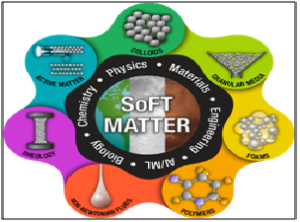
About Soft Matter:
-
- Definition: Soft matter, or soft materials, is a sub-field of “condensed matter”, referring to a variety of materials that can be easily deformed or structurally altered by thermal fluctuations or nominal external stress.
- Ubiquity: They exhibit many useful and appealing properties, which account for their ubiquity in everyday life, finding use in a diverse range of applications in industry including, food, medical, automotive, construction, transportation, electronics, and manufacturing.
- Scale: One of the important characteristics of soft matter is their physical structures in the mesoscopic scale.
-
- Behaviour: It is the properties and interactions of these structures that determine the overall behaviour of the material.
- Weak intermolecular forces: Unlike “hard” materials (metals, ceramics) held together by strong bonds, soft matter building blocks are linked by weak forces.
-
- Viscoelasticity: These materials exhibit a “borderline” behaviour between solids and liquids—they can show both viscosity (liquid-like resistance) and elasticity (solid-like springiness).
- High sensitivity: Small changes in temperature or pressure can drastically alter their physical properties.
- Common Examples
-
- Food items: Curd, ice cream, butter, and ketchup.
- Personal care: Shampoo, toothpaste, and soap bubbles.
- Biological systems: Living cells, blood, proteins, and cell membranes.
- Industrial materials: Polymers, colloids, liquid crystals, gels, and foams.
Source:
Category: Defence and Security
Context:
- Recently, Indian Coast Guard Ship (ICGS) Sankalp visited Port Louis in Mauritius as part of overseas deployment in the Indian Ocean Region.
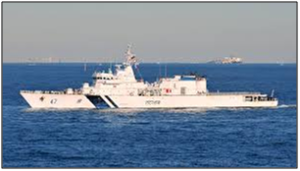
About ICGS Sankalp:
-
- Nature: ICGS Sankalp is a 5th generation Advanced Offshore Patrol Vessel (AOPV).
- Construction: The vessel is indigenously built by the Goa Shipyard Limited.
- Commissioning: It was commissioned on May 20, 2008, in Goa.
-
- Motto: Its motto is “Extending the Horizon”.
- Functions: It is designed primarily for extended maritime surveillance, exclusive economic zone (EEZ) protection, search and rescue operations, and enforcement of maritime laws within India’s vast oceanic domains.
- Structure: The ship is 105-meter-long with an endurance of 6,500 nautical miles.
- Capacity: It has displacement capacity of approximately 2,325 tonnes at full load.
- Surveillance: It consists of HAL Chetak rotary-wing aircraft for enhanced aerial surveillance and SAR.
- Armaments: It is equipped with primary armament consisting of two 30 mm CRN-91 twin-barrel naval guns, designed for surface engagement and controlled by an integrated fire control system.
- Navigation: It is equipped with state-of-the-art navigation and communication equipment. It is also fitted with davits to deploy up to five high-speed interceptor boats.
Source:
Category: Government Schemes
Context:
- The Chips to Start-up Programme has delivered measurable outcomes across capacity building, infrastructure access, and hands-on chip design enablement.
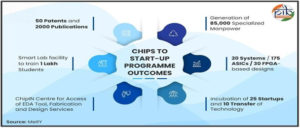
About Chips to Start-Up Programme:
-
- Nodal ministry: It is an umbrella capacity-building initiative launched by the Ministry of Electronics and Information Technology (MeitY) in 2022.
- Objective: It aims to catalyse the incubation of 25 start-ups and enable 10 technology transfers.
- Funding and tenure: The total outlay of the scheme is Rs. 250 crore over five years.
- Institutional framework: The Centre for Development of Advanced Computing (C-DAC) is the nodal implementing agency.
- Focus areas:
-
-
- It targets the development of 85,000 industry-ready professionals across undergraduate, postgraduate, and doctoral levels.
- It seeks to provide access to SMART lab facilities, train one lakh students, generate 50 patents, and support at least 2,000 focused research publications.
- It supports innovation, enhances employability, and enables academic institutions to play a more active role in India’s semiconductor value chain.
-
- Programme approach:
-
- The C2S Programme adopts a comprehensive approach, providing students with hands-on experience in chip design, fabrication, and testing.
- It is achieved through regular training sessions in collaboration with industry partners, combined with mentorship and practical support.
- Students gain access to advanced chip design tools, fabrication facilities, and testing resources, including state-of-the-art EDA software and semiconductor foundries.
- These opportunities also include implementing R&D projects under the C2S Programme to develop working prototypes of Application-Specific Integrated Circuit (ASICs), Systems-on-Chip (SoCs), and Intellectual Property (IP) Core designs.
Source:
Category: History and Culture
Context:
- Recently, the Prime Minister of India witnessed a performance of the traditional Bagurumba dance of the Bodo community in Assam.
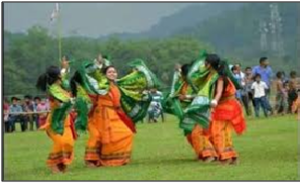
About Bagurumba Dance:
-
- Nature: It is one of the folk dances of the Bodo community, deeply inspired by nature.
- Location: It is performed by indigenous Bodo Tribe of Assam and Northeast India.
-
- Other names: It is often called the “Butterfly Dance” because its gentle, flowing hand movements mimic the fluttering of butterflies.
- Significance: It represents peace, fertility, joy and collective harmony, and is closely associated with festivals such as Bwisagu, the Bodo New Year, and Domasi.
- Formation of geometric shapes: Performances are usually organised in groups, forming circles or lines that enhance its visual elegance.
- Performance: It is traditionally performed only by women of the Bodo community, with the musical instruments being played by their male counterparts.
- Dance attire: The dancers dress in handwoven, bright red, yellow, and green dokhna, jwmgra, and aronai, dancing to the beautiful beats of the handmade percussion instruments.
- Musical instruments used: The musical instruments include the traditional kham (a drum made of wood and goatskin), including sifung (a bamboo flute), and other wooden instruments like jota, gongwna and tharkha.
Source:
(MAINS Focus)
GS II: “India and its neighbourhood–relations; bilateral, regional and global groupings and agreements involving India and/or affecting India’s interests.”
Context (Introduction)
The evolving global order in 2026 is marked by great-power rivalry, institutional gridlock, and fragmented multilateralism. In this environment, India’s diplomatic leverage lies not in headline-driven mega-summits, but in small, functional coalitions that deliver outcomes. The Republic Day invitation to the European Union’s institutional leadership, India’s chairmanship of BRICS, and the continued relevance of the Quad illustrate this shift.
Core Idea
In a multipolar but leaderless world, India’s strategic advantage lies in “diplomatic white spaces”—forums where no single power dominates and coordination is possible. By focusing on issue-based, small-group diplomacy, India can shape rules, deliver public goods, and balance competing power blocs without over-alignment.
Why ‘Small Tables’ Matter in Today’s World
- Limits of Big Multilateral Forums
- UN: High legitimacy but weak delivery when major powers are divided.
- G-20: Increasingly paralysed by domestic politics and agenda fragmentation (e.g., U.S. boycott of Johannesburg G-20, narrowing agenda under U.S. presidency).
- Outcome: Coalitions move faster than consensus-based institutions.
- Bilateral Diplomacy is Necessary but Insufficient
- Neighbourhood diplomacy remains demanding.
- Persistent friction with major powers (trade disputes with the U.S., strategic competition with China).
- Hence, bilaterals alone cannot anchor India’s global strategy.
Key Diplomatic ‘White Spaces’ for India
- India–European Union Engagement
- EU leadership at Republic Day signals intent to revive the India-EU Free Trade Agreement.
- Engagement goes beyond tariffs to:
- Data standards
- Climate and sustainability regulations
- Competition policy
- Strategic value:
- Access to re-worked global value chains
- Hedge against U.S. trade unpredictability
- EU’s desire to reduce dependence on China creates a strategic opening for India
- BRICS: Political Coalition with Delivery Challenges
- BRICS expansion has blurred focus due to divergent member priorities.
- Yet, demands are real:
- Fairer global representation
- Alternatives to Western-dominated finance
- India’s role as Chair (2026):
- Shift BRICS from rhetoric to delivery
- Use New Development Bank guarantees
- Translate communiqués into actionable outcomes
- Caution:
- Avoid drifting into anti-West rhetoric or de-dollarisation crusades
- Balance reform with engagement
- The Quad: Functional Public Goods Coalition
- Quad is not an alliance but a capability-driven platform.
- Focus areas:
- Maritime security
- Resilient port infrastructure
- Humanitarian assistance & disaster relief
- Example:
- Operation Sagar Bandhu after Cyclone Dithwa in Sri Lanka demonstrated rapid, non-provocative deployment of Indian assets.
- Strategic value:
- Converts power into services accessible to smaller states
- Avoids forcing countries into binary choices
Constraints and Risks
- U.S. tariff threats against countries perceived as BRICS-aligned increase economic risk.
- Over-politicisation of platforms reduces effectiveness.
- Compliance burdens from EU standards may strain Indian firms.
- Managing balance between reform and rejection of existing global systems.
Way Forward:
- Turn White Spaces into Working Arrangements
- Prioritise delivery over declarations.
- Different Forums, Different Functions
- Europe → standards & markets
- BRICS → development finance & Global South voice
- Quad → public goods & security capacity
- Coalitions, Not Camps
- Avoid rigid alignment; pursue strategic autonomy through functionality.
- Institutional Follow-Through
- Translate summits into operational mechanisms.
- Domestic Capacity Building
- Align trade, technology, climate and regulatory institutions with external commitments.
Conclusion
In a fragmented global order, power no longer flows only from the biggest table. India’s comparative advantage lies in choosing the right tables—and making them work. By anchoring its foreign policy in small, functional coalitions, India can shape outcomes, deliver global public goods, and exercise leadership without overextension. In 2026, India’s diplomatic success will depend less on symbolism and more on precision, partnerships, and performance.
Mains Question
- “In an era of institutional gridlock and great-power rivalry, India’s diplomatic effectiveness increasingly depends on issue-based coalitions rather than large multilateral forums.” Critically examine (15marks)

GS II: Effect of policies and politics of developed and developing countries on India’s interests, Indian diaspora.
Important International institutions, agencies and fora— their structure, mandate.
Context (Introduction)
The second term of Donald Trump (Trump 2.0), beginning January 2025, has already produced systemic shocks to global governance. The editorial argues that U.S. mid-term elections will act as a bellwether for the remaining three years of Trump’s presidency, shaping the future of multilateralism, global security regimes, and India–U.S. relations.
Core Issue
Trump 2.0 represents a structural retreat from rules-based multilateralism towards unilateralism, deal-making, and personality-driven diplomacy, with consequences for:
- Global institutions (UN, WHO, climate bodies)
- Arms control and nuclear stability
- Middle East conflict management
- India’s diplomatic calculus vis-à-vis the U.S.
The outcome of U.S. mid-term elections will determine whether this trajectory intensifies or moderates.
Key Developments Highlighted in the Article
- Systematic Unravelling of Multilateralism
- State Department review ordered to identify international organisations “contrary to U.S. interests”.
- Withdrawal from 66 international organisations, including:
- UNFCCC / IPCC
- UN Human Rights Council
- UNESCO
- UN Women, UNFPA, UN Population Fund
- Nearly 35 non-UN bodies exited.
- “America First” as Governance Doctrine
- Sharp move towards unilateral actions and bilateral deals.
- Viewing multilateral institutions as:
- Constraints on sovereignty
- Wasteful
- Misaligned with U.S. interests
Examples (continuity with Trump 1.0):
- Exit from Paris Climate Agreement
- Withdrawal from WHO
- Global Security Risks and Arms Control Breakdown
- New START Treaty expired on February 2025, the last bilateral nuclear arms control agreement between the U.S. and Russia.
- Managing WMD norms now an “abiding challenge”.
- Rising instability in:
- NATO cohesion
- Strategic nuclear deterrence
- Iran nuclear issue
- Middle East and UN Marginalisation
- UN sidelined during:
- Gaza conflict
- Iran tensions
- Trump’s approach marked by:
- Indifference to civilian casualties
- Preference for ad-hoc diplomacy over institutional mediation
- Iranian tests killing over 5,000 people saw limited U.S. accountability rhetoric.
- Domestic Polarisation and Governance Uncertainty
- Intensifying polarisation within the U.S.:
- Immigration protests
- State-level resistance (e.g., Minnesota)
- Inconsistent, personalist leadership style:
- Diplomatic humiliation of interlocutors
- Disregard for institutional dignity
Implications for India
- India–U.S. Relations: Strategic Caution Needed
- Trump invited PM Modi to participate in a “Board of Peace for Gaza”.
- This could become a diplomatic Catch-22:
- Symbolic participation vs reputational risks
- Unclear mandate and conditions
- Trade and Economic Frictions
- India–U.S. ties already strained by:
- High tariffs
- Transactional trade logic
- Political unpredictability heightens risks for long-term strategic alignment.
- Why U.S. Mid-terms Matter for India
- Democratic victory:
- Potential moderation of unilateralism
- Institutional course correction
- Republican consolidation:
- Deepening of America First
- Further weakening of multilateral order
Why This Matters
- India’s foreign policy autonomy depends on navigating great-power volatility.
- Weakening of global institutions increases reliance on:
- Issue-based coalitions
- Minilateral groupings
- India must hedge against:
- Norm erosion
- Strategic instability
- Trade weaponisation
Way Forward for India
- Strategic Prudence
- Maintain engagement with the U.S. without political over-investment.
- Avoid legitimising unstable or ad-hoc global initiatives.
- Multilateral Hedging
- Strengthen alternative platforms:
- G20
- Quad
- EU partnerships
- Preserve normative leadership in global forums.
- Strengthen alternative platforms:
- Autonomy in Diplomacy
- Reaffirm commitment to rules-based order, even if major powers retreat.
- Separate leadership personalities from long-term bilateral interests.
- Scenario Planning
- Prepare differentiated strategies for:
- Democratic resurgence
- Extended Trump-style governance
- Prepare differentiated strategies for:
Conclusion
Trump 2.0 has transformed uncertainty into a structural feature of global politics. U.S. mid-term elections will be decisive in determining whether the remaining years entrench or soften this disruption. For India, the optimal path lies in measured engagement, institutional commitment, and strategic autonomy, rather than alignment with volatile leadership cycles.
Mains Question
- “The resurgence of transactional unilateralism in U.S. foreign policy under Trump 2.0 is reshaping the global order.” Discuss the implications of this shift for multilateralism and India’s strategic choices. (250 words, 15 marks)