

Archives
(PRELIMS Focus)
Category: Science and Technology
Context:
- Officials explained that ammonia spikes in the Yamuna are a chronic winter issue, generally occurring between 15 and 22 times a year.
About Ammonia:
-
- Composition: It is a colourless, pungent gas composed of nitrogen and hydrogen with the formula NH3.
- Nature: It is the simplest stable compound of these elements and serves as a starting material for the production of many commercially important nitrogen compounds.
- Solubility: It is highly soluble in water, forming ammonium hydroxide, an alkaline solution.
- Density: It is lighter than air.
-
- Existence: It exists naturally in humans and in the environment. In the environment, ammonia is part of the nitrogen cycle and is produced in soil from bacterial processes.
- Natural production: Ammonia is also produced naturally from decomposition of organic matter, including plants and animals.
- Industrial production: It is manufactured mainly by the Haber–Bosch process (from nitrogen and hydrogen).
- Liquid ammonia: Ammonia gas can be dissolved in water. This kind of ammonia is called liquid ammonia or aqueous ammonia. Once exposed to open air, liquid ammonia quickly turns into a gas.
-
- Toxicity: Exposure to high levels of ammonia in air may be irritating to a person’s skin, eyes, throat, and lungs and cause coughing and burns. To prevent the release of toxic fumes, ammonia should not be mixed with other chemicals (like chlorine bleach).
- Key applications:
-
-
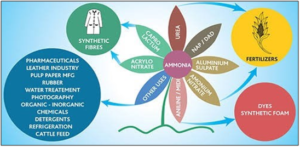
- Ammonia is a basic building block for ammonium nitrate fertilizer, which releases nitrogen, an essential nutrient for growing plants. About 90 percent of ammonia produced worldwide is used in fertilizer.
- Additional uses include as a refrigerant, stabilizer, neutralizer, and purifier — particularly in food transport and water treatment applications.
- It can also be used in the manufacture of plastics, explosives, fabrics, dyes, and pharmaceuticals.
- It has 9 times the energy density of Li-ion batteries and 3 times that of compressed hydrogen, making it a promising carbon-free energy carrier.
-
- Types:
-
- Grey Ammonia: Produced from natural gas (methane); highly carbon-intensive.
- Blue Ammonia: Produced from fossil fuels but coupled with Carbon Capture and Storage (CCS) to reduce emissions.
- Green Ammonia: Produced using renewable energy (solar/wind) to power water electrolysis for hydrogen; 100% carbon-free.
Source:
Category: Economy
Context:
- The Engineering Export Promotion Council of India recently demanded lowering of income tax for non-corporate manufacturing MSMEs in the Union Budget.

About Engineering Export Promotion Council of India (EEPC India):
-
- Nature: It is the premier trade and investment promotion organization in India, catering to the Indian engineering sector.
- Objective: It actively contributes to the policies of the Government of India as an advisory body and acts as an interface between the engineering industry and the government.
- Nodal ministry: It operates under the Ministry of Commerce & Industry.
-
- Establishment: Set up in 1955, EEPC India now has a membership base of over 13,000, out of whom 60% are SMEs.
- Headquarters: Its headquarters is located in Kolkata, with regional offices in Delhi, Mumbai, and Chennai.
- Key functions: EEPC India facilitates sourcing from India and encourages MSMEs to raise their standard at par with international best practices. It also encourages MSMEs to integrate their business with the global value chain.
- Motto: The motto of EEPC India is “Engineering the Future.”
- Significance: It serves as the reference point for the Indian engineering industry and the international business community in its efforts towards establishing India as a major engineering hub in the future.
- Reports: EEPC India publishes several reports/studies to make its members aware of international trends and opportunities in order to enhance their global footprint.
Source:
Category: Miscellaneous
Context:
- Recently, Mozambican rights activist Graca Machel has been selected for the Indira Gandhi Prize for Peace, Disarmament and Development for 2025.
About Indira Gandhi Peace Prize:
- Establishment: It was instituted in the memory of the former Prime Minister Indira Gandhi by a trust in her name in 1986.
- Other names: It is also known as the Indira Gandhi Prize for Peace, Disarmament, and Development.
-
- Key features: The prize carries a cash prize of Rs 1 crore, a citation and a trophy, and is regarded as one of India’s prestigious international peace awards.
- Eligibility: It is awarded annually by the Indira Gandhi Memorial Trust to a person or organization without any distinction of nationality, race or religion, in recognition of creative efforts towards:
- Promoting international peace and disarmament, racial equality, and goodwill and harmony among nations;
- Securing economic co-operation and promoting a new international economic order;
- Accelerating the all-round advancement of developing nations;
- Ensuring that the discoveries of science and modern knowledge are used for the larger good of the human race; and
- Enlarging the scope of freedom and enriching the human spirit.
- Recent winners:
-
- 2025: Graça Machel (Mozambican activist) – For her contributions to peace and humanitarian action.
- 2024: Michelle Bachelet (Former President of Chile) – For her work in gender equality and human rights.
- 2023: Daniel Barenboim and Ali Abu Awwad (Jointly) – For promoting peace in the Israel-Palestine conflict through music and dialogue.
Source:
Category: Environment and Ecology
Context:
- Recently, a forest fire continued to rage inside Sikkim’s Pangolakha Wildlife Sanctuary along the Indo-China border at an altitude of 13,000 feet.
About Pangolakha Wildlife Sanctuary:
-
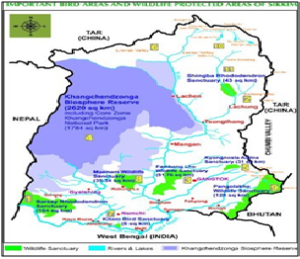
- Location: It is located in the state of Sikkim. It is the largest wildlife sanctuary in the state, with the Pangolakha range separating Sikkim from Bhutan to the east.
- Connectivity: It forms an important transboundary wildlife corridor, linked to the Neora Valley National Park in West Bengal and the forests of Samtse and Haa districts in Bhutan.
-
- Lakes: High-altitude lakes, including Lake Tsongmo (Changu Lake), are located within the sanctuary and serve as biodiversity hotspots.
- Rivers: The Rangpo River and Jaldhaka River originate from nearby lakes in the area.
- Significance: It serves as a natural water regulator and a crucial habitat for endangered Himalayan species.
- Altitude: The sanctuary features a wide altitudinal variation from approximately 1,300m to over 4,000m.
- Biomes: It supports diverse biomes including subtropical, temperate, and alpine ecosystems. It falls at the junction of the Palearctic and Indomalayan realms.
- Flora: Key vegetation here includes Rhododendron, Silver Fir, Juniper, and moss-filled oak forests, which provide an ideal habitat for the Red Panda.
- Fauna: It is home to diverse species, including the Red Panda (Sikkim’s state animal), Tiger, Leopard, Takin, Musk Deer, Goral, and Asiatic Black Bear. It is also a designated Important Bird Area (IBA), known for migratory birds and species like the Himalayan Monal and the vulnerable Wood Snipe.
Source:
Category: International Organisations
Context:
- Recently, India has welcomed Spain joining the Indo-Pacific Oceans Initiative (IPOI).
About Indo Pacific Oceans Initiative:
- Launch: It was launched by India in November 2019 at the ASEAN-led East Asia Summit (EAS) in Bangkok.
-
- Objective: It aims to promote cooperation for a free and open Indo-Pacific and the rules-based regional order.
- Nature: It is a non-treaty-based voluntary arrangement.
- Focus: It leans heavily on the EAS mechanism, which includes ASEAN member states and its eight dialogue partners.
- Philosophy: It builds upon India’s SAGAR (Security and Growth for All in the Region) vision (2015) and integrates with the “Act East” and “Act West” policies.
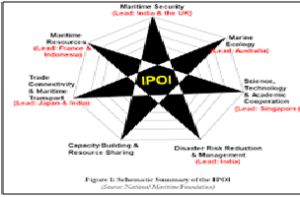
- Pillars: It has outlined 7 pillars, and it was indicated that one or two countries could take the lead for a pillar with others joining in voluntarily. These pillars are:
- Maritime Security: The United Kingdom (UK) and India
- Maritime Ecology: Australia and Thailand
- Maritime Resources: France and Indonesia
- Capacity Building and Resource Sharing: Germany
- Disaster Risk Reduction and Management: India and Bangladesh
- Science, Technology, and Academic Cooperation: Italy and Singapore
- Trade, Connectivity, and Maritime Transport: Japan and the United States (US).
Source:
(MAINS Focus)
GS-II: “Functions and responsibilities of the Union and the States, issues and challenges pertaining to the federal structure, devolution of powers and finances up to local levels and challenges therein.”
Context (Introduction)
Delimitation, the constitutionally mandated redrawing of electoral boundaries to reflect population changesnwill resume after the first Census conducted post-2026, i.e., Census 2027. This will be India’s most consequential delimitation exercise since Independence, as the inter-State distribution of Lok Sabha seats has remained frozen since 1976, based on 1971 population data (≈548 million), while India’s population is now about 1.47 billion.
The freeze was intended to avoid penalising States that successfully implemented population control, reinforced by the 84th Constitutional Amendment Act, 2001, which extended the suspension till 2026.
Why Delimitation After 2027 Is Politically and Constitutionally Explosive
- Representation imbalance: Current representation rests on 50-year-old population data, undermining equal suffrage.
- Federal fault line: Southern and western States (low fertility, better governance outcomes) risk losing relative political weight, while northern States (higher fertility) gain.
- Moral paradox: States rewarded earlier for population control now face political disadvantage.
- Coalition arithmetic: Uttar Pradesh and Bihar together could command over 25% of Lok Sabha seats, fundamentally reshaping coalition politics.
Key Constitutional and Legal Framework
- Article 82: Delimitation after every Census.
- Articles 170, 330, 332: Delimitation for State Assemblies and reserved constituencies.
- 84th Constitutional Amendment (2001): Froze inter-State seat redistribution till Census after 2026.
- Delimitation Commission: Independent, decisions have force of law, not just executive discretion.
The Numbers That Drive the Anxiety (Illustrative Projections)
If seats are allocated purely by population in an expanded Lok Sabha (~888 seats):
- Uttar Pradesh: ~151 seats (from 80)
- Bihar: ~82 seats (from 40)
- Tamil Nadu: ~53 seats (from 39) → share falls from 7.2% to ~6%
- Kerala: ~23 seats (from 20) → share falls to ~2.6%
Parliament functions on absolute numbers, not proportional fairness thus bargaining power shifts sharply.
Governance and Federalism Concerns
- Distortion of cooperative federalism
- Erosion of Rajya Sabha’s balancing role, already weakened due to dilution of domicile norms
- Regional alienation, particularly in southern States
- Risk of legal challenges under Article 14 (equality) if redistribution appears arbitrary
Policy Options Debated (As Highlighted in the Article)
- 1. Extend the Freeze Beyond 2026
- Preserves current balance
- But violates equal representation principle
- Risks constitutional challenge
- Expand Lok Sabha Strength (e.g., 543 → 700–888)
- No State loses absolute seats
- But proportional imbalance remains
- Weighted Delimitation Formula
- Example: 80% population + 20% governance indicators
- Literacy, health, fertility control
- Analogous to Finance Commission’s composite criteria
- Rewards outcomes, not just numbers
- Strengthen the Rajya Sabha as a Federal Chamber
- Restore domicile linkage
- Reduce population dominance
- Consider equal or tiered State representation (U.S. Senate model adaptation)
- Structural Federal Solutions
- Bifurcation of large States (e.g., Uttar Pradesh into 3–4 States)
- A federal—not merely administrative—solution
- Phased Redistribution
- Partial reallocation in 2034, full in 2039
- Reduces political shock, allows adjustment
Procedural and Institutional Safeguards Needed
- Delimitation Commission must include demographers, constitutional experts, federal scholars
- Transparency, public hearings, and reasoned orders
- Careful handling of SC/ST reserved constituencies, where location discretion is high and manipulation risks exist
Way Forward
Delimitation after 2027 must balance:
- Democratic equality (one person, one vote)
- Federal fairness
- Political stability
- Governance incentives
A hybrid approach, Lok Sabha expansion + weighted formula + strengthened Rajya Sabha + phased implementation offers the most viable path.
Conclusion
Delimitation will not merely redraw constituencies; it will redefine India’s federal compact.
Done well, it can modernise representation and restore trust. Done poorly, driven by political arithmetic alone, it risks deepening regional mistrust and weakening India’s federal spirit.
“The Census will count India’s population; delimitation will measure the health of its democracy.”
Mains Question
- “The resumption of delimitation after the 2027 Census will redefine India’s federal balance and the principle of political representation.” Critically examine the constitutional, federal and political challenges posed by post-2027 delimitation. Suggest institutional and policy safeguards to ensure democratic fairness without undermining cooperative federalism. (250 words)

GS-II: “India and its neighbourhood–relations; Bilateral, regional and global groupings and agreements involving India and/or affecting India’s interests.”
Context (Introduction)
The global order shaped after the Cold War is fracturing under geopolitical shocks the Russia–Ukraine war, US–China rivalry, supply-chain disruptions, energy insecurity and technological decoupling.
Against this backdrop, India–EU relations are entering a strategic phase, marked by high-level political engagement, renewed momentum on the India–EU Free Trade Agreement (FTA), and convergence on technology, security and global governance.
Core Idea
India and the European Union can no longer rely on inherited multilateral structures or US-centric stability. Instead, they must build issue-based, technology-driven, and norm-anchored partnerships to shape a new multipolar order grounded in:
- Strategic autonomy
- Rules-based cooperation
- Technological self-reliance
- Plural partnerships over rigid alliances
The relationship’s value lies not in symmetry of power, but in complementarity of interests and capabilities.
Key Pillars of India–EU Cooperation (from the article)
- Trade & Economic Integration
- Revival of the India–EU FTA with expanded scope (goods, services, investment, standards).
- EU trade with India growing among the fastest in the Indo-Pacific.
- FTA seen as a tool for:
- Supply-chain diversification
- De-risking from China
- Resilient global value chains
- Technology as the New Power Axis
- Convergence on digital public goods, Artificial Intelligence, and semiconductors.
- Aim to prevent global duopolies in frontier technologies.
- Cooperation in:
- AI governance
- Semiconductor ecosystems
- Science, technology and innovation mobility
- Strategic & Security Convergence
- Europe emerging as an advanced defence and security partner for India.
- Cooperation across:
- Maritime security
- Underwater domain
- Cyber and space
- Shared concern over:
- Indo-Pacific fragility
- Terrorism, especially emanating from Pakistan
- Global commons governance
- Global Governance & Multipolarity
- Both sides recognise:
- Large multilateral forums (UN, G20) face delivery deficits.
- Smaller coalitions and “working arrangements” are more effective.
- India–EU partnership can shape:
- Rule-based multipolarity
- Global public goods
- Norms on climate, technology, and development finance
Challenges and Constraints
- Divergences in Strategic Culture
- EU remains cautious, consensus-driven, and regulation-heavy.
- India prioritises strategic flexibility and sovereignty.
- External Pressures
- US unpredictability and China’s assertiveness complicate alignment.
- India–Russia ties and EU–China tensions create diplomatic sensitivities.
- Compliance & Regulatory Burdens
- EU’s climate, data, and sustainability standards raise costs for Indian firms.
- Perception Gaps
- Mutual public narratives and political expectations sometimes lag strategic reality.
Why This Matters for India
- Strategic autonomy: Diversifies India’s partnerships beyond US–China binaries.
- Economic resilience: Secures access to European markets, capital and technology.
- Technology sovereignty: Reduces dependence on monopolised tech ecosystems.
- Global influence: Positions India as a rule-shaper, not a rule-taker, in a multipolar order.
Way Forward
- Conclude the India–EU FTA with balance between market access and regulatory flexibility.
- Operationalise technology cooperation in AI, semiconductors, and digital public infrastructure.
- Deepen defence and maritime collaboration, especially in the Indo-Pacific.
- Expand mobility programmes for students, researchers, and skilled professionals.
- Use minilateral platforms to convert shared norms into deliverable outcomes.
- Sustain political trust through regular summits and strategic dialogues.
Conclusion
The central truth is the old-world order will not return, and stability will emerge not from dominance but from deliberate partnerships. India and the EU, by combining India’s scale and strategic depth with Europe’s institutional strength and technological capacity, can help shape a resilient multipolar order rooted in rules, cooperation, and shared responsibility.
In a turbulent world, building together matters more than waiting for order to restore itself.
Mains Question
- “In a world where the post-Cold War order is irreversibly fragmenting, India–EU relations are no longer about alignment but about co-building a resilient multipolar order.” Critically examine this statement, in shaping the India–EU strategic partnership. (250 words, 15 marks)