

Archives
(PRELIMS Focus)
Category: Environment and Ecology
Context:
- For the first time, the Tamil Nadu forest department has begun a study on the rare mammal species Madras Hedgehog at the Theri forests in the district.
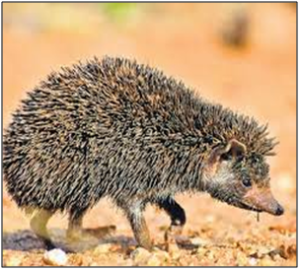
About Madras Hedgehog:
-
- Nature: It is a nocturnal species, which curls into a ball to protect itself from danger. It has mastered survival in some of the harshest and driest landscapes.
- Scientific name: Its scientific name is Paraechinus nudiventris.
- Other names: Madras Hedgehog, locally known as Mulleli is a tiny mammal. It is also known as the bare-bellied hedgehog, discovered in 1851.
- Features: It has sharp spines on its back and soft white fur on its belly. Its spines offer protection from predators such as foxes, jackals and mongooses.
- Habitat: The species prefers dry scrublands, thorn forests, grasslands and the edges of farmlands.
- Distribution: It is found only in peninsular India, primarily across Tamil Nadu, Kerala, Andhra Pradesh and parts of Karnataka.
- Diet: It feeds on insects such as beetles, ants, earthworms and termites, apart from plants.
- Threats: Its population declined largely due to hunting driven by mythical beliefs that its quills and meat have medicinal value.
- Conservation status: It is classified as Least Concern in the IUCN Red List.
- Hedgehog Species in India: Of the 17 species of hedgehog around the world, India is home to three:
-
- Madras Hedgehog: Southern India (Endemic).
- Indian Long-eared Hedgehog: Northern India and Pakistan.
- Indian Hedgehog: Arid and sandy desert regions of India and Pakistan.
Source:
Category: Polity and Governance
Context:
- Recently, the Prime Minister of India extended greetings to citizens on the occasion of National Voters’ Day.
About National Voters’ Day (NVD):
- Commemoration: It is observed on January 25th across India every year since 2011 to commemorate the foundation day of the Election Commission of India.
-
- Objective: It is celebrated to honour voters, strengthen democratic values, encourage youth participation, and promote universal adult suffrage. It celebrates democracy and empowers every citizen to take part in the electoral process.
- Theme: The theme for National Voters’ Day 2026 is “My India, My Vote” with a tagline of “Citizen at the Heart of Indian Democracy.
- Celebrations: It is celebrated at the level of national, state, district, constituency, and polling booth and NVD stands as one of the country’s most widespread and significant celebrations.
- Focus on young voters: It is dedicated to the voters of the nation, National Voters’ Day also promotes the enrolment of new voters, particularly young individuals who have recently become eligible.
- Historical milestone: In 2025, the ECI celebrated its 75th year of service to the nation (it was established on Jan 25, 1950).
- Significance of NVD:
- Electoral reforms: NVD highlights initiatives like SVEEP (Systematic Voters’ Education and Electoral Participation) and digital tools like the Voter Helpline App and e-EPIC.
-
- Democratic values: It reinforces the concept that voting is not just a right but a civic responsibility essential for the accountability of representatives.
- Inclusivity: Efforts are made to include Persons with Disabilities (PwDs), senior citizens, and marginalised groups through the principle of “No Voter to be Left Behind.”
Source:
Category: Miscellaneous
Context:
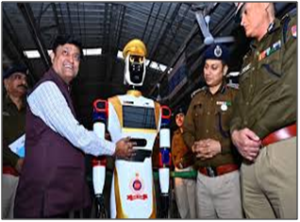
- Recently, the Indian Railways has introduced a humanoid robot named “ASC ARJUN” at Visakhapatnam Railway Station.
About ASC Arjun:
- Nature: It is a humanoid robot introduced by the Indian Railways.
- Objective: The robot will operate alongside Railway Protection Force (RPF) personnel to assist in station operations, particularly during periods of heavy passenger movement.
- Development: It is designed and developed entirely in Visakhapatnam using home-grown technology. A dedicated team worked continuously for more than a year to bring this project to fruition.
- Use of AI: It is equipped with a Face Recognition System (FRS) for intrusion detection, AI-based crowd monitoring and real-time alert generation for RPF control rooms.
- Multilingual: It can also make automated public announcements in English, Hindi and Telugu to assist passengers and promote safety awareness.
- Navigation: It also features semi-autonomous navigation with obstacle-avoidance capability,
- Patrolling: It can patrol station platforms round the clock, supporting surveillance and optimising manpower deployment.
- Welcoming gestures: It has been designed for passenger interaction, offering gestures such as a ‘Namaste’ for passengers and salutes for RPF personnel, along with an interface to provide information and assistance.
- Equipped for emergency: It is also fitted with fire and smoke detection systems to aid timely response during emergencies.
Source:
Category: Science and Technology
Context:
- New filtration technology developed by Rice University may absorb some Pfas “forever chemicals” at 100 times the rate previously possible.

About Forever Chemicals:
- Nature: Forever chemicals, are a large chemical family of thousands of highly persistent, toxic, man-made, hazardous chemicals.
-
- Nomenclature: The name ‘forever chemicals’ comes from the fact that they remain in the environment without breaking down for generations.
- Other names: They are also known as PFAS (per- and poly- fluoroalkyl substances).
-
- Uniqueness: PFAS molecules have a chain of linked carbon and fluorine atoms. Because the carbon-fluorine bond is one of the strongest, these chemicals do not degrade easily in the environment.
- Durability: In manufacturing, PFAS are favoured for their durability and useful properties such as non-stick, water repellence, and anti-grease.
- Uses: PFAS are used in the manufacture of many domestic products, including- skin creams and cosmetics, car and floor polish, rinse aid for dishwashers, textile and fabric treatments, food packaging and microwave popcorn bags, baking equipment, frying pans, outdoor clothing and shoes, firefighting foam, etc.
- Concerns: Over time, PFAS may leak into the soil, water, and air.
- Exposure: People are most likely exposed to these chemicals by consuming PFAS-contaminated water or food, using products made with PFAS, or breathing air containing PFAS. Because PFAS breaks down slowly, if at all, people and animals are repeatedly exposed to them, and blood levels of some PFAS can build up over time.
- Impacts of PFAS on human health: Forever chemicals have been linked to multiple health problems, including compromised immune systems, liver damage, thyroid diseases, increased cholesterol levels, hypertension, developmental delays in infants, and increased certain cancers such as kidney and testicular.
- Regulation: The Stockholm Convention has listed some PFAS, such as Perfluorooctane sulfonic acid (PFOS) and Perfluorooctanoic acid (PFOA), as persistent organic pollutants (POPs).
Source:
Category: Geography
Context:
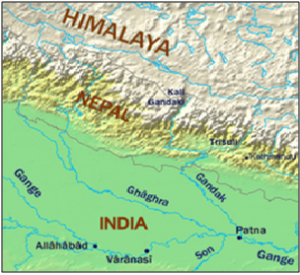
- The Gandak River has emerged as the second major river after the Chambal with the highest number of gharials, also known as fish-eating crocodiles.
About Gandak River:
- Location: Gandak is one of the major rivers in Nepal and a left-bank tributary of the Ganges in India.
- Other names: The Gandak River is also known as the Narayani and Gandaki.
- Mentioned in Epics: It is mentioned in the ancient Sanskrit epic Mahabharata.
- Length: The total length of the river is 700 km. In India, it covers a course of more than 300 km.
-
- Boundaries: It is bounded on the north by the Himalayas, south by the River Ganga, east by the Burhi Gandak Basin and on the west by the Ghagra Basin.
- Origin: It originates at an altitude of 7620 m above msl to the north of Dhaulagiri Mountain in Tibet near the Nepal border. After flowing through Tibet, it crosses Nepal, where it is also known as Narayani, to enter the Indian Territory.
- Course in India: The river enters India from Valmikinagar in the West Champaran district of Bihar. The entry point of the river is at the Indo–Nepal border and is known as Triveni. In India, it flows southeast, across the upper Gangetic plain in eastern Uttar Pradesh and northwestern Bihar.
- Shifting of course: Due to the steep slope and loose soil in the upper catchment, it carries a lot of silt and other deposits to the Indian side, resulting in a continuous shifting course of the river. Because of this, it is also known as ‘Sorrow of Bihar.’
-
- Formation of gorge: While flowing through the Nepal Himalayas, it forms the Kali Gandaki gorge, one of the deepest river gorges in the world.
- Glaciers: There are about 1,710 glaciers and over 300 lakes in the upper catchment of Gandaki.
- Major tributaries: These include Daraudi, Seti, Madi, Marsyandi, and Budhi Gandaki.
- Protected areas: Two important protected areas, Chitwan National Park in Nepal and the adjacent Valmiki Tiger reserve in India, have been established in the basin.
Source:
(MAINS Focus)
GS-II: India and its relations with other countries; international institutions, global groupings and agreements involving India and/or affecting India’s interests.
GS-III: Awareness in the fields of Information Technology, Computers; cyber security; issues relating to intellectual property rights
Context (Introduction)
Cybercrime has emerged as a transnational threat cutting across national security, economic stability, democratic rights, and data sovereignty. In December 2024, the UN General Assembly adopted the UN Convention against Cybercrime, the first global criminal justice instrument in over two decades. However, India, the U.S., Japan, and Canada did not sign, exposing deep fractures in global cyber governance and highlighting a wider crisis of multilateralism.
Core Issue
The debate around the UN Cybercrime Convention reflects a principle–practice divide in international law, where consensus on abstract norms masks sharp divergence in implementation, especially concerning:
- Definition of cybercrime
- Human rights safeguards
- State control over data
- Cross-border law enforcement cooperation
This fragmentation is occurring amid a shift from rule-based multilateralism to polycentrism, where governance increasingly relies on smaller, issue-based coalitions.
Key Developments
- The Convention was proposed by Russia (2017) and negotiated through 8 formal UN sessions.
- Adopted in Dec 2024, supported by 72 countries.
- Seeks to move beyond the Budapest Convention (2001), which:
- Is European-led
- Excludes Russia and China
- Operates via invitation-only accession
- India actively participated in negotiations but rejected the final text.
- U.S. and civil society groups flagged risks of:
- Overbroad crime definitions
- Political misuse against journalists and activists
- Russia–China view the Convention as a way to legitimise sovereign control over cyberspace.
Challenges Exposed
- Principles–Practice Rift
- Vague definitions of “serious cybercrime” allow criminal law expansion, threatening:
- Freedom of expression
- Due process
- Judicial oversight
- Human rights protections remain anchored in domestic legal systems, not international enforcement.
- Data Sovereignty vs Data Flows
- India sought stronger institutional control over citizens’ data, which was diluted.
- Near-universal acceptance that trusted data flows are necessary, but mechanisms remain contested.
- Erosion of Multilateral Institutions
- UN credibility weakened by:
- Security Council paralysis (Ukraine, Gaza)
- U.S. funding cuts
- WTO dispute settlement paralysis (since 2019)
- Cyber governance mirrors this institutional breakdown.
- Rise of Polycentrism
- Governance shifting to:
- Plurilateral groups (Quad, Five Eyes)
- Regional frameworks
- Leads to institutional overlap, coordination failures, and uneven state capacity.
Why This Matters for India
- Cybersecurity is now integral to:
- National security
- Digital economy
- Democratic resilience
- India risks:
- Losing rule-making influence
- Being forced into rule-taker status
- India’s regulatory experiments (e.g., AI content watermarking) show the danger of over-prescriptive domestic rules diverging from global norms.
- Balancing:
- Strategic autonomy
- Human rights
- Global interoperability
is becoming increasingly complex.
Way Forward
At the Global Level
- Advocate narrow, precise definitions of cybercrime.
- Push for mandatory judicial review, proportionality, and due process safeguards.
- Engage in issue-based coalitions without abandoning multilateral forums.
At the National Level
- Build technical negotiating capacity across:
- Cyber law
- Encryption
- AI governance
- Harmonise domestic cyber laws with globally accepted principles (privacy, necessity, proportionality).
- Invest in regulatory institutions, not just rule-making.
Strategic Approach
- Adopt a calibrated polycentric strategy:
- Multilateral engagement where possible
- Plurilateral leadership where necessary
- Avoid binary choices between sovereignty and cooperation.
Conclusion
Cybercrime governance today mirrors the wider global governance crisis—fragmented authority, contested norms, and weakened institutions. For India, the challenge is not merely whether to sign a convention, but whether it can shape the evolving cyber order without surrendering institutional autonomy or democratic values. The shift to polycentrism is unavoidable, but without strategic capacity-building, it risks deepening inequality and instability in cyberspace governance.
Mains Question
- The failure to build consensus around the UN Convention against Cybercrime highlights a deeper crisis of multilateral governance in cyberspace. Critically examine. (250 words)

GS-II: “India and its relations with other countries; effect of policies and politics of developed and developing countries on India’s interests.”
GS-III: “Indian Economy and issues relating to planning, mobilisation of resources, growth, development and employment.”
Context (Introduction)
The erosion of the rules-based global economic order marked by US policy unpredictability, Chinese excess capacity, weakening multilateralism, and rising protectionism—has altered the external environment facing India. While near-term indicators suggest a cyclical recovery in India’s economy in 2026, however, cyclical tailwinds are insufficient in a structurally volatile global system. Only deep domestic reforms can provide durable economic insulation.
Core Idea
Cyclical growth impulses vs structural growth capacity:
- India’s current upturn is driven by GST and income-tax buoyancy, lower commodity prices, regulatory easing, and residual post-pandemic momentum.
- However, in a world where global trade rules are fragmenting, export-led certainty cannot be assumed.
- Therefore, India’s growth strategy must pivot decisively from temporary demand support to long-term structural reform, especially in investment, labour, capital formation, and productivity.
Key Economic Signals Highlighted
- GDP growth shows cyclical strength, supported by:
- GST and direct tax collections
- Monetary and regulatory easing
- Moderation in urban consumption slowdown
- Consumption recovery is uneven:
- Wage growth in listed firms slowed to mid-single digits (2025)
- Personal credit growth driven by gold loans, not income growth
- Exports resilient but slowing:
- Non-oil export growth slowed to ~3% by end-2025
- Export momentum expected to weaken further in 2026
- Private capex remains tentative, constrained by:
- Excess Chinese capacity
- US trade and industrial policy uncertainty
Structural Challenges Identified
- Global Economic Fragmentation
- Collapse of predictable trade rules
- Weaponisation of tariffs and industrial policy
- Weakening WTO dispute settlement
- Rising geopolitical risk premia
- Exhaustion of Cyclical Policy Space
- Fiscal consolidation imperative:
- Combined Centre–State fiscal deficit must decline by ~1% of GDP
- Limited monetary policy headroom:
- Real interest rates already ~1.25%
- Nominal GDP growth alone cannot sustain long-term expansion
- Investment and Productivity Constraints
- India’s growth has become capital-intensive, not labour-absorbing
- Formalisation and compliance costs risk crowding out MSMEs
- Labour productivity growth remains inadequate for demographic needs
Why It Matters for India
- External insulation: With exports exposed to geopolitical shocks, domestic demand and private investment must anchor growth.
- Employment challenge: Only labour-intensive growth can absorb India’s expanding workforce.
- Strategic autonomy: Economic resilience underpins India’s foreign policy flexibility in an unstable global order.
- Middle-income transition: Achieving $15,000 per capita income by 2047 requires sustained 8% growth, which cyclical rebounds cannot deliver.
Way Forward
- Structural Investment Push
- Shift from episodic public capex to crowding-in private investment
- Focus on capital deepening without suppressing labour demand
- Labour-Intensive Growth Strategy
- Mission-mode focus on:
- Education
- Skilling
- Health
- Align labour reforms with employment elasticity, not only ease of doing business
- Trade and Industrial Strategy
- Avoid pessimistic trade disengagement
- Selective FTAs that enhance competitiveness (not defensive protectionism)
- Rationalise tariffs and non-tariff barriers to integrate into global value chains
- Institutional Reforms
- Predictable tax and regulatory regime
- Simplification without excessive compliance burdens
- Strengthen policy credibility to revive animal spirits
Conclusion
As the rules-based global order weakens, India cannot rely on external stability or short-term macro tailwinds. Cyclical recovery may provide breathing space, but only sustained structural reforms—in investment, labour markets, productivity, and institutional credibility—can shield the economy from global volatility. In a fragmented world, domestic reform becomes the first line of economic defence.
Mains Question
- “In a phase of weakening rules-based global economic governance and rising geoeconomic fragmentation, India’s economic resilience increasingly depends on domestic institutional capacity rather than external trade predictability.” Critically examine (250 words, 15 marks)