

Archives
(PRELIMS Focus)
Category: Science and Technology
Context:
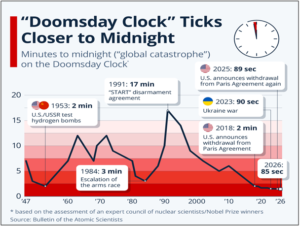
- Bulletin of the Atomic Scientists advanced the 2026 Doomsday Clock to 85 seconds to midnight, underscoring that the world is edging closer to a man-made global disaster.
About Doomsday Clock:
- Nature: It is a symbolic clock adopted by atomic scientists to show how close human beings are considered to be to a global catastrophe.
- Symbolism: Midnight represents total annihilation, while movements away from or toward midnight reflect changes in existential risk.
- Origin: Doomsday Clock was established in 1947 by the Bulletin of the Atomic Scientists (BAS), which was founded two years earlier. During that time, the clock was set at seven minutes to midnight.
- Setting mechanism: The time is adjusted annually by the Bulletin website in consultation with its Board of Sponsors.
- Key determinants: Existential threats include nuclear risk, climate change, disruptive technologies like generative AI and cyberattacks, and biological risks.
- Mechanism: Metaphorically, the clock’s minute hand moves closer to or farther from midnight, depending on the level of threat thought to be posed by nuclear weapons, climate change, or disruptive technologies.
- Current setting: Since its invention in 1947, the clock has been reset 27 times. In January 2026 the clock was set to 85 seconds before midnight, the closest it has ever been to doomsday.
Source:
Category: International Organisations
Context:
- The European Union (EU) and India recently committed to promoting collaboration on the peaceful uses of nuclear energy under the India-Euratom agreement.

About Euratom:
- Full Form: Euratom stands for European Atomic Energy Community.
- Establishment: Euratom is an international organization established under the Treaty of Rome in 1957.
- Objective: It aims to form a common market for the development of the peaceful uses of atomic energy.
-
- Association with nuclear materials: A major incentive for the creation of Euratom was the desire to facilitate the establishment of a nuclear-energy industry on a European rather than a national scale. Euratom’s control was not extended to nuclear materials intended for military use.
- Membership: The original members were Belgium, France, West Germany, Italy, Luxembourg, and the Netherlands. It subsequently came to include all members of the European Union (EU).
- Regulation: Euratom regulates the European civil nuclear industry, which produces almost 30% of energy in the EU. Euratom’s work safeguards nuclear materials and technology, facilitates investment, research, and development, and ensures equal access to nuclear supplies, as well as the correct disposal of nuclear waste.
- Governance: It is governed by the Commission and Council, operating under the jurisdiction of the European Court of Justice. Its main instruments are the Euratom Supply Agency and its research and nuclear safeguard activities.
- Research: The EU has its own Joint Research Centre (JRC) in the nuclear field. Euratom is involved in developing atomic fusion technology, which has the potential of delivering abundant sustainable energy in the future.
Source:
Category: Environment and Ecology
Context:
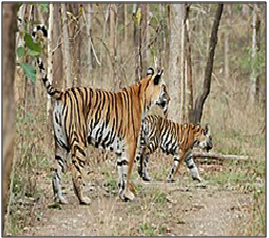
- A young male tiger was found dead inside Chhattisgarh’s Achanakmar Tiger Reserve, with forest officials attributing the death to a territorial clash with another male.
About Achanakmar Tiger Reserve:
-
- Location: It is situated in the state of Chhattisgarh.
- Establishment: Originally a wildlife sanctuary (1975), it was declared a Tiger Reserve in 2009.
- Biosphere connection: It forms the core area of the Achanakmar-Amarkantak Biosphere Reserve, which was recognized by UNESCO in 2012.
- Wildlife corridor: It provides a vital migratory link between Kanha Tiger Reserve and Bandhavgarh Tiger Reserve in Madhya Pradesh, ensuring genetic diversity.
- Drainage: The Maniyari River flows through the heart of the reserve and is considered its lifeline.
- Tribal Communities: It is home to the Baigas (a Particularly Vulnerable Tribal Group or PVTG), as well as the Gond communities, residing inside of this tiger reserve.
- Vegetation: Tropical moist deciduous vegetation covers the majority of the area.
- Flora: Sal, bija, saja, haldu, teak, tinsa, dhawara, lendia, khamar, and bamboo bloom here, along with over 600 species of medicinal plants.
- Fauna: It includes the tiger, leopard, bison, flying squirrel, Indian giant squirrel, chinkara, wild dog, hyena, sambar, chital, and over 150 species of birds.
Source:
Category: Geography
Context:
- A severe winter storm impacting the U.S. from Texas to New England recently highlights the dynamic role of the stratospheric polar vortex.
About Polar Vortex:
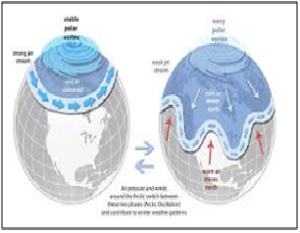
- Nature: The polar vortex is a large area of low pressure and cold air surrounding both of the Earth’s poles. The polar vortex contains some of the coldest air on Earth.
- Extension: The polar vortex extends from the tropopause (the dividing line between the stratosphere and troposphere) through the stratosphere and into the mesosphere (above 50 km).
- Nomenclature: The term “vortex” refers to the counter-clockwise flow of air that helps keep the colder air near the Poles. These winds circulate and form a vortex near the North and South Poles of the planet.
- Intensity: The strength of the polar vortex varies with the season, but it is strongest during the winter season in each hemisphere, when the temperature contrast between the pole and the Equator is greatest. It may weaken or disappear entirely during the warmer months of the year.
- Expansion: Many times, during winter in the northern hemisphere, the polar vortex will expand, sending cold air southward with the jet stream. This occurs fairly regularly during wintertime and is often associated with large outbreaks of Arctic air in the United States.
- Cold surges: This is not confined to the United States. Portions of Europe and Asia also experience cold surges connected to the polar vortex. By itself, the only danger to humans is the magnitude of how cold temperatures will get when the polar vortex expands, sending Arctic air southward into areas that are not typically that cold.
- Difference between Antarctic and Arctic polar front: The Antarctic polar-front jet stream is more uniform and constant than its Arctic counterpart, because Antarctica is surrounded by ocean rather than a mix of land and water. Cold-air outbreaks, however, do occur in the Southern Hemisphere, but less frequently.
Source:
Category: Government Schemes
Context:
- Recently, the Union Minister of State for Panchayati Raj launched the PANCHAM – Panchayat Assistance and Messaging Chatbot.

About PANCHAM:
- Full form: PANCHAM stands for Panchayat Assistance and Messaging Chatbot.
- Development: It is a digital tool developed in collaboration with UNICEF.
- Objective: It is a flagship digital initiative aimed at empowering Panchayat Elected Representatives and Functionaries.
- Focus areas: It is designed as a digital companion for Panchayats, providing timely and contextual guidance, simplified workflows, and easy access to information to support day-to-day governance and service delivery functions.
- Direct connect: It enables, for the first time, a direct digital-connect between the Government of India and Elected Panchayat Functionaries across the country.
- Language support: It is integrated with BHASHINI and will support 22 Indian languages, enabling Panchayat representatives to interact with the platform in their preferred local language.
- Citizen access: Citizens would be able to access PANCHAM through a QR-code-based entry mechanism. It will facilitate quicker decision-making, and stronger feedback loops between the grassroots and decision-making centres.
- Two-way communications: It facilitates two-way communication and officials can send feedback, ask questions, and flag local problems directly to the ministry.
- Information dissemination: The Ministry would be able to directly disseminate circulars, advisories, key messages, and updates to Panchayat Elected Representatives and Functionaries.
Source:
(MAINS Focus)
GS-I: Urbanisation: problems and remedies.
Context (Introduction)
India marks 20 years of the Jawaharlal Nehru National Urban Renewal Mission (JNNURM)—one of the earliest large-scale urban regeneration programmes.
Since 1990, India’s urban population has risen from 25% to about one-third, and is projected to reach ~40% by the end of the decade. This shift signals not just demographic change, but a reorientation of political power, infrastructure priorities, and state–citizen relations.
Core Idea
Urbanisation in India has transformed the city from a site of residence into a site of power. “Urban is the new political” because cities now shape:
- Economic growth strategies
- Infrastructure investment models
- Social aspirations
- Democratic engagement
Urbanisation must therefore be understood as a political and infrastructural process, not just spatial expansion.
Key Arguments & Analysis
- From Agrarian Imagination to Urban Reality (GS-1)
India, long imagined as:
- A village-centric society (Gandhian ideal)
- An agrarian democracy
is now experiencing a decisive urban turn:
- Over 500 million Indians live in towns and cities
- Urban spaces increasingly define youth aspirations, consumption patterns and social mobility
- Evolution of Urban Policy Regime (GS-3)
Post-1990 liberalisation reshaped urban governance through:
- JNNURM (2005) – infrastructure + governance reforms
- AMRUT (2015) – water, sanitation, mobility
- Smart Cities Mission – technology-driven urban management
These programmes reflect a shift from welfare-oriented planning to growth-led urban infrastructure.
- The New Urban Model: Capital Attraction over Citizenship
According to the article, contemporary cities are increasingly designed to:
- Attract global capital
- Enable elite consumption
- Promote urban beautification and gentrification
Manifestations include:
- Gated communities
- Corporate-friendly highways
- Glass towers replacing traditional livelihoods
This top-down urbanism privileges:
- Wealthy residents
- Cosmopolitan elites
- Entrepreneurial classes
often at the cost of:
- Informal workers
- Migrants
- Urban poor
- Infrastructure Conflicts as Political Flashpoints
Urban infrastructure has become a site of contestation:
- Protests against Aravalli hill exploitation
- Opposition to Great Nicobar Island Development Project
- Gig workers’ resistance to platform-based service aggregators
These conflicts reflect:
- Displacement and ecological stress
- Unequal distribution of urban gains
- Weak participatory planning
Urban infrastructure is no longer neutral—it is political.
- Changing State–Citizen Relationship
Urbanisation reshapes democracy itself:
- Citizens engage the state through municipal politics, not just national elections
- Governance shifts from redistribution to service delivery and growth management
- Democracy becomes more managerial, technocratic and uneven
Why It Matters
- Cities generate the bulk of GDP and infrastructure demand
- Urban youth shape future political behaviour
- Poorly governed urbanisation leads to:
- Social unrest
- Ecological degradation
- Democratic alienation
Urbanisation, if exclusionary, can undermine social cohesion and democratic legitimacy.
Way Forward: Towards Good Urban Politics
- Re-centre Citizenship in Urban Planning
- Move beyond capital-centric city building
- Recognise migrants, informal workers and slum dwellers as urban citizens, not encroachments
- Strengthen Urban Local Governments
- Genuine fiscal and functional devolution
- Empower municipalities as democratic institutions, not implementation agencies
- Infrastructure with Social Legitimacy
- Participatory planning
- Environmental safeguards
- Inclusive housing and transport systems
- Balance Growth with Justice
- Avoid “glass-tower urbanism”
- Integrate ecological sustainability with infrastructure expansion
Conclusion
Urbanisation in India is not just about cities growing bigger, but about democracy changing shape. Better cities will not emerge from infrastructure alone. They require good urban politics inclusive, participatory and socially grounded if India’s urban future is to strengthen rather than fragment its democracy.
Mains Question
Urbanisation in India is not merely a demographic shift but a political and infrastructural transformation. Examine how urban growth is reshaping Indian politics and development priorities. (15 marks) (250 words)
GS-I: “Salient features of Indian Society.”
GS-III: “Indian Economy and issues relating to planning, mobilisation of resources, growth, development and employment.”
Context (Introduction)
India possesses extraordinary civilisational depth, cultural diversity and natural beauty, yet attracts only 5.6 million foreign tourists (Aug 2025)—a modest figure for a country of 1.4 billion people. Countries like Thailand and Singapore, despite smaller size, outperform India in tourism receipts and arrivals.
This gap reflects not a lack of heritage, but structural and social deficits in how India delivers the tourism experience.
Core Idea
Tourism is a social experience economy, not just a cultural showcase. India’s tourism underperformance arises from three interlinked societal challenges:
- The Three “I” Deficit
- Image
- Infrastructure
- India itself (social behaviour and service culture)
Unless these are addressed together, India will remain a “tantalising idea rather than a top-tier destination.”
Key Challenges (Indian Society Lens)
- Image Deficit: Perception of Safety and Inclusiveness
- Persistent global concerns about women’s safety, harassment, and scams
- Negative headlines outweigh branding campaigns like ‘Incredible India’
- Tourists seek welcome, trust and predictability, not confrontation
- Infrastructure as a Social Experience
Tourist experience begins at:
- Airports, immigration counters, taxis, public toilets, signage, Wi-Fi. Hospitality sector faces a ~40% trained staff shortfall
Issues:
- Poor last-mile connectivity
- Unreliable sanitation and digital access
- Inconsistent quality outside luxury hotels
- “India Itself”: Social Behaviour and Service Culture
- Overcrowding, noise, aggressive solicitation
- Lack of multilingual professionalism
- Tourism seen as fallback employment, not a respected vocation
Graduates prefer office jobs over hospitality, affecting service quality.
- Gender Dimension
- Women travellers disproportionately affected by safety concerns
- Underrepresentation of women in tourism workforce reduces trust
- Harassment and scams erode India’s social image abroad
Why It Matters
- Tourism creates more jobs per rupee than manufacturing (WTO data)
- Employs unskilled and semi-skilled youth—key for demographic dividend
- Acts as a soft-power amplifier shaping global perceptions of Indian society
- In South Asia, tourism failure has contributed to youth unrest (Sri Lanka, Bangladesh)
Tourism is not just economic—it is a social stabiliser.
Way Forward
- Rebrand Beyond Monuments
- Move from generic branding to segmented narratives:
- Spiritual India, Adventure India, Luxury India, Living India
- Promote curated circuits:
- Buddhist Circuit
- Ramayana Circuit
- Himalayan & Coastal Trails
- Professionalise the Social Interface
- Large-scale vocational training in hospitality
- Multilingual guides and tourist police
- Centralised verified apps for guides, transport, and payments
- Treat tourism as a calling, not casual labour
- Gender-Responsive Tourism
- Hire and train more women in tourism services
- Strong enforcement against harassment and scams
- Safe public spaces and transport as default infrastructure
- Ease of Entry & Welcome Culture
- Expand e-visas, long-term multi-entry visas
- Train immigration officers in courtesy and cultural sensitivity
- “Visa on Arrival for the World” as an aspirational goal
- Sustainable & Community-Based Tourism
- Regulate footfalls at fragile sites
- Promote homestays, eco-lodges, local artisans
- Ensure development does not degrade culture or environment
Conclusion
India does not need to reinvent itself it needs to refine itself. The world is not rejecting India’s culture; it is hesitating at India’s functionality, safety and social experience. Until image, infrastructure and social behaviour align, India will remain admired from afar but avoided in practice. Making India functional is the first step to making India unforgettable.
Mains Question
- Tourism is not merely about heritage and culture but about social experience, safety and functionality. Critically examine India’s tourism challenges and suggest measures to make India a truly global destination. (15 marks) (250 words)
