

Archives
(PRELIMS Focus)
Category: Geography
Context:
- A panel under the Ministry of Environment, Forest and Climate Change recently approved the Dulhasti Stage-II hydropower project in Jammu & Kashmir.
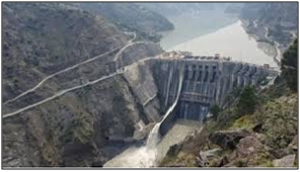
About Dulhasti Stage II Hydropower Project:
- Location: It is a 260-megawatt hydropower project proposed on the Chenab River in the Kishtwar District of Jammu and Kashmir.
- Nature: It is an extension of the existing 390 MW Dulhasti Stage-I Hydroelectric Project (Dulhasti Power Station), which has been successfully operating since its commissioning in 2007.
- Construction: It is developed by the National Hydroelectric Power Corporation Limited (NHPC) Limited on a Build, Own, Operate, and Transfer (BOOT) basis.
- Cost: The project is estimated to cost more than Rs 3,200 crore.
- Type: It is a run-of-the-river project. It uses the natural flow and elevation drop of Chenab river to produce electricity without creating a large reservoir for water storage.
- Composition: The project includes a surge shaft, a pressure shaft, and an underground powerhouse housing two 130 MW units, resulting in a total installed capacity of 260 MW and an annual energy generation.
- Mechanism: Under the plan, water will be diverted from the Stage-I power station through a separate tunnel measuring 3,685 metres in length and 8.5 metres in diameter to form a horseshoe-shaped pondage for Stage-II.
- Source of water: The project will divert water from the Stage-I power station through a 3,685-metre-long tunnel. It also aims to draw water from the Marusudar River (a major tributary of the Chenab) via the Pakal Dul project to optimize generation.
- Strategic significance: The project gained momentum after the suspension of the Indus Water Treaty (IWT), 1960, following the Pahalgam terror attack.
Source:
Category: Defence and Security
Context:
- Prime Minister, Shri Narendra Modi congratulated the designers, artisans, shipbuilders and the Indian Navy for their dedicated efforts in bringing INSV Kaundinya to life.

About INSV Kaundinya:
- Nature: It is a stitched ship which is inspired by a fifth-century vessel shown in Ajanta cave paintings.
- Nomenclature: It is named after Kaundinya, a legendary Indian mariner credited with founding the Funan kingdom in Southeast Asia (modern-day Cambodia/Vietnam) about 2,000 years ago
- Collaboration: It is a joint initiative of the Indian Navy, Ministry of Culture, and Hodi Innovations.
- Technique used: It has been built using traditional stitching techniques instead of metal nails. Artisans from Kerala used coconut fibre, coir rope, wooden joinery, natural resins, and cotton sails.
- Use of motifs: It features symbolic motifs like Gandabherunda (mythical two-headed eagle), a Simha Yali and a Harappan-style stone anchor on the deck.
- Significance: It showcases India’s ancient maritime traditions. It reflects India’s historic role in trade, cultural exchange, and modern maritime diplomacy.
Source:
Category: Science and Technology
Context:
- Recently, researchers at IIT Delhi developed an AI system named AILA that can perform real scientific experiments, just like human scientists.

About AILA (Artificially Intelligent Lab Assistant):
- Nature: It is an AI agent which can independently run complex scientific experiments, analyse results, and make decisions in real time.
- Development: It was developed by IIT Delhi researchers in collaboration with scientists from Denmark and Germany.
- Difference with earlier AI tools: Unlike earlier AI tools that mainly helped with writing or data analysis, AILA works directly with laboratory instruments.
- Significance: It can operate real scientific equipment, particularly the Atomic Force Microscope (AFM), one of the most delicate and complex instruments used to study materials at the nanoscale.
- Uniqueness: The agent has helped reduce the time taken to optimize high-resolution AFM imaging from 24 hours to 7–10 minutes. It performs experiments much like a trained scientist.
- Interface: It utilizes a chat-based interface where instructions in plain English are converted into executable computer code.
- Mechanism: When AILA is instructed to perform an experiment, it writes the necessary code, operates the scientific instrument, collects data, and analyses the results on its own. The entire scientific workflow, data generation, processing, and interpretation, is automated through AILA.
Source:
Category: Environment and Ecology
Context:
- Fisher-folk have urged the Centre to include their representatives in policymaking bodies to attain the goal of responsible fishing in the Exclusive Economic Zone (EEZ).
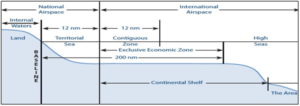
About Exclusive Economic Zone (EEZ):
- Definition: An EEZ is an area of the ocean, generally extending 200 nautical miles (230 miles) beyond a nation’s territorial sea, within which a coastal nation has jurisdiction over both living and non-living resources.
- Associated convention: The concept of an exclusive economic zone (EEZ) was adopted through the 1982 United Nations Convention on the Law of the Sea.
- Rights involved: Under international law, within its defined EEZ, a coastal nation has:
- Sovereign rights for the purpose of exploring, exploiting, conserving, and managing natural resources of the seabed, subsoil, and waters above it.
- Jurisdiction as provided for in international law with regard to the establishment and use of artificial islands, installations, and structures; marine scientific research; and the protection and preservation of the marine environment.
- Other rights and duties provided for under international law.
- Fishing quotas: UNCLOS (United Nations Convention on the Law of the Sea) indicates that the coastal state determines the acceptable level of fishing quotas in its EEZ, with a focus on sustainable management.
- Exchange of information: Provisions under UNCLOS also provide for the regular exchange of information about the populations of resources in an EEZ in order to promote international scientific cooperation.
- Removal of marine hazards: EEZs have also been used to determine which country is responsible for removing marine hazards such as space debris.
- Rights of other states: UNCLOS establishes rights for how other countries may access the waters in an EEZ. Other States have the right for their ships and aircraft to traverse the EEZ and its airspace and to lay cables and pipelines.
- India and EEZ: India’s maritime zones are defined by the Territorial Waters, Continental Shelf, Exclusive Economic Zone and Other Maritime Zones Act, 1976. India’s EEZ covers approximately 2.30 to 2.37 million sq. km and includes areas around the Lakshadweep and Andaman and Nicobar Islands.
Source:
Category: Polity and Governance
Context:
- Recently, CAQM outlined a detailed strategy to curb air pollution in Delhi, projecting an increase in the number of clear “blue-sky” days over the next three to four years.
About Commission for Air Quality Management (CAQM):
-
- Nature: The CAQM is a statutory body established under the Commission for Air Quality Management in National Capital Region (NCR) and Adjoining Areas, Act 2021.
- Objective: It aims for betterment in terms of coordination, research, identification, and resolution of problems surrounding the air quality index and for matters connected therewith or incidental thereto.
- Replacement: It replaced the Environment Pollution (Prevention and Control) Authority (EPCA), which was a non-statutory body created by the Supreme Court.
- Focus on Delhi-NCR: It undertakes action for the prevention and control of Air pollution in Delhi-NCR and coordinate its actions on monitoring of air quality with the government of Delhi and the adjoining states, which includes Punjab, Haryana, Rajasthan, and Uttar Pradesh.
- Binding orders: All the directions and orders by the Commission are of binding nature, and any person, officer, or authority shall be bound to comply with the same.
- Accountability: The commission is directly accountable to the parliament.
- Major powers:
-
- Restricting activities influencing air quality.
- Investigating and conducting research related to environmental pollution impacting air quality, preparing codes and guidelines to prevent and control air pollution,
- Issuing directions on matters including inspections, or regulations, which will be binding on the concerned person or authority.
- Composition: It will be chaired by a government official of the rank of Secretary or Chief Secretary. It will also have five ex officio members who are either Chief Secretaries or Secretaries in charge of the department dealing with environment protection in the States of Delhi, Punjab, Haryana, Rajasthan, and Uttar Pradesh.
Source:
(MAINS Focus)
(GS Paper II: Effect of Policies and Politics of Developed and Developing Countries on India’s Interests)
Context (Introduction)
The global order in 2025 is undergoing a structural transition marked by diffusion of power across regions, yet dominated by an intensifying U.S.–China rivalry, with Russia acting as a pivotal swing power shaping strategic outcomes.
Current Situation: Nature of the Emerging Global Order
- End of unipolarity: The post–Cold War U.S.-led unipolar moment has decisively ended, visible since Russia’s annexation of Crimea (2014) and its sustained capacity to defy Western sanctions.
- Persistence of U.S. dominance: The U.S. remains the world’s largest military spender and technological leader but no longer enjoys uncontested influence.
- China as systemic challenger: China’s economy has reached roughly two-thirds of U.S. GDP and continues to grow faster, translating economic strength into military and technological power.
- Russia as swing power: Despite a weaker economy, Russia’s nuclear arsenal, energy resources and willingness to use force preserve its great power status.
- Bipolar core: Strategic outcomes are increasingly shaped by U.S.–China competition, lending bipolar characteristics to an otherwise multipolar system.
- Fluidity and uncertainty: Unlike the Cold War, the emerging order lacks stable blocs, increasing unpredictability and risks of miscalculation.
India’s Position in the Emerging Order
- Natural middle power: India’s economic size, demographic strength and geopolitical location place it among key middle powers navigating the transition.
- Strategic autonomy: India avoids formal alliances, engaging simultaneously with the U.S., Russia, China, Europe and the Global South.
- Issue-based alignment: Participation in QUAD, BRICS, SCO and G20 reflects India’s multi-alignment approach.
- Economic opportunity: Supply chain diversification and re-globalisation offer India manufacturing and investment prospects.
- Security challenges: Intensifying U.S.–China rivalry and China’s regional assertiveness directly affect India’s neighbourhood.
- Diplomatic leverage: Fluid multipolarity expands India’s space for agenda-setting in global governance reforms.
Need of the Hour: Policy Imperatives for India
- Strengthen strategic autonomy: Maintain flexibility to avoid entanglement in great-power rivalry.
- Deepen economic resilience: Accelerate manufacturing, technology and energy security to withstand global fragmentation.
- Shape regional order: Play a stabilising role in the Indo-Pacific and Indian Ocean Region.
- Lead Global South: Use platforms like G20 and BRICS to amplify developing country concerns.
- Reform multilateralism: Push for UN and global financial institution reforms reflecting new power realities.
- Balance deterrence and diplomacy: Manage China challenge while keeping dialogue channels open.
Conclusion
The emerging world order is multipolar in structure but bipolar in strategic thrust. For India, this transition presents both risks and opportunities. By sustaining strategic autonomy, strengthening domestic capacity and practising proactive diplomacy, India can convert global uncertainty into long-term strategic advantage.
UPSC Mains Question
“In a world that is multipolar but strategically bipolar, middle powers have greater responsibility but narrower margins for error.” Discuss with reference to India’s foreign policy choices. (250 words,15 marks )
Source: The Hindu
(GS Paper II – Polity: Fundamental Rights, Social Justice | GS Paper I – Society)
Context (30–40 words)
The death of Angel Chakma, a student from Tripura, following a violent assault in Uttarakhand has once again exposed the persistence of hate crimes in India, particularly against people from the Northeast, raising concerns over dignity, equality and internal security.
Current Status of Hate Crimes in India
- Rising incidents: NCRB data shows a steady rise in crimes motivated by identity—caste, tribe, region, religion—though “hate crime” is not a separate legal category.
- Northeast vulnerability: Students and migrant workers from the Northeast frequently report racial profiling, stereotyping and violence in mainland cities.
- Under-reporting: Fear of harassment, delayed FIRs and social pressure lead to significant under-reporting of hate-based violence.
- Legal fragmentation: Hate crimes are prosecuted under IPC provisions (murder, assault) and special laws like SC/ST (PoA) Act, without recognising bias motivation separately.
- Institutional response: Bodies like NHRC often intervene post-facto, highlighting systemic gaps in prevention.
- Public protests: Repeated incidents trigger protests and solidarity marches, reflecting erosion of trust in local law enforcement.
Structural Reasons Behind Hate Crimes
- Stereotyping and racism: Racialised perceptions of Northeast citizens as “foreign” persist despite constitutional equality.
- Weak deterrence: Low conviction rates in atrocity-related crimes reduce deterrence value of existing laws.
- Delayed policing: Past cases (e.g., Nido Tania, 2014) show delayed FIRs and poor sensitivity training.
- Urban anonymity: Migrants lack local social capital, making them easy targets.
- Social media amplification: Hate narratives spread rapidly, normalising everyday discrimination.
- Limited awareness: Citizens often remain unaware that racial abuse and targeted violence constitute serious offences.
Key Reports and Committees
- Bezbaruah Committee (2014):
- Recommended treating racial discrimination as a specific offence.
- Called for fast-track courts for crimes against Northeast citizens.
- Emphasised police sensitisation and legal awareness campaigns.
- NHRC Observations:
- Repeatedly flagged lack of uniform hate crime data.
- Highlighted failure of States to implement preventive mechanisms.
- Law Commission Discussions:
- Suggested need for recognising motive-based crimes to strengthen prosecution.
Previous Similar Cases
- Nido Tania (2014, Delhi): Death following racist assault; led to Bezbaruah Committee.
- Manipuri student attacks (Bengaluru, 2017): Highlighted pattern of regional bias.
- Recent assaults on migrant workers: Indicate spillover of identity politics into everyday violence.
Actions Taken in the Angel Chakma Case
- Criminal action: Multiple arrests including adults and juveniles; absconding accused pursued across borders.
- Legal provisions invoked: SC/ST (Prevention of Atrocities) Act, 1989 and Protection of Civil Rights Act, 1955.
- Compensation: Interim relief provided to the victim’s family under statutory schemes.
- NHRC intervention: Notice issued to district authorities, demanding accountability.
- Political condemnation: Cross-party condemnation reflects national concern, though policy response remains limited.
- Public scrutiny: Protests and civil society pressure have kept the issue in national focus.
Gaps and Challenges
- No hate crime law: Absence of a distinct legal category obscures motive-based violence.
- Policing deficits: Lack of cultural sensitivity training among frontline police.
- Jurisdictional bias: Victims face hostility when crimes occur outside home States.
- Weak data: NCRB does not publish consolidated hate crime statistics.
- Reactive approach: State response remains largely post-incident.
- Trust deficit: Repeated denials of bias undermine faith in institutions.
Way Forward
- Legal recognition: Introduce hate crime as a distinct offence, incorporating motive-based sentencing.
- Implement Bezbaruah Committee recommendations: Fast-track courts, special cells and monitoring mechanisms.
- Police sensitisation: Mandatory training on diversity, internal migration and racial discrimination.
- Data reform: NCRB to publish disaggregated hate crime data.
- Preventive outreach: University and city-level support systems for migrant students and workers.
- Social transformation: Public campaigns reinforcing constitutional fraternity and national integration.
Conclusion
The Angel Chakma case is not an isolated crime but a mirror to deeper social fault lines. Without legal clarity, institutional sensitivity and preventive frameworks, hate crimes will continue to threaten India’s constitutional promise of equality, dignity and unity in diversity.
UPSC Mains Question
- “Hate crimes are not merely law-and-order issues but reflect deeper social and institutional failures.”
Discuss in the context of recent incidents involving internal migrants in India.(250 words, 15 marks)
Source: The Hindu