

Archives
(PRELIMS Focus)
Category: Science and Technology
Context:
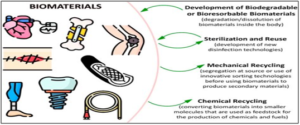
- As countries look to shift to cleaner processes to manufacture consumer products, biomaterials will become the new frontier of materials engineering.
About Biomaterials:
-
- Nature: Biomaterials refer to materials that are derived wholly or partly from biological sources or are engineered using biological processes to replace or interact with conventional materials.
- Usage: Unlike traditional petroleum-based materials, biomaterials are designed to reduce environmental impact while supporting sustainable production systems. They are increasingly used in sectors such as packaging, textiles, construction, and healthcare.
-
- Classification: Broadly, biomaterials are classified into three categories.
- Drop-in biomaterials are chemically identical to petroleum-based materials and can be used in existing manufacturing systems without major modifications. Examples include bio-PET used in packaging.
- Drop-out biomaterials are chemically different and require new processing or end-of-life systems, such as polylactic acid (PLA), which needs industrial composting.
- Novel biomaterials go a step further by offering entirely new properties, including self-healing materials, bioactive implants, and advanced composites with enhanced performance characteristics.
- Significance: The development of biomaterials is seen as the next frontier in materials engineering as industries attempt to reduce carbon footprints and comply with tightening environmental regulations.
- Classification: Broadly, biomaterials are classified into three categories.
- Global Developments:
-
-
- The European Union has introduced binding regulations under its Packaging and Packaging Waste Regulation, recognising the environmental benefits of compostable materials in specific applications.
- The United States supports biomaterials through government procurement policies, particularly under programmes that prioritise bio-based products.
- Meanwhile, countries like the UAE are positioning themselves as major manufacturing hubs through large-scale investments in PLA production.
- These global developments underscore the competitive urgency for India to scale up its biomaterials ecosystem.
-
- Current Status of Biomaterials in India:
-
-
- India’s biomaterials sector, encompassing bioplastics, biopolymers, and bio-derived materials, is at an early but rapidly emerging stage.
- The bioplastics market alone was valued at around $500 million in 2024 and is expected to grow steadily through the decade. Several domestic initiatives highlight this transition.
- Large-scale investments such as the planned PLA plant by Balrampur Chini Mills in Uttar Pradesh mark a significant step toward commercial-scale biomanufacturing.
-
- Indian start-ups are also playing a role, with enterprises converting agricultural and floral waste into value-added biomaterials.
Source:
Category: Economy
Context:
- Tickets for 170 ASI protected heritage sites and museums can now also be purchased online through Open Network for Digital Commerce (ONDC).
About Open Network for Digital Commerce (ONDC):
-
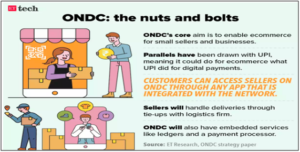
- Nature: Open Network for Digital Commerce (ONDC) is a network of interconnected e-marketplaces through which sellers, including brands, can list and sell their products directly to customers bypassing any middlemen or intermediaries.
- Objective: It is aimed at promoting open networks for all aspects of exchange of goods and services over digital or electronic networks.
- Significance: It allows transitioning from a platform-centric model to an open source network for buying and selling goods and services.
- Launch: It was incorporated in 2021 with initial investment from Quality Council of India (QCI) and Protean eGov Technologies Limited (formerly NSDL e-Governance Infrastructure Limited).
- Nodal ministry: It was launched under the Department for Promotion of Industry and Internal Trade (DPIIT) by the Ministry of Commerce as part of the Digital India initiative.
- Similarity: Similar to the Unified Payments Interface (UPI), ONDC aims to level the operational playing field among e-commerce platforms.
- Objectives:
-
- Democratisation and decentralisation of e-Commerce
- Inclusivity and access for sellers, especially small and medium enterprises as well as local businesses
- Increased choices and independency for consumers
- Making goods and services cheaper.
- Working Mechanism: It functions on the basis of an open network where it will not be a single platform similar to Amazon or Flipkart but rather in the form of a gateway where buyers and sellers across different platforms will be able to connect.
Source:
Category: History and Culture
Context:
- Prime Minister Narendra Modi extended greetings to the nation on the commencement of Somnath Swabhiman Parv.

About Somnath Temple:
- Deity: It is a Hindu temple dedicated to Lord Shiva.
- Location: It is located in Prabhas Patan near Veraval in Saurashtra on the western coast of Gujarat.
- Uniqueness: It is the first of the 12 jyotirlinga shrines in India that are regarded as the manifestation of the Lord Shiva Himself.
- Religious significance: References to the temple are found in ancient texts like Skandpuran, Shreemad Bhagavat, Shivpuran, and the Rig-Veda. It is also the Neejdham Prasthan Leela site where Lord Shri Krishna took his last journey.
- Geographical Significance: Situated at the confluence of Kapila, Hiran, and Saraswati rivers with the Arabian Sea. Abadhit Samudra Marg (Tirth Stambh) indicates an uninterrupted sea route to the South Pole, with the nearest landmass ~9,936 km away, reflecting ancient Indian geographical knowledge.
- Timeline: The ancient temple’s timeline can be traced from 649 BC but is believed to be older than that.
- Construction: According to tradition, it was built in phases—first in gold by Somraj (Moon God), then in silver by Ravana, later in wood by Lord Krishna. King Bhimdev I (or Bhima I) of the Solanki dynasty rebuilt the temple in stone after its destruction by Mahmud of Ghazni in 1026 CE.
- Attacks and reconstructions: First major attack on the temple took place in 1026 AD by Mahmud of Ghazni (documented by Al-Biruni). The temple was looted and destroyed multiple times, including in 1026, 1297, 1394, and 1706 CE (Aurangzeb). 2026 marks 1,000 years since the first attack, a significant civilisational milestone.
- Present form: The existing temple was rebuilt post-independence as a symbol of national resurgence. Sardar Vallabhbhai Patel initiated the reconstruction in 1947. The Pran-Pratistha was performed by President Dr. Rajendra Prasad in May, 1951.
Source:
Category: Environment and Ecology
Context:
- Ahead of the sea turtle nesting season, the forest department has intensified conservation measures along the Mangaluru coastline by setting up hatcheries.

About Olive Ridley Sea Turtles:
-
- Nature: They are the smallest and most abundant of all sea turtles found in the world.
- Nomenclature: It gets its name from the olive green colouration of its carapace (shell).
- Uniqueness: It is best known for its unique mass nesting, called Arribada, where thousands of females come together on the same beach to lay eggs.
- Global spread: They are mainly found in the warm waters of the Pacific, Atlantic, and Indian oceans.
- Distribution in India: Major nesting beaches along the Odisha coast (Gahirmatha, Rushikulya, Devi River mouth), solitary nesting also occurs along the Tamil Nadu, Andhra Pradesh, and Andaman coasts.
-
- Largest rookery: Odisha’s Gahirmatha Marine Sanctuary is known as the world’s largest rookery (a colony of breeding animals) of sea turtles.
- Omnivorous: They are omnivorous, meaning they feed on both plants and animals.
- Solitary: They are solitary, preferring the open ocean. These turtles spend their entire lives in the ocean, and migrate thousands of kilometers between feeding and mating grounds in the course of a year.
- Conservation Status:
- IUCN Red List: Vulnerable
- Wildlife Protection Act, 1972: Schedule 1
- CITES: Appendix I.
Source:
Category: Defence and Security
Context:
- Indian Army signed a ₹293 crore contract with private defence manufacturer NIBE Limited, for the supply of an advanced long-range rocket launcher system Suryastra.

About Suryastra Rocket Launcher System:
- Nature: It is an advanced long-range rocket launcher system.
-
- Development: It is developed by Pune-based NIBE Limited in collaboration with Israel’s Elbit Systems.
- Uniqueness: It is India’s first indigenous universal multi-calibre rocket launcher system.
- Range: It is capable of executing precision surface-to-surface striking targets at ranges of 150 and 300 kilometers.
- Multi-target Capability: It is designed to engage multiple targets simultaneously at varying ranges.
- Precision: It achieves a high degree of accuracy with a circular error probable (CEP) of less than five metres during trials. The same launcher is also capable of firing loitering munitions up to a range of 100 km.
- Technologies used: The system is based on Elbit Systems’ PULS (Precise & Universal Launching System) launcher technology. It is equipped with a modern fire control system that integrates GPS, inertial navigation, and digital ballistic computation.
Source:
(MAINS Focus)
GS-II: Issues relating to development and management of Social Sector/Services relating to Health.
Context (Introduction)
Antimicrobial Resistance (AMR) has emerged as one of India’s most serious public health challenges. The Prime Minister’s reference to AMR in the December 2025 Mann Ki Baat broadcast marks a rare moment of political signalling on the issue. This intervention has the potential to mainstream AMR as a public concern, but awareness alone will be insufficient without systemic strengthening of surveillance and governance.
Core Idea
AMR occurs when microorganisms evolve resistance to antibiotics due to their irrational and excessive use. In India, AMR has expanded beyond hospitals into communities, agriculture, and the environment, demanding a comprehensive One Health approach that integrates human, animal, and environmental health systems.
Problem Diagnosis: Gaps in India’s AMR Response
- Indiscriminate antibiotic use: Self-medication and over-the-counter availability have accelerated resistance, reducing the effectiveness of antibiotics for common infections.
- Surveillance blind spots: India’s AMR surveillance network remains heavily urban- and tertiary-care-centric, failing to capture community-level resistance patterns.
- Limited representativeness: The National AMR Surveillance Network (NARS-Net) and WHO’s GLASS data draw from a restricted number of sites, excluding large non-urban populations.
- Exclusion of private healthcare: Absence of private hospitals from routine surveillance weakens the national resistance picture.
- Fragmented implementation: While policy frameworks exist, enforcement, monitoring, and investment remain uneven.
Why It Matters
- Threat to health security: Rising resistance undermines treatment of pneumonia, urinary tract infections, and post-surgical care.
- Economic burden: AMR increases healthcare costs, prolongs illness, and reduces workforce productivity.
- Equity concern: Rural and primary-care settings face higher vulnerability due to poor diagnostics and delayed treatment.
- Global obligation: India’s AMR trends influence global health outcomes, given its population size and pharmaceutical footprint.
Way Forward
- Expand AMR surveillance to secondary and primary healthcare centres, especially in non-urban regions
- Mandate inclusion of private hospitals and laboratories in national surveillance systems
- Strengthen enforcement of prescription-only antibiotic sales
- Integrate AMR awareness with behavioural change campaigns beyond episodic messaging
- Operationalise a robust One Health framework linking human health, veterinary use, and environmental controls
Conclusion
Political acknowledgement of AMR is a necessary first step, but India’s real challenge lies in fine-tuning surveillance, regulation, and enforcement. Without representative data and systemic integration, AMR will continue to outpace policy responses. A strengthened, inclusive surveillance architecture is essential to convert awareness into effective national action against one of the gravest health threats of the 21st century.
Mains Question
Antimicrobial Resistance (AMR) is no longer a confined clinical issue but a systemic public health and governance challenge. Examine the major gaps in India’s response to AMR and discuss how strengthening surveillance and adopting a One Health approach can improve health outcomes. (250 words, 15 marks)

GS-II: Government policies and interventions and issues arising out of their design and implementation.
GS-III: Various Security forces and agencies and their mandate; Challenges to internal security through communication networks and role of technology.
Context (Introduction)
India’s experience with terrorism, particularly the 26/11 Mumbai attacks, exposed serious intelligence coordination failures. In response, the National Intelligence Grid (NATGRID) was conceived as a technological solution to aggregate scattered datasets for counter-terrorism. However, NATGRID’s evolution from a limited intelligence-sharing tool into a vast analytics-driven surveillance architecture raises serious constitutional, governance, and security concerns.
Core Idea
NATGRID was originally envisaged as a middleware platform enabling authorised agencies to query multiple databases to prevent intelligence failures. Its contemporary expansion—marked by large-scale data access, integration with the National Population Register (NPR), and algorithmic analytics signals a shift from targeted intelligence to population-scale surveillance, blurring the line between national security and everyday policing.
Problem Diagnosis: Governance and Security Risks
- Absence of statutory backing: NATGRID operates through executive orders without a dedicated parliamentary law, weakening democratic accountability.
- Mass surveillance creep: Expansion of access to police units and routine policing functions normalises extraordinary surveillance powers.
- Integration with NPR: Linking population registers with intelligence databases shifts surveillance from event-based tracking to continuous citizen profiling.
- Algorithmic opacity: Tools such as “entity resolution” rely on probabilistic inference, increasing risks of false positives and discriminatory outcomes.
- Oversight deficit: Lack of independent judicial or parliamentary supervision enables unchecked data access and mission creep.
Why It Matters
- Constitutional implications: The Supreme Court in Justice K.S. Puttaswamy v. Union of India (2017) recognised privacy as a fundamental right, requiring legality, necessity, and proportionality for state surveillance standards NATGRID currently struggles to meet.
- Rule of law and accountability: Intelligence failures are often institutional, not data-deficit driven; technology cannot substitute governance reform.
- Internal security effectiveness: Over-reliance on mass data risks diluting actionable intelligence, repeating the very coordination failures NATGRID sought to fix.
- Social cohesion: Automated suspicion disproportionately impacts vulnerable communities, risking alienation and long-term security blowback.
Way Forward: Rebalancing Security and Liberty
- Enact a comprehensive statutory framework for NATGRID with clear purpose limitation
- Establish independent oversight mechanisms involving Parliament and judiciary
- Limit access strictly to counter-terrorism and serious national security threats
- Mandate algorithmic transparency, auditability, and bias safeguards
- Re-emphasise human intelligence and institutional coordination over data maximalism
Conclusion
The trauma of 26/11 continues to shape India’s security imagination, but the response risks overshooting the constitutional balance. Without statutory grounding, independent oversight, and proportional use, NATGRID risks becoming an infrastructure of digital authoritarianism rather than a tool of effective security. True prevention lies not in omnipresent surveillance, but in accountable intelligence systems rooted in constitutional values.
Mains Question
- Post-26/11 intelligence reforms in India have increasingly relied on large-scale data aggregation and algorithmic surveillance mechanisms such as NATGRID. Critically examine whether such technology-driven intelligence architectures strengthen internal security or risk undermining constitutional governance and civil liberties. (250 words, 15 marks)
