

Archives
(PRELIMS Focus)
Category: International Organisations
Context:
- The Madhya Pradesh State Tiger Strike Force has successfully apprehended an international wildlife offender wanted under an INTERPOL Red Notice.
About Interpol:
- Nomenclature: Interpol stands for International Criminal Police Organization.
- Nature: It is an international organization facilitating international police cooperation against cross-border terrorism, trafficking, and other crime.
- Headquarters: Its headquarters is located in Lyon, France.
- Uniqueness: It is the world’s largest international police organization, representing 195 member countries.
- Official Languages: These include Arabic, English, French, and Spanish.
- Status: It is ‘not’ a unit or part of a united nation system. It is an independent international organization.
- First point of contact: It is often the first point of contact for many countries pursuing an international investigation. It does not actively investigate crimes.
- Governance: The General Assembly, consisting of one delegate from each member country, is Interpol’s supreme decision-making body. Interpol’s day-to-day operation is managed by a General Secretariat under the direction of a Secretary General, who is appointed for a five-year term by the General Assembly.
- India’s representation: The Central Bureau of Investigation (CBI) represents Interpol in India as the country’s National Central Bureau (NCB).
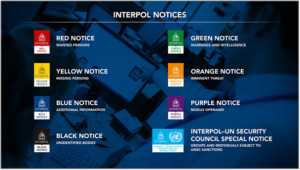
- Types of Notices issued by Interpol: It issues 8 types of notices (7 of which are colour-coded) to share critical crime-related information.
- Red Notice: To seek the location and arrest of a person wanted by a judicial jurisdiction or an international tribunal with a view to his/her extradition. It is the “closest instrument to an international arrest warrant”.
- Blue Notice: To locate, identify, or obtain information on a person of interest in a criminal investigation.
- Green Notice: To warn about a person’s criminal activities if that person is considered to be a possible threat to public safety.
- Yellow Notice: To locate a missing person or to identify a person unable to identify himself/herself.
- Black Notice: To seek information on unidentified bodies.
- Orange Notice: To warn of an event, a person, an object, or a process representing an imminent threat and danger to persons or property.
- Purple Notice: To provide information on modus operandi, procedures, objects, devices, or hiding places used by criminals.
- Interpol-UNSC Special Notice: To inform Interpol’s members that an individual or an entity is subject to UN sanctions.
Source:
Category: Defence and Security
Context:
- Defence Minister recently inaugurated 125 border infrastructure projects, marking the highest number of inaugurations by Border Roads Organisation in a single day.
About Border Roads Organisation (BRO):
- Nature: It is a road construction executive force in India that provides support to the Indian Armed Forces.
- Establishment: It was formed on 7 May 1960 to secure India’s borders and develop infrastructure in remote areas of the north and northeastern states of the country.
- Mandate: It develops and maintains road networks in India’s border areas and friendly neighbouring countries. This includes infrastructure operations in 19 states and three union territories (including Andaman and Nicobar Islands) and neighbouring countries such as Afghanistan, Bhutan, Myanmar, Tajikistan, and Sri Lanka.
- Nodal ministry: It was entirely brought under the Ministry of Defence in 2015 to enhance border connectivity and operational efficiency (though it previously received funds from the Ministry of Road Transport & Highways).
- Motto: Its motto is ‘Shramena Sarvam Sadhyam (everything is achievable through hard work).’
- Specialisation: It specialises in constructing and maintaining Roads, Bridges, Tunnels, Airfields and Marine Works across some of the world’s most challenging terrains.
- Role during national emergencies: It has an operational role during national emergencies, when it provides direct support to the Army in the maintenance of roads in the forward zones. It also provides the workforce for the rehabilitation of certain forward airfields of the Indian Air Force during operations.
- Inclusion in Order of Battle: It is included in the Order of Battle of the Armed Forces, ensuring their support at any time.
- Leadership: The Government of India has set up the Border Roads Development Board (BRDB) with the Prime Minister as Chairman of the Board and the Defence Minister as Deputy Chairman.
- Cadre: Officers and personnel from the General Reserve Engineer Force (GREF) form the parent cadre of the BRO. It is also staffed by officers and troops drawn from the Indian Army’s Corps of Engineers on extra-regimental employment (on deputation).
Source:
Category: Government Schemes
Context:
- Government of India recently said that it will not impose any penalties for next three months against those who have not registered waqf properties on the UMEED Portal.
About UMEED Portal:
-
- Full form: UMEED stands for ‘Unified Waqf Management, Empowerment, Efficiency, and Development.’
- Mandate: It acts as the centralized digital platform for real-time uploading, verification, and monitoring of Waqf properties.
- Nodal Ministry: It comes under Ministry of Minority Affairs, Government of India.
- Legal Support: It was formed under the Unified Waqf Management, Empowerment, Efficiency and Development Act, 1995.
- Management: Under this initiative, the registrations of properties are facilitated by respective State Waqf Boards.
- Key Features of the portal:
-
-
- Time-Bound Registration: All Waqf properties must be registered within 6 months of launch.
- Geotagging and Digitization: Properties must include precise measurements and geolocation data during registration.
- Dispute Resolution: Unregistered properties after deadline will be declared disputed and sent to Waqf Tribunal.
- User Support Services: Provides legal awareness tools and clarifies rights under amended law.
- Women-Centric Provision: Properties under women’s names cannot be designated as Waqf, but women, children, and EWS will remain eligible beneficiaries.
-
- Major objectives of the portal:
-
- To ensure transparent and time-bound registration of Waqf properties.
- To empower beneficiaries with digital access to rights, obligations, and legal safeguards.
- To resolve long-standing property disputes and enhance accountability.
- To facilitate policy-level insights through real-time data and geotagged mapping.
Source:
Category: Science and Technology
Context:
- Despite a highly effective vaccine, measles caused approximately 95,000 deaths globally in 2024, primarily among unvaccinated children under five.
About Measles:
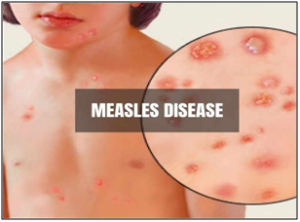
- Nature: Measles is a highly contagious, serious airborne disease caused by a virus.
- Causative agent: It is caused by a virus in the paramyxovirus family.
- Transmission: It is one of the world’s most contagious diseases, spread by contact with infected nasal or throat secretions (coughing or sneezing) or breathing the air that was breathed by someone with measles.
- Affected body part: The virus primarily infects the respiratory tract, and then spreads throughout the body, causing severe disease, complications, and even death.
- Symptoms: The first sign of measles is usually high fever, beginning about 10 to 14 days after exposure to the virus. A runny nose, cough, red and watery eyes, and small white spots inside the cheeks can also develop in the initial stage.
- Vulnerable people: Any non-immune person (not vaccinated or vaccinated but did not develop immunity) can become infected. Unvaccinated young children and pregnant persons are at the highest risk of severe measles complications.
- Global spread: It is common, particularly in parts of Africa, the Middle East, and Asia.
- Treatment: No specific antiviral treatment presently exists for measles.
- Prevention: It can be prevented with a safe and effective measles-rubella (MR) vaccine that gives long-term immunity.
- Step taken by India: The Government of India (GoI) introduced the measles vaccine in its Universal Immunization Programme in 1985.
Source:
Category: History and Culture
Context:
- The Karnataka High Court recently allowed the festival of “Hori Habba” but directed strict compliance of conditions laid by the Supreme Court in the Jallikattu matter.
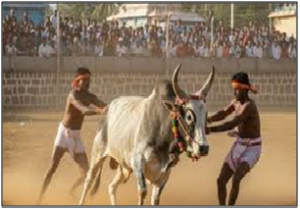
About Hori Habba Festival:
- Location: It is primarily practiced in the rural areas of Karnataka, especially in the Shivamogga, Haveri, Davangere, and Uttara Kannada districts.
- Nature: It is an ancient bull-taming game native to Haveri district, and played on the lines of Jallikattu in Tamil Nadu and Kambala in Dakshina Kannada district.
- Celebration time: It is held during the harvest season, typically after the Diwali festival and extending up to Sankranti.
- Other names: It is also known as Hatti Habba or Kobbari Hori Competition.
- Rituals: Trained and decorated draught cattle and bulls are made to run through large crowds. Participants attempt to subdue the animals and snatch prizes, such as dried coconuts (copra), cash, or other gift items, that are tied to their necks or horns.
- Cultural Significance: It symbolizes the cultural bond between humans and bulls in the local community, showcasing courage and unity.
- Symbol of Status: In rural areas of Shivamogga and Haveri, the social status of an individual is often determined by the quality of the bulls they rear for the event, not by material possessions like cars.
- Spectator Event: The event attracts massive crowds, sometimes up to 50,000 people.
- Regulation: Following a 2017 Supreme Court ban, the festival’s continuation has been contingent upon compliance with strict government conditions and High Court rulings.
Source:
(MAINS Focus)
(UPSC GS Paper II – International Relations: India’s Foreign Policy, Bilateral Relations, Strategic Groupings)
Context (Introduction)
The 23rd India–Russia Summit in New Delhi signalled a deliberate recalibration of ties amid the Ukraine war, U.S.–Russia tensions, and shifting geopolitical alignments. India used the moment to reinforce strategic autonomy while responding to emerging economic and security imperatives.
Main Arguments
- Geopolitical Signalling: Inviting President Putin amid Western isolation efforts underscores India’s confidence in openly sustaining ties with Moscow despite ICC warrants, sanctions, and intensifying Russia–West polarisation.
- Peace Process Alignment: India’s support for emerging peace efforts led by U.S. actors like Steve Witkoff and Jared Kushner reflects New Delhi’s strategic alignment with Washington on ending the Ukraine war, even while engaging Moscow directly.
- Economic Roadmap 2030: The adoption of Programme 2030, focusing on national currency settlements, diversification of trade baskets, and removal of non-tariff barriers, aims to push bilateral trade toward the $100 billion target.
- Energy Security Imperative: With India being the world’s second-largest fossil fuel importer, Russian resources are vital for energy security; losing space to China or U.S. companies in Russian energy markets carries strategic costs.
- New Strategic Domains: Advances in maritime connectivity (C–V corridor, Northern Sea Route), Arctic cooperation, and export of Indian skilled labour are emerging pillars shaped by Russia’s demographic shortages and India’s labour surplus.
Challenges / Constraints
- Western Sensitivities: Despite strong optics, India avoided announcements in defence, nuclear or space that could jeopardise negotiations with the U.S. and EU, indicating calibrated engagement rather than revivalism.
- Ukraine War Pressures: A tightening Russian battlefield position and Europe’s reluctance toward Trump-led peace initiatives complicate India’s balancing between major partners.
- Energy Competition: China’s entrenched position in Russian oil, gas and critical minerals threatens India’s future access unless New Delhi accelerates negotiations and investments.
- Logistical Bottlenecks: Maritime corridors like Chennai–Vladivostok still face infrastructural, regulatory and cost-related hurdles that may slow economic gains.
- Defence Dependency Risks: Large Indian inventories of Russian-origin equipment necessitate continued cooperation, but sanctions and supply-chain disruptions create long-term vulnerability.
Way Forward
- Institutionalised Multi-Alignment: Adopt a France-style strategic autonomy doctrine ensuring stable engagement with both Russia and the West, preventing episodic oscillations caused by external crises.
- Energy Diversification Strategy: Mirror South Korea’s multi-supplier approach, securing Russian long-term contracts while building LNG capacity and renewable partnerships with the West.
- Maritime Corridor Acceleration: Follow Japan’s model of quality infrastructure partnerships to upgrade ports and cold-chain systems needed for the Chennai–Vladivostok corridor to become commercially viable.
- Labour Mobility Frameworks: Use Russia’s demographic crisis to institutionalise Indian labour pipelines similar to Philippines’ overseas worker agreements, ensuring protections and skill recognition.
- Niche Defence Co-development: Shift from platform dependence to co-development of advanced systems—patterned on Israel’s joint R&D model—to reduce vulnerability to sanctions while retaining Russian technological advantages.
Conclusion
The summit marks an inflection point in India–Russia relations, defined not by nostalgia but by strategic recalibration in a fractured global order. Sustaining this partnership while deepening Western engagement will test India’s diplomatic agility and its long-term commitment to strategic autonomy.
Mains Question
- Critically examine the geopolitical, economic, and defence dimensions shaping India’s Russia policy today. How can India maintain equilibrium between Moscow and its Western partners?
Source: The Hindu
(UPSC GS Paper II – International Relations: India’s Relations with Neighbours, Regional Groupings, Bilateral Cooperation, Trade & Development)
Context (Introduction)
China’s 15th Five-Year Plan signals renewed economic outreach and developmental ambition, projecting opportunities for India–China cooperation even amid strategic tensions. As both nations pursue modernisation, the article highlights complementarities but also necessitates a careful assessment of challenges and calibrated engagement.
Main Arguments
- Developmental Convergence: China’s high-quality growth agenda under its 15th Five-Year Plan aligns with India’s Viksit Bharat 2047 vision, creating shared incentives for cooperation in technology, industry, and global governance.
- Trade Interdependence: Bilateral trade touched $138.46 billion in 2024, with 11% growth in 2025, establishing China as one of India’s largest trading partners and creating platforms like the Canton Fair for export diversification.
- Industrial Complementarity: China’s strength in electronics, renewables and manufacturing complements India’s capabilities in IT, pharma and digital innovation, offering potential for supply-chain synergy during global technological transitions.
- People-to-People Revival: Resumption of Kailash–Mansarovar pilgrimages, restoration of tourist visas, and direct flights enhance cultural linkage, building societal goodwill crucial for long-term stability.
- Multilateral Cooperation Imperative: India and China, as major economies within BRICS, SCO, G20, hold shared stakes in climate action, South–South cooperation, and shaping a more equitable multipolar order.
Challenges / Constraints
- Border Tensions & Trust Deficit: The post-2020 Line of Actual Control (LAC) standoff has significantly eroded strategic trust, limiting the space for expansive cooperation despite economic complementarities.
- Ballooning Trade Imbalance: India’s exports remain narrow and China-centric supply chains deepen a trade deficit exceeding $85 billion, posing vulnerability risks to critical sectors.
- Technology & Security Concerns: Chinese investments in telecom, digital infrastructure and apps have triggered national security concerns leading to bans, restrictions, and scrutiny of FDI inflows.
- Geopolitical Rivalry in Indo-Pacific: China’s assertive posturing in the Indian Ocean, growing footprint in South Asia, and closer ties with Pakistan complicate India’s strategic calculus.
- Asymmetry in Power & Influence: China’s GDP (~$20 trillion) and manufacturing scale create structural asymmetries that limit India’s bargaining leverage unless balanced by partnerships elsewhere.
Way Forward
- Dual-Track Diplomacy: Adopt a “guardrails approach” similar to the U.S.–China model — manage security disputes while keeping economic and cultural channels open.
- Strategic Export Diversification: Replicate Vietnam’s targeted export strategies to expand India’s footprint in electronics, pharma, agro-products and services in Chinese markets.
- Resilient Supply Chains: Build “China-plus-one” frameworks with Japan, South Korea and ASEAN to reduce overdependence without disengaging economically from China.
- Revitalised Boundary Negotiations: Institutionalise more frequent WMCC and SR-level talks; emulate the India–Bangladesh model of incremental confidence-building to stabilise border dynamics.
- Sector-Specific Cooperation: Pursue cooperation only in low-risk domains—healthcare, climate adaptation, green technologies—while ring-fencing sensitive sectors like digital infrastructure and telecom.
- People-Centric Connectivity: Strengthen educational, tourism and cultural exchanges, learning from EU–China people-to-people dialogue formats that build societal resilience.
Conclusion
India–China ties require a mature blend of engagement and vigilance. While economic complementarities offer shared gains, unresolved strategic frictions demand calibrated, interest-driven cooperation. A stable “dragon–elephant tango” will depend on restoring trust while safeguarding national priorities.
Mains Question
- Critically examine the complementarities and challenges shaping bilateral engagement between India and China and discuss the way forward for a stable and balanced relationship. (250 words, 15 marks)
Source: The Hindu